Ellie Rines Debuts New Gallery in Tribeca
Ellie Rines has officially opened her new gallery at 46 Walker Street in Tribeca in September 2026, transitioning from her decade-long presence in Chinatown. This move places her among a growing number of galleries establishing themselves in Tribeca, a neighborhood increasingly recognized for contemporary art. The opening drew significant attention during a crowded gallery night, highlighting Rines’s rising prominence in New York’s art ecosystem.
The new gallery occupies the former Soho Rep theatre space, featuring 14.5-foot-high ceilings that accommodate large-scale works. This physical expansion aligns with Rines’s vision to provide her artists with a more flexible and dynamic environment, reflecting her growing autonomy since launching her first gallery in 2013.
A Decade of Growth and Strategic Moves
Rines’s gallery journey began in 2013 with a modest space at 55 Gansevoort Street in the Meatpacking District, operating initially alongside day jobs at other galleries. After losing this space in 2015 to Restoration Hardware, she opened 56 Henry in Chinatown, a neighborhood she helped establish as a vibrant gallery district. In 2022, she expanded to a second venue at 105 Henry Street, showing steady growth over the years.
Her move to Tribeca consolidates these two Henry Street locations into one, addressing programming challenges and the increasing demands of participating in international art fairs. Rines notes that operating two spaces proved financially inefficient, despite the post-pandemic art market boom that saw rising rents and slower sales in recent months.
Inaugural Exhibition Highlights Contemporary Sculpture
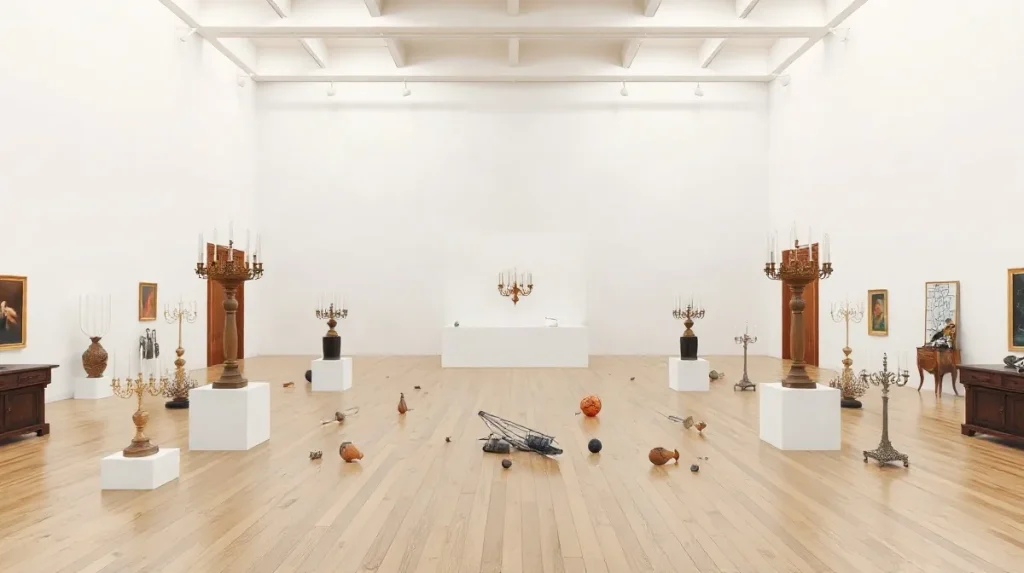
The inaugural show at 46 Walker Street features 20 candelabra sculptures by Christopher K. Ho, whose work draws on Brutalism, Futurism, and Cubism. The sculptures, displayed on white pedestals of varying heights, incorporate playful elements such as cigarette holders, combining artistic seriousness with humor. The exhibition’s atmosphere was enhanced at the opening by lighting all the candles, creating a lively, convivial setting.
Ho’s installation also includes scattered everyday objects on the gallery’s wooden floor, such as a Toblerone wrapper and a strawberry, encouraging viewers to navigate the space thoughtfully. This presentation underscores Rines’s commitment to innovative, engaging contemporary art that challenges traditional exhibition formats.
Strategic Location and Industry Connections
Situated directly across from the gallery of Stefania Bortolami, Rines’s former mentor, the new Tribeca space benefits from its proximity to established art institutions and peers. Real estate broker Jonathan Travis facilitated the acquisition, emphasizing the significance of location in Rines’s strategic decision to move from Chinatown to Tribeca.
Tribeca’s growing reputation as a gallery hub offers new opportunities for both artists and dealers. Rines aims to foster a supportive community by leaving her former Henry Street spaces ready for other galleries to occupy, maintaining the momentum she helped build in that neighborhood.
Expanded Team and Continued Vision
Alongside the new gallery, Rines has expanded her team by hiring Isabelle Hogenkamp as director. Hogenkamp brings experience from prominent galleries Mitchell-Innes & Nash and Lehmann Maupin, signaling Rines’s intention to strengthen her gallery’s operational and curatorial capacities. The six-person team supports a program that remains focused on emerging and mid-career artists.
Despite the move and expansion, Rines continues to navigate the complexities of the post-pandemic art market, balancing growth with financial sustainability. Her pragmatic approach—consolidating spaces and expanding personnel—reflects broader trends among New York galleries adapting to evolving market conditions and real estate pressures.
Takeaway: Ellie Rines’s new Tribeca gallery marks a strategic consolidation and evolution, reinforcing her influence in New York’s contemporary art scene while adapting to shifting market dynamics.