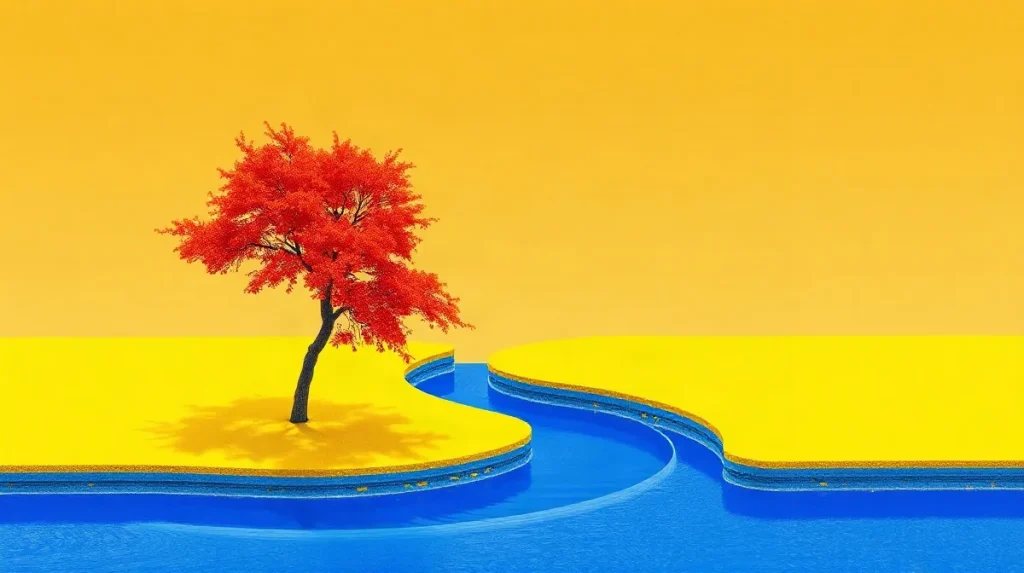
Fauvism was an early twentieth-century art movement that used intense, often non-naturalistic colour to make paintings feel vivid and expressive. Its aim was not to reproduce a scene exactly, but to use colour, simplified forms and energetic brushwork as independent tools of expression.
The name “Fauvism” is associated with paintings that startled viewers through their bold hues and direct handling. To recognise the movement, look beyond whether a landscape or portrait seems realistic: Fauvist colour can depart sharply from what the eye would expect, while the composition remains clear and immediate.
| Painting element | Fauvist tendency | What to notice |
|---|---|---|
| Colour | Intense and non-naturalistic | Hues need not describe the subject realistically |
| Paint handling | Textured, decisive brushwork | Strokes remain visible on the surface |
| Colour edges | Sharp boundaries, minimal blending | Adjacent areas stay distinct |
| Space | Flat areas rather than traditional 3D space | Colour helps organise the canvas |
- Early 20th century Period when Fauvism was established
- 2 named pioneers Henri Matisse and André Derain
- 2 earlier movements Post-impressionism and neo-impressionism in Tate's account of Fauvism's influences
What is Fauvism, in one page?
Fauvism is an early-20th-century art movement, initially associated mainly with French artists, that uses colour as an expressive and structural force rather than simply to describe what things look like. Henri Matisse and André Derain were among its pioneers. In Fauvist painting, colour can depart from natural appearances to set a mood or organise the composition.
Fauvism is recognisable by bold colour, textured brushwork and non-naturalistic depiction. Instead of blending colours to reproduce light and shade convincingly, Fauvist artists could apply intense hues directly, with sharp contrasts that make colour itself prominent. The result is not just a brighter version of a realistic scene: colour helps shape how the scene is felt and read.
Fauvism’s central shift was to treat colour as an independent element of the picture, not merely a descriptive tool. That change connects the movement’s vivid surfaces to its broader aim: making colour carry expressive and compositional work at once.
Why did Fauvist artists separate colour from what they saw?
Fauvist artists separated colour from what they saw so that colour could shape a painting’s mood and structure instead of merely identifying an object. In works by Henri Matisse and André Derain, a tree or stretch of water could take hues chosen for their effect on the canvas, not for naturalistic accuracy.
Colour as mood and structure
In Fauvism, an early-20th-century movement, vivid colour became an active element: its contrasts could project a feeling without relying on a literal account of the subject. This shift helped make colour an independent tool of modern art rather than only a descriptive label.
Colour also organised the picture. Fauvist painters used flat areas and decisive brushwork to establish relationships across the canvas, instead of depending on conventional naturalistic shading to suggest three-dimensional form. The result was not simply an unusually coloured view; it was a different way to build the image.
What should you look for in a Fauvist painting?
Look for Fauvist paintings that use intense, non-naturalistic colour, keep neighbouring hues distinct, and organise the image through decisive brushwork and flattened space. Rather than testing whether a colour accurately describes its subject, notice what the colour does on the canvas: it can create mood and structure.
Colour
Fauvist colour is not simply a record of what an object looks like. Henri Matisse and André Derain are associated with the movement’s early development, in which colour could operate independently of description. Check how each hue meets the next: sharp boundaries and little blending preserve their intensity, while broad areas of colour can hold the composition together.
- Hue: Look for bold colours that do not depend on naturalistic description.
- Edges: Notice whether adjoining colours meet sharply, with minimal blending.
Surface and space
Fauvist brushwork often remains visible: textured, decisive strokes contribute to the painting’s surface instead of vanishing into a smooth finish. Also look at how the image is arranged. Broad colour areas and flattened space can replace traditional three-dimensional depth, so judge the composition by its colour blocks and surface relationships rather than by how convincingly it recedes.
- Brushwork: Check for visible, textured strokes rather than a uniformly smooth finish.
- Space: Look for broad colour areas and flattened arrangements in place of conventional depth.
How did Fauvist technique keep colour intense?
Fauvist technique kept colour intense by applying pure, undiluted paint directly from the tube, blending it as little as possible, and separating neighbouring hues with sharp edges. This approach made colour an independent element rather than merely a way to describe what something looked like. In the early 20th century, Henri Matisse and André Derain helped establish this approach within Fauvism.
Minimal blending lets adjacent colours retain their distinct identities instead of merging into muted mixtures. Sharp boundaries, in turn, make each colour area read as a deliberate part of the composition; flat patches can organise a painting even when they do not follow naturalistic shading or three-dimensional space.
Paint surface as structure
Fauvist brushwork is textured and decisive, so the marks remain visible rather than smoothing into an even finish. That assertive surface reinforces the arrangement of colour: the brushstroke contributes to the painting’s structure, while the separation of hues keeps its visual impact vivid.
How does Fauvism relate to earlier art?
Fauvism relates to earlier art as a radical reworking of two tendencies: the Post-Impressionism associated with Vincent van Gogh and the Neo-Impressionism associated with Georges Seurat. Tate describes Fauvism as an extreme extension of their approaches, not as a simple repetition of either movement.
For Henri Matisse and his followers, these earlier influences helped loosen the rules of traditional three-dimensional representation. Instead of relying on shading and perspective to make forms appear solid and space appear deep, Fauvist paintings use flat areas of colour to carry more of that visual work.
The comparison is therefore about artistic tendencies, not identical styles: Fauvism drew on Van Gogh’s Post-Impressionism and Seurat’s Neo-Impressionism while pushing colour and flatness toward its own ends. Its relationship to those precedents is visible in the shift away from modelling and spatial illusion, rather than in a direct copy of either artist’s method.
When does Fauvist colour become a limitation or a mistake?
Fauvist colour becomes a limitation when its intensity is treated as sufficient proof of Fauvism, or when it overwhelms the painting’s other choices. A red tree or blue face is not enough on its own: Fauvism, associated with Henri Matisse and André Derain in the early 20th century, also made colour independent of straightforward description, using it to shape mood and structure.
Read colour alongside brushwork and space
Fauvist paintings call for a combined reading of hue, brushwork and space, rather than a bright-colour test. Direct, minimally blended colour and sharp edges can be clues, but turning them into compulsory rules risks flattening differences between works; the relevant question is how those choices operate together, not whether every mark fits a checklist.
- Colour: Ask whether a hue serves only to describe an object or also works independently to organise the canvas. A vivid palette alone does not settle the classification.
- Brushwork: Minimal blending can preserve colour intensity, but it is a clue, not a pass-or-fail condition.
- Space: Fauvism’s rejection of traditional three-dimensional space makes flattened areas an intentional possibility. Measuring a painting only against realistic depth mistakes its aims for a failure of perspective.
The mistake, then, is not using strong colour; it is judging Fauvism by colour alone or treating conventional realism as the standard it must meet.
Frequently asked questions
Who pioneered Fauvism?
Does Fauvist colour have to look realistic?
How can I recognise Fauvist brushwork?
Did Fauvism use three-dimensional space?
What this piece draws on
- zephyeer.com — “Fauvism Art Guide: Color, Artists & Key Works”
- Rise Art — “What is Fauvism?”
- Guide — “Magical Henri Matisse Fauvism Color Theory Application”
- TheArtStory — “Fauvism Movement Overview”

Topic guide: Artists: The Complete Guide