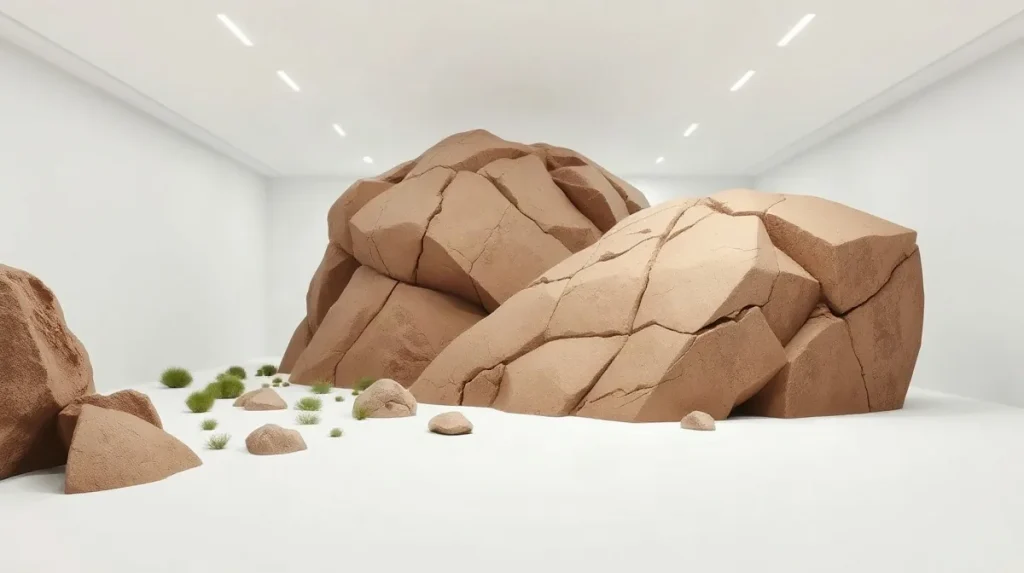
Introduction: Land Art’s Defiance of Traditional Galleries
Land Art emerged in the late 1960s as a radical departure from conventional art forms confined within institutional white cube galleries. Artists such as Robert Smithson, Nancy Holt, and Michael Heizer created works inseparable from their natural surroundings, challenging the gallery’s role as the primary site for experiencing art. By 2026, this defiance continues to influence curatorial practices, pushing institutions to rethink how to engage with site-specific works that resist collection, commodification, and indoor display.
Understanding Land Art’s relationship with institutional spaces is crucial for contemporary curation. It highlights tensions between permanence and ephemerality, public access and exclusivity, and the physical versus conceptual framing of art. This article explores these dynamics through concrete examples, institutional policies, and recent developments.
Site-Specificity as Institutional Challenge
Land Art is inherently tied to its environment, often created in remote or rural locations, making it incompatible with traditional gallery spaces. For example, Robert Smithson’s Spiral Jetty (1970) is located on the northeastern shore of Utah’s Great Salt Lake, over 1,500 miles from major art centers like New York or London. Its scale and natural materials defy transport or indoor exhibition.
Key Characteristics of Site-Specific Land Art
- Integration with natural landscape and geological features
- Dependence on environmental conditions and seasonal change
- Resistance to commodification through lack of physical object
- Requirement for physical travel to experience the work
This site specificity complicates exhibition logistics and audience engagement, demanding new curatorial models beyond the white cube gallery.
Institutional Spaces and the White Cube Paradigm
The dominant gallery model—white cubic rooms with controlled lighting and climate—has shaped modern art’s presentation since the early 20th century. However, this model conflicts with Land Art’s scale and environmental integration. The white cube’s neutrality is disrupted by Land Art’s materiality and context.
Limitations of White Cube Galleries for Land Art
- Physical constraints on size and materiality
- Disconnection from original environmental context
- Inability to convey temporal and ecological processes
For instance, attempts to exhibit Land Art in galleries often reduce it to documentation—photographs, films, and maps—rather than the work itself. This reduction raises questions about authenticity and artistic intent.
| Criteria | Land Art | White Cube Galleries |
|---|---|---|
| Scale | Often vast, outdoor, kilometers in length | Limited to room dimensions, typically <30m² |
| Material Permanence | Ephemeral, subject to erosion/weather | Controlled environment, preserves materials |
| Audience Engagement | Requires site visit, physical interaction | Passive viewing within confined space |
| Documentation | Supplemental, not primary experience | Primary method of engagement |
Case Study: Narberth Kadinsky Gallery Conversion Refusal
The controversy over the Narberth Kadinsky gallery in Pembrokeshire underscores institutional tensions. In 2026, plans to convert the former gallery into a dental surgery were refused by Pembrokeshire County Council due to insufficient evidence that the building was unsuitable for art use and concerns about loss of employment space.
This refusal highlights the role of local institutions in preserving art spaces and the challenges posed when art venues face redevelopment pressures. It also reflects a broader discourse on how art venues, even smaller galleries, are integral to cultural infrastructure and community identity.
Implications for Land Art and Galleries
- Preservation of art-specific institutional spaces is key to maintaining cultural ecosystems.
- Repurposing galleries can diminish opportunities for experimental and site-specific art presentations.
- Local government policies impact the viability of art spaces outside major urban centers.
Contemporary Curatorial Responses to Land Art’s Institutional Challenge
By 2026, curators and institutions have developed innovative strategies to engage Land Art within or alongside galleries without confining it. The Dia Art Foundation’s stewardship of Spiral Jetty includes conservation efforts and public programming that contextualize the work beyond the gallery walls.
Additionally, institutions such as the Museum of Contemporary Art in Kraków have organized Land Art exhibitions that combine on-site visits with immersive digital technologies, like virtual reality and augmented reality, to bridge the gap between environment and gallery.
Curatorial Strategies
- Use of multimedia documentation and immersive technologies to simulate site experience
- Organizing field trips and collaborations with local communities for site visits
- Temporary outdoor exhibitions within institutional land holdings
- Educational programs emphasizing ecological and geographical contexts
Challenges and Opportunities in Collecting and Conserving Land Art
Unlike traditional artworks, Land Art resists conventional collecting due to its scale and environmental integration. Conservation is complicated by natural degradation processes and legal ownership issues, especially when works are on public or protected lands.
For example, the preservation of Michael Heizer’s Double Negative (1970) in Nevada has required cooperation between private collectors, government agencies, and conservationists. The cost of maintaining such works can exceed $500,000 annually, factoring in land management and environmental monitoring.
| Work | Annual Conservation Cost (USD) | Ownership | Management Entity |
|---|---|---|---|
| Spiral Jetty | ~$200,000 | Private Foundation | Dia Art Foundation |
| Double Negative | ~$500,000 | Private Collector | Collaborative conservation group |
Frequently asked questions
Why can’t Land Art be exhibited in traditional galleries?
How do institutions preserve ephemeral Land Art works?
What alternatives do curators use to present Land Art?
How does local policy affect Land Art and galleries?
Key takeaways
- Land Art’s site-specificity fundamentally challenges traditional gallery exhibition models.
- The white cube gallery is often inadequate to convey Land Art’s scale and environmental context.
- Local institutional and government decisions critically impact art space preservation.
- Contemporary curation integrates technology and site visits to engage audiences with Land Art.
- Conservation of Land Art requires significant financial and organizational resources.
Conclusion
Land Art’s refusal to conform to institutional gallery spaces remains a defining characteristic that continues to shape contemporary art discourse and curatorial practice in 2026. The challenge it poses forces museums, foundations, and local authorities to innovate beyond traditional exhibition methods, embracing hybrid models that honor the work’s environmental origins while expanding public accessibility. As demonstrated by cases like the Narberth Kadinsky gallery, the fate of art spaces is intertwined with broader cultural and economic policies, underscoring the necessity of protecting venues that support experimental and site-responsive art forms. Ultimately, Land Art remains a catalyst for rethinking how art institutions engage with space, nature, and audience in an evolving artistic landscape.
Sources
- Western Telegraph — “Narberth Kadinsky gallery to dental surgery refused”
- Installation Art Class Notes — “Institutional spaces and white cube galleries”
- herald.wales — “Plan to convert former Narberth art gallery into dental surgery refused – Herald.Wales”