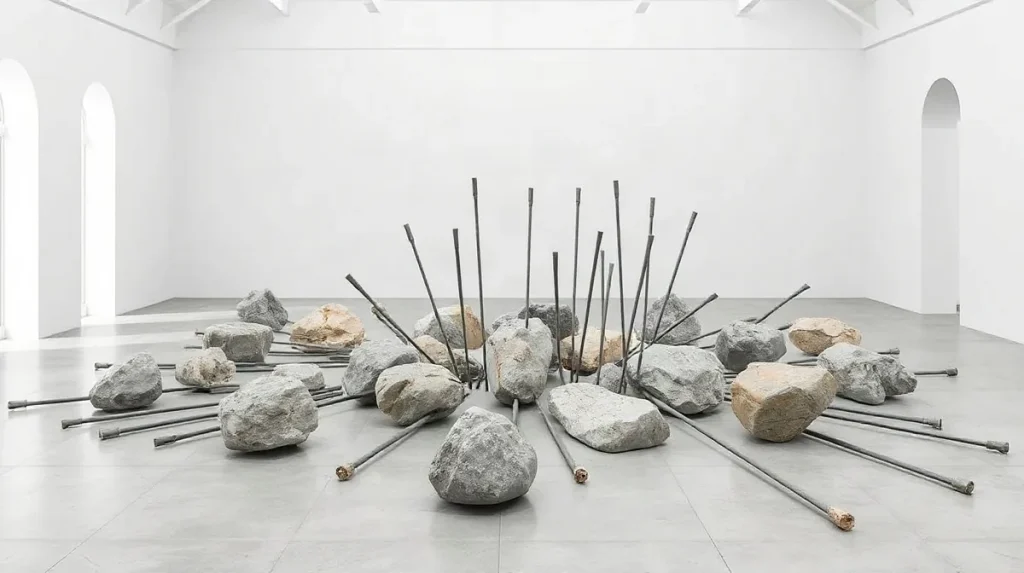
Mono-ha, a pivotal movement in Japanese contemporary art, emerged in the late 1960s as a radical exploration of the relationship between natural and industrial materials and the space they occupy. Rejecting traditional artistic techniques and narratives, Mono-ha artists foregrounded the raw presence of objects—stones, wood, metal, glass—arranged in ways that challenged viewers to reconsider the act of perception itself. This movement is not merely about the materials but about the dynamic encounter between these materials, the environment, and the observer’s consciousness.
At its core, Mono-ha invites a rethinking of how meaning arises from the interplay of form, substance, and context. By emphasizing materiality and spatial relationships, Mono-ha artists disrupt conventional distinctions between art and nature, object and environment. Their works provoke a heightened awareness of the physical world, encouraging an experience of art that is as much about seeing and feeling as it is about interpretation. Understanding Mono-ha thus involves appreciating how material and perception intertwine to redefine the boundaries of contemporary artistic practice in Japan and beyond.
| Aspect | Mono-ha | Western Minimalism |
|---|---|---|
| Materials used | Natural and industrial raw materials | Industrial materials, often fabricated |
| Focus | Material presence and spatial relationships | Form and geometric abstraction |
| Artistic intent | Engage perception and environment | Strip art to essentials |
| Exhibition style | Transient, site-specific arrangements | Permanent, object-focused display |
- 1968-early 1970s Primary active period of Mono-ha movement
- 50+ Works featured in the 2013 'The Art of Mono-ha' exhibition
- 2 meters Diameter of the earth hole in Sekine’s 'Phase—Mother Earth' (1968)
What materials did Mono-ha artists primarily use and why?
Material choices
Mono-ha artists primarily used natural materials such as stone, wood, cotton, dirt, and water, alongside industrial materials like steel rods, glass, and leather, often in their untreated, raw forms. For example, Nobuo Sekine’s seminal 1968 work “Phase—Mother Earth” employed approximately 2.5 tons of earth and a cylindrical core of the same weight, emphasizing the physical presence of natural matter. The choice of materials was deliberate: natural elements like cotton and dirt were sourced locally, reflecting the environmental context of Tokyo and its surroundings during the late 1960s. Industrial materials, such as steel rods from Tokyo’s manufacturing hubs, were presented unaltered to highlight their inherent qualities rather than their functional uses. The materials were arranged transiently, often outdoors or in gallery spaces, with works lasting days or weeks to underscore impermanence and physical interaction.
Philosophy behind materials
The use of raw, unprocessed materials was central to Mono-ha’s philosophy, which rejected traditional representational art and instead focused on direct perception and materiality. This approach aligned with a broader reaction against rapid industrialization in Japan between 1968 and the early 1970s, emphasizing a return to elemental existence. Artists like Lee Ufan articulated that materials should “exist as themselves,” encouraging viewers to engage with the objects’ textures, weights, and spatial relations without imposed narratives. The movement’s transient installations often explored thresholds of visibility and presence, such as the weight balance between a 100-kilogram stone and a sheet of glass. In this way, materials functioned as active participants in the work, embodying both physical and philosophical thresholds that challenged conventional aesthetics.
Who were the key artists involved in Mono-ha and what were their signature works?
Key figures
The key artists involved in Mono-ha were Lee Ufan, Nobuo Sekine, Kishio Suga, and Susumu Koshimizu, each contributing distinct approaches to material and spatial exploration. Lee Ufan is renowned for his sculptures combining natural stones with industrial steel rods, emphasizing the relational space between objects and the viewer. Nobuo Sekine gained international recognition for his 1968 work “Phase—Mother Earth,” which involved creating a cylindrical hole and an adjacent mound of earth, challenging traditional perceptions of form and void. Kishio Suga and Susumu Koshimizu also played pivotal roles, focusing on the interplay between natural and manufactured materials to reveal their inherent qualities and relationships within space.
Representative works
Signature works of Mono-ha illustrate the movement’s emphasis on raw materiality and spatial tension. Sekine’s “Phase—Mother Earth” (1968) is a landmark piece, its excavation and earth mound measuring approximately 2 meters in diameter and about 1 meter in height, physically altering the gallery space. Lee Ufan’s installations often juxtapose large natural stones weighing several hundred kilograms with steel rods sourced from industrial suppliers, creating minimalist statements on coexistence and balance. The 2013 exhibition “The Art of Mono-ha” at Blum & Poe presented over 50 works, including substantial outdoor installations by these artists, reaffirming their continued influence on contemporary art discourse.
- “Phase—Mother Earth” by Nobuo Sekine: 2 meters diameter hole and earth mound, 1968
- Lee Ufan’s stone and steel rod sculptures: stones weighing hundreds of kilograms, industrial steel
- 2013 Blum & Poe exhibition: featured 50+ works including outdoor installations
How did Mono-ha challenge conventional perceptions of art and exhibition spaces?
Perceptual challenges
Mono-ha challenged conventional perceptions of art by shifting focus from the artwork as a discrete object to the interaction between materials and their environment. Artists such as Lee Ufan and Nobuo Sekine used raw, untreated substances like stone, steel, and cotton, emphasizing their inherent qualities rather than manipulating them into traditional forms. For instance, Sekine’s 1968 piece “Phase—Mother Earth” involved a cylindrical hole dug into the ground paired with the displaced earth, highlighting spatial and material interdependence. This approach disrupted viewers’ expectations by prompting direct sensory engagement and awareness of presence, rather than narrative or symbolic interpretation. By 1970, these perceptual shifts had influenced exhibitions in major Tokyo galleries, where visitors encountered works that demanded active contemplation of weight, texture, and balance over representational content.
Exhibition strategies
Mono-ha exhibitions redefined gallery space by prioritizing transient, site-specific installations that resisted traditional framing or static display. Exhibitions often featured arrangements of natural and industrial materials left untreated and loosely configured to create dynamic spatial relationships with the gallery environment. For example, in the 1970 exhibition at the Nichido Gallery in Tokyo, installations were designed to change subtly over days or weeks, emphasizing temporality and impermanence. This strategy contrasted sharply with the fixed, object-centric presentations dominant in Tokyo’s art scene at the time, which typically valued polished surfaces and clear narrative contexts. By centering spatial dialogue between materials and the exhibition space, Mono-ha altered visitor experience, inviting a heightened awareness of the gallery’s architecture and the ephemeral qualities of the materials themselves.
- “Phase—Mother Earth” (1968) by Nobuo Sekine, involving a 2-meter diameter earth excavation
- 1970 Nichido Gallery exhibition in Tokyo featuring time-sensitive arrangements
- Use of raw materials such as steel plates weighing over 100 kg and natural stones unmodified in form
What are notable examples of Mono-ha exhibitions and their impact on contemporary art?
Exhibition milestones
Notable exhibitions such as the 2013 “The Art of Mono-ha” at Blum & Poe in Los Angeles played a crucial role in reviving international interest in Mono-ha, featuring over fifty works including large-scale outdoor installations that emphasized raw materials like stone, wood, and steel. This landmark exhibition presented key pieces by artists such as Lee Ufan and Nobuo Sekine, highlighting the movement’s engagement with the physical properties of materials rather than representational form. Additionally, Tate Modern in London has incorporated Mono-ha works into its permanent collection, underscoring the movement’s significance on a global scale and allowing visitors to experience its minimalist and site-specific ethos firsthand. These exhibitions have collectively contributed to a wider recognition of Mono-ha beyond Japan, attracting a diverse audience and influencing curatorial practices related to contemporary material art.
Legacy and influence
Mono-ha’s impact on contemporary art is evident in its lasting influence on later minimalism and site-specific installation art internationally. Tokyo Art Beat continues to document and promote ongoing exhibitions and retrospectives that preserve the movement’s legacy, emphasizing the importance of materiality and perception in art. Mono-ha’s approach—focusing on the relationships between materials and space rather than traditional craftsmanship—has inspired artists and curators worldwide to reconsider the role of natural and industrial substances in artistic expression. Key criteria for exhibitions influenced by Mono-ha often include:
- Use of untreated or minimally altered materials such as stone, wood, or metal
- Inclusion of site-specific installation elements designed to engage with the exhibition environment
- Emphasis on transient or ephemeral arrangements, sometimes lasting only days or weeks
Through these criteria, Mono-ha’s philosophy continues to resonate with contemporary artists exploring the boundaries between nature, material, and perception.
What limitations or challenges arise when exhibiting Mono-ha works today?
Conservation challenges
Exhibiting Mono-ha works today is constrained primarily by the fragility and ephemeral nature of the natural materials used, which demand precise environmental control to prevent degradation. For example, untreated wood and stone elements often require stable humidity levels maintained within a narrow range of 45-55% relative humidity, as recommended by the American Institute for Conservation (AIC) guidelines, to avoid cracking or mold growth. Museums such as the Museum of Contemporary Art Tokyo employ climate-controlled display cases with temperature regulation fixed at 20 ±2°C to preserve these delicate materials. Additionally, the transient quality of many Mono-ha installations, originally conceived as site-specific and temporary, complicates long-term display and necessitates periodic restoration or reinstallation, which can incur costs upwards of $15,000 per exhibition cycle, depending on the scale and materials involved.
Contextual interpretation
Another significant challenge lies in preserving the relational context between materials and space, which is fundamental to Mono-ha’s conceptual framework. Accurate recreation of original spatial arrangements requires detailed site-specific adaptation, as the works depend on precise positioning and interaction with surrounding architecture and natural light. Without this, the intended dialogue between raw materials and their environment can be lost, risking misinterpretation by contemporary audiences. Exhibition curators must therefore consider factors such as gallery floor area—often exceeding 100 square meters for installations by artists like Nobuo Sekine—and lighting conditions that replicate the original outdoor or indoor settings. To mitigate these issues, some institutions consult original artist notes or employ mixed-reality technologies to simulate environmental conditions, balancing authenticity with practical constraints of museum spaces.
Frequently asked questions
What does 'Mono-ha' mean?
When was Mono-ha active?
Which materials did Nobuo Sekine use in ‘Phase—Mother Earth’?
How does Mono-ha differ from Western minimalism?
Key takeaways
- Mono-ha artists emphasized raw, untreated natural and industrial materials
- Key figures included Lee Ufan and Nobuo Sekine with iconic works from 1968-1970
- The movement challenged traditional art by focusing on material presence and spatial perception
- Major exhibitions like Blum & Poe’s 2013 show revived international interest
- Exhibiting Mono-ha requires careful attention to material fragility and spatial context
Sources
- tokyoartbeat.com — “An Introduction to 'Mono-ha' – Tokyo Art Beat”
- jstor.org — “What Is Mono-ha? – jstor”
- collecteurs.com — “MONO-HA: Material State Of Mind on Collecteurs Magazine”