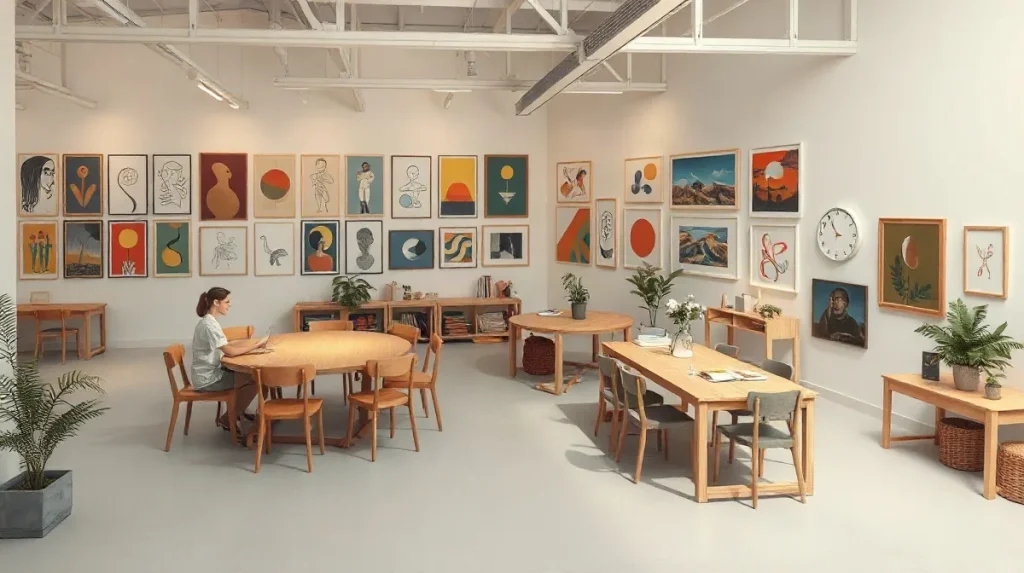
Artists’ collectives have long served as dynamic hubs where creativity and collaboration converge, shaping the course of art history in profound ways. These groups, often formed by individuals united by shared ideals or aesthetic goals, challenge traditional notions of authorship and artistic practice. Understanding artists’ collectives reveals how they function not only as creative incubators but also as social and political catalysts within their cultural contexts.
From their origins rooted in mutual support and resistance to mainstream art institutions, artists’ collectives have evolved to embrace diverse purposes—ranging from experimental projects to community engagement and activism. By examining their formation and objectives, we gain insight into the collective’s unique role in amplifying voices, fostering innovation, and influencing art movements worldwide. This exploration unveils the lasting impact these collaborative entities have on the art world and beyond.
| Aspect | Artist Collectives | Individual Artists | Traditional Art Institutions |
|---|---|---|---|
| Size | 2-8 members | 1 artist | Varies, often large staff |
| Collaboration | High, shared projects | Solo practice | Curated exhibitions |
| Space | Shared studios/galleries | Private studios | Dedicated museum/gallery buildings |
| Purpose | Economic, political, ideological | Personal artistic development | Preservation, curation |
| Structure | Non-hierarchical, self-organized | Independent | Hierarchical, institutional |
- 2 to 8 members Typical size range of artist collectives
- 1949 Year of COBRA’s First International Exhibition of Experimental Artists
- 1957 Founding year of the Situationist International collective
- Early Middle Ages Period of earliest known reverence for artists in medieval China
What historical roots and early examples define artists’ collectives?
Medieval and Early Modern Origins
The historical roots of artists’ collectives can be traced back to early reverence for individual artistic skill in medieval China, where during the flourishing of Buddhism in the early Middle Ages, artists were esteemed similarly to poets, a distinction that elevated their social and creative status above that of mere artisans. This recognition is documented in Chinese art history, where the valuation of individual mastery over craftwork became an important cultural marker, setting a precedent for communal artistic identity based around shared values of skill and creativity rather than purely economic or guild affiliations. Such early examples highlight the emergence of collaborative artistic environments that valued innovation and collective esteem.
Mid-20th Century European Movements
The modern concept of artists’ collectives took a definitive shape in post-World War II Europe, notably with the formation of groups like the COBRA collective, which in 1949 participated in the First International Exhibition of Experimental Artists at Amsterdam’s Stedelijk Museum. This event symbolized a new era of artistic collaboration aimed at experimentation and breaking away from traditional forms. Later, the Situationist International, founded in 1957, further exemplified the collective’s role as a political and creative force pushing for radical social change through art. These movements were characterized by small core groups, often between two and eight artists, who shared studios, exhibited together, and pursued collective ideologies.
- Early medieval China: artist skill recognized above artisan craft during Buddhism’s flourishing (6th–9th centuries CE)
- COBRA collective: exhibited in 1949 at the Stedelijk Museum’s First International Exhibition of Experimental Artists
- Situationist International: formed in 1957, blending political activism with collaborative art practice
- Typical collective size: 2 to 8 artists maintaining shared studio or exhibit space
Why do artists form collectives in contemporary art practice?
Economic and Practical Benefits
Artists form collectives primarily to share the significant costs and resources involved in producing and exhibiting contemporary art. Maintaining a collective space, such as a studio or gallery, allows groups—often composed of 2 to 8 members—to reduce individual overheads, which can range from $1,500 to $4,000 monthly for rent in major art hubs like New York or Berlin. By pooling budgets, collectives can jointly organize exhibitions, lowering individual expenses for gallery fees that typically cost between $500 and $2,000 per show. This collaborative approach also facilitates access to shared equipment and materials, which might otherwise require investments of several thousand dollars per person. Such economies of scale enable emerging artists to sustain their practice in competitive markets where solo exhibition costs and living expenses frequently exceed $3,000 per month.
Political and Ideological Collaboration
Beyond economic reasons, artist collectives often unite to advance shared social, cultural, or political agendas through their work. Groups like the Belarus-based “Belarus Free Theatre,” formed in the early 2000s, illustrate how collectives can embody resistance against censorship and authoritarianism. These collaborations allow artists to amplify their voices within global networks, leveraging platforms such as the Venice Biennale or documenta, where collective projects can attract international attention. Additionally, collectives provide frameworks for navigating intellectual property challenges by negotiating joint authorship, which can be complex in politically engaged art practices. By working together, artists can sustain long-term activist projects that require continuous collaboration over multiple years, sometimes exceeding five years of coordinated effort.
- Collective size: typically 2–8 artists
- Shared gallery rental costs: $500–$2,000 per exhibition
- Studio rent in major cities: $1,500–$4,000 monthly
- Duration of activist projects: often 3–5 years or more
How do artist collectives influence creative communities and art movements today?
Experimental and Cross-Cultural Practices
Artist collectives today significantly influence creative communities by fostering experimental art practices through the pooling of diverse skills and ideas. For example, the Moscow-based collective Chto Delat regularly exhibits in prominent venues like the Garage Museum of Contemporary Art, where their interdisciplinary projects merge visual art, literature, and activism. These collectives often maintain shared studio or exhibition spaces, enabling small groups of two to eight artists to collaborate intensely. Additionally, the rise of digital platforms has enabled collectives such as the international group Forensic Architecture to create global networks that facilitate cross-cultural collaborations in digital projects, often addressing social and environmental issues. These collaborations frequently result in exhibitions and performances that reach audiences beyond traditional gallery settings, expanding the impact of collective creativity.
Redefining Authorship and Social Roles
Artist collectives also challenge traditional art historical notions of individual authorship and ownership by emphasizing communal creation and shared intellectual property. This shift is evident in collectives like the Polish group Azorro, which operates under shared decision-making frameworks to question hierarchical authorship models. Furthermore, many contemporary collectives actively contribute to social activism, participating in community engagement projects that intersect art with politics and social justice. For instance, the Berlin-based collective Frauennotruf uses art to support survivors of domestic violence, exemplifying how collectives integrate community-oriented goals. Their efforts align with broader movements emphasizing art as a tool for societal change rather than solely aesthetic expression.
- Collective size typically ranges from 2 to 8 members, as exemplified by groups like Chto Delat.
- Exhibition venues include established institutions such as the Garage Museum of Contemporary Art.
- Cross-cultural digital collaborations often involve international networks, exemplified by Forensic Architecture.
- Community-focused collectives engage in social activism, with projects like those by Frauennotruf in Berlin.
What are the common challenges and limitations faced by artists’ collectives?
Legal and Ownership Complexities
Artists’ collectives often face significant challenges regarding authorship and ownership of the works they produce, which complicates copyright management and fair use considerations. When multiple artists contribute to a single piece, determining who holds the copyright or how royalties are divided can become contentious. For example, the U.S. Copyright Act of 1976 stipulates joint authorship only when contributions are inseparable or interdependent, which is difficult to prove in collective contexts. This ambiguity can hinder licensing agreements, especially when digital platforms like Adobe Creative Cloud charge subscription fees ranging from $20 to $80 per month per user, making resource sharing and rights management more complex. Moreover, unresolved authorship disputes may restrict access to grants such as the $30,000 National Endowment for the Arts (NEA) awards, which often require clear attribution. These legal uncertainties can discourage collaboration or delay public exhibition opportunities, undermining the collective’s goals.
Operational and Ideological Sustainability
Sustainability is a recurring challenge for artists’ collectives, as they often rely on pooled funding and shared resources that are inherently limited and unstable. Many groups disband within 3 to 5 years due to financial strain and logistical difficulties. For instance, renting a shared studio space in cities like Berlin or Moscow can cost between €500 and ₽50,000 per month, a substantial burden when split among several members. Additionally, maintaining unified political or ideological aims among members with diverse backgrounds and artistic visions can create internal tensions. Collectives such as Russia’s Chto Delat have struggled to balance individual artistic identities with collective agendas, impacting cohesion and public messaging. Successful groups often employ formal agreements outlining member roles, financial contributions, and decision-making processes to manage this balance.
- NEA grant threshold: $30,000 – requires clear authorship attribution
- Adobe Creative Cloud subscription: $20–$80 per user monthly – impacts resource sharing
- Studio rental in Berlin/Moscow: €500 to ₽50,000 monthly – affects financial sustainability
- Typical collective lifespan: 3–5 years – reflects operational challenges
How do artist collectives differ from individual artists or traditional art institutions?
Size and Collaboration
Artist collectives typically consist of small groups ranging from 2 to 8 members who collaborate closely or present individual work under a shared banner, distinguishing them from solo artists who work independently. These collectives often share studio spaces or exhibition venues, such as the 120-square-meter warehouse used by the Moscow-based collective AES+F, which fosters ongoing collaboration and resource pooling. In contrast, individual artists generally maintain private studios without the continual physical interaction that collectives emphasize. The cooperative nature of collectives also means that joint projects and group exhibitions are common, with exhibitions sometimes lasting several weeks in venues managed by the collective itself rather than rented commercial galleries.
Organizational and Ideological Differences
Unlike traditional art institutions such as museums or galleries—which often have hierarchical structures, professional curators, and focus on curation, preservation, and market positioning—artist collectives operate as grassroots, self-organized entities without formal leadership. For instance, the Berlin-based collective ZK/U operates under consensus decision-making, eschewing traditional top-down management. These groups emphasize shared ideological or political goals, frequently engaging in activism or community outreach as part of their mission. Their focus might include social justice themes or environmental issues, contrasting with institutions like the State Hermitage Museum, which prioritize historical collections and scholarly research. The absence of formal hierarchies also allows collectives to bypass conventional funding models, often relying on small grants under $10,000 or member contributions instead of large institutional budgets.
- Collective size: 2 to 8 artists
- Shared workspace: up to 120 m² (e.g., AES+F’s Moscow studio)
- Exhibition duration: several weeks, often self-organized
- Institutional hierarchy: absent in collectives, present in museums
- Funding: under $10,000 grants or member contributions typical for collectives
Frequently asked questions
What size are typical artists’ collectives?
How do artists in collectives usually share resources?
Are artist collectives a recent phenomenon?
What challenges do artist collectives face regarding ownership?
Key takeaways
- Artist collectives typically comprise small groups of 2-8 members sharing resources
- Historical roots trace back to early medieval China and mid-20th century Europe
- Collectives serve economic, political, and professional purposes
- They influence art movements by fostering collaboration and challenging authorship norms
- Sustainability and legal ownership are key challenges for collectives
Sources
- elephant.art — “A Brief History of Collective Action – ELEPHANT”
- artforum.com — “Art history after Black studies”
- CAA — “Fair Use | Programs”