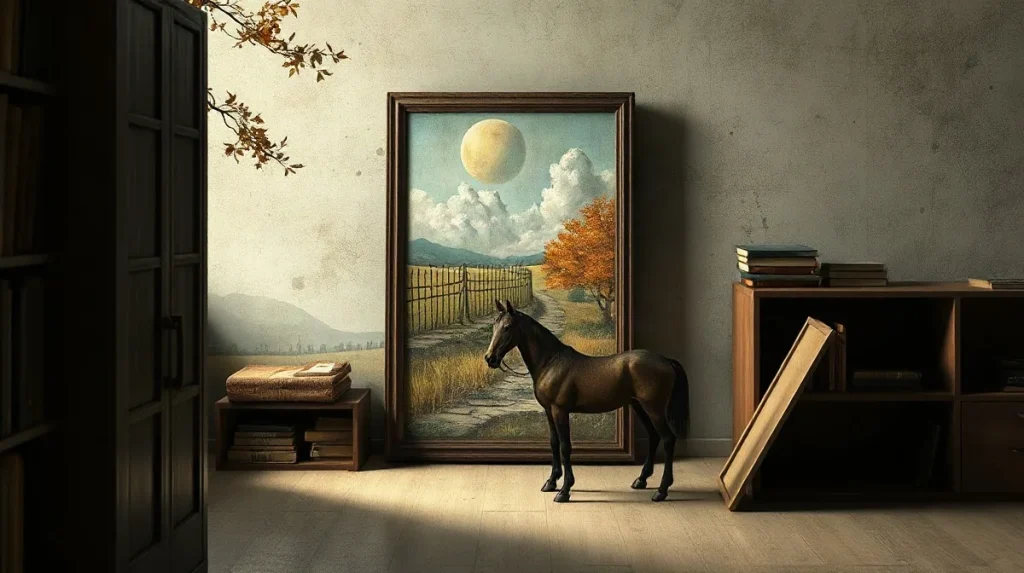
A painting by Leonora Carrington has reappeared after seven decades out of public view, bringing renewed attention to a body of Surrealist work shaped by myth, folklore and the occult. The account of its rediscovery remains spare: the work’s return is reported, but no location, finder or sale details are identified.
A return after decades
The painting’s reported absence from public view is the central fact of its reappearance. Seven decades is long enough for a work to pass beyond ordinary exhibition histories, but that period alone does not establish where it was kept or whether it changed hands. Those details matter to its provenance—the documented history of ownership and custody—yet they are not part of the known account.
Nor is the resurfaced painting identified by title in the announcement. It should not be confused with Self-Portrait (Inn of the Dawn Horse), which Carrington completed in 1938 and which is now in the permanent collection of the Metropolitan Museum of Art. That well-known painting provides a point of reference for her practice, not an identification of the newly returned work.
Carrington’s Surrealist context
Carrington’s paintings were first shown by André Breton in Paris in 1937. Her images often place women and half-human beasts in dreamlike settings, drawing on myth, folklore and occult subjects. Rather than treating those elements as decoration, she used them to build scenes in which ordinary forms and uncanny transformations coexist.
That mix helps explain why a painting emerging from a long period out of sight is more than a curiosity about an object’s whereabouts. Carrington’s work has continued to attract attention beyond its original Surrealist setting. Her influence was visible in the context of the 2022 Venice Biennale, which was associated with a renewed focus on her vision.
From Europe to Mexico City
Carrington’s later life and work also shaped the range of her practice. After escaping an asylum, she sailed for New York and settled in Mexico City, where she spent the next seven decades painting and writing short stories and novels. Her writing included The Hearing Trumpet, published in 1976.
That biography gives the resurfacing a wider frame, but it does not fill in the missing history of this particular painting. A work can be absent from public view without being lost, and the phrase does not say whether it remained in private hands, was stored, or was otherwise inaccessible. The distinction is important: the return of a painting to view is not, by itself, a complete account of its journey.
What comes next
The next meaningful development is a fuller identification of the work and the circumstances of its rediscovery. A title, image, date of execution, current location or exhibition announcement would make it possible to distinguish the painting from Carrington’s documented works and assess how it fits within her career. None of those details is established in the current account.
For now, the reported seven-decade absence is the firm point around which the story turns. Any further account should establish who brought the painting back into view and where it can next be seen; check the official notice for those details.
Sources
- thebeliever.net — “An Interview with Leonora Carrington – Believer Magazine”
- Books — “in praise of Leonora Carrington – 100 years on”
- news.artnet.com — “Who Was Leonora Carrington, the Mystical Surrealist Artist”