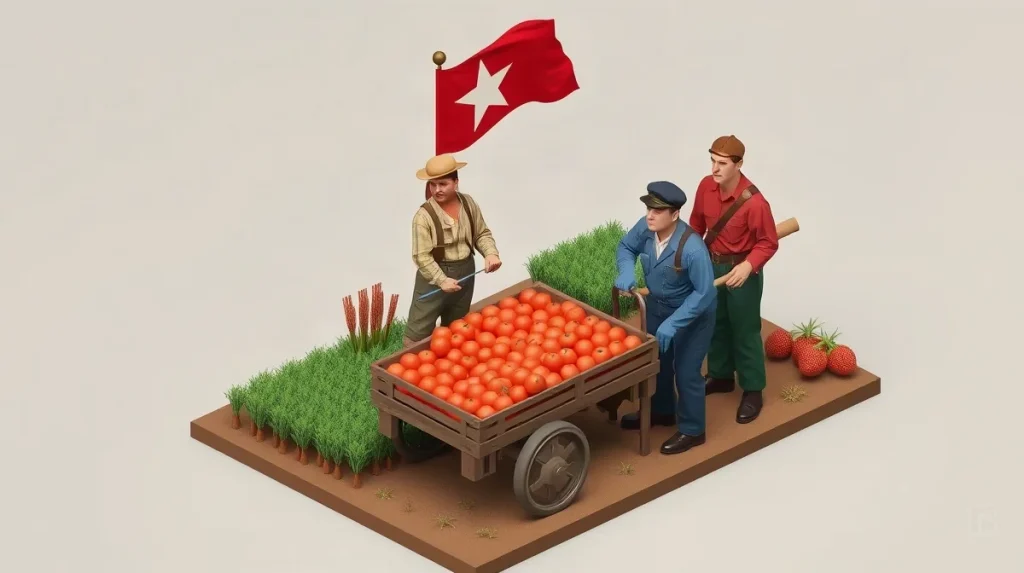
Socialist Realism as a state doctrine emerged as a defining artistic and cultural policy in the Soviet Union, shaping not only creative expression but also political ideology. It was more than an art style; it was a government-mandated framework designed to promote the ideals of socialism through accessible and optimistic representations of everyday life, labor, and progress. Understanding Socialist Realism as a state doctrine requires examining how it functioned as a tool for controlling artistic production and reinforcing the values of the ruling regime.
This doctrine dictated that art must serve the state’s goals by portraying a glorified vision of socialist life that inspired citizens to contribute to the collective good. Artists, writers, and performers were expected to adhere to strict guidelines that emphasized realism, heroism, and ideological clarity. Exploring the origins, implementation, and impact of Socialist Realism reveals its role not only in the Soviet Union but also in other socialist states that adopted similar cultural policies during the 20th century.
| Period | Artistic Freedom | Dominant Style | State Control |
|---|---|---|---|
| Pre-1932 | Moderate, avant-garde movements flourished | Constructivism, Futurism | Limited enforcement |
| 1932-1988 | Strictly controlled, no deviation allowed | Socialist Realism | State-mandated through Union of Soviet Artists |
| Post-1988 | Expanded artistic freedom | Pluralism: abstract, conceptual art | Reduced, ended by 1991 |
- 56 years Duration Socialist Realism was official Soviet art doctrine (1932-1988)
- 1937 Year Vera Mukhina’s 'Worker and Kolkhoz Woman' sculpture was unveiled
- 1988 Year Socialist Realism policy was officially relaxed under Gorbachev
- 1991 Year of the Soviet Union’s dissolution, ending state art control
What is Socialist Realism and when was it officially established?
Origins and Legal Establishment
Socialist Realism was officially established as the mandated art doctrine of the Soviet Union in 1932 by a decree from the Central Committee of the Communist Party. This legal framework institutionalized Socialist Realism as the exclusive artistic style, requiring artists to produce works that idealized the lives and labor of workers, peasants, and Communist leaders. The doctrine emphasized a heroic and optimistic portrayal of socialist progress, aligning cultural production with state propaganda goals. The Union of Soviet Artists, founded in the same period, became a key institution enforcing these requirements, controlling artistic output through membership and state commissions.
Duration of Official Status
Socialist Realism remained the official art style of the Soviet Union for over 56 years, from its establishment in 1932 until its formal decline beginning in 1988. During this period, all visual arts, literature, music, and theater were expected to conform to its principles, with state funding and exhibitions reserved exclusively for compliant works. The policy was legally enforced through state cultural bodies, ensuring that nonconforming artistic expressions were marginalized or censored. The doctrine’s longevity reflects its central role in Soviet cultural policy throughout most of the 20th century.
- Established by Central Committee decree in 1932
- Enforced by the Union of Soviet Artists and other state bodies
- Mandated style for 56 years, from 1932 to 1988
- Required depiction of idealized workers, peasants, and Communist leaders
How did Socialist Realism serve Soviet ideological and propaganda goals?
Themes and Subjects
Socialist Realism served Soviet ideological and propaganda goals by portraying idealized images of the working class, peasants, and soldiers that embodied Marxist-Leninist values and the Communist Party’s vision for a socialist future. Artworks frequently depicted heroic factory workers wielding tools, collective farmers harvesting grain, and soldiers in dynamic, triumphant stances, reinforcing notions of productivity, unity, and loyalty to the state. For example, paintings from the 1950s often showed workers exceeding production targets set by the Five-Year Plans, visually communicating success and progress under socialism. The style mandated a naturalistic yet idealized realism, deliberately avoiding abstract or avant-garde approaches that could confuse or alienate the masses. This approach aimed to educate and inspire Soviet citizens by illustrating an attainable, optimistic vision of society aligned with state ideology.
State Sponsorship and Exhibition
State institutions like the State Art Museum of the USSR played a central role in enforcing Socialist Realism as a tool of propaganda by curating exhibitions that emphasized the Communist Party’s achievements and goals. From 1934, the Union of Soviet Artists regulated the production and display of art to ensure conformity with official standards, with artists required to depict themes favorable to socialism. Major exhibitions, such as the 1957 All-Union Art Exhibition, showcased hundreds of works that glorified industrialization and collectivization, reinforcing the party’s narrative to millions of viewers. These state-sponsored events often attracted tens of thousands of visitors, making art a powerful mass medium for ideological reinforcement.
- The Union of Soviet Artists mandated adherence to Socialist Realism from 1934 onward.
- The 1957 All-Union Art Exhibition featured over 1,200 Socialist Realist works.
- State museums prioritized artists whose works depicted industrial and agricultural triumphs exceeding planned targets.
Who were notable artists and what are key examples of Socialist Realist works?
Prominent Artists
Alekandr Gerasimov was a leading figure in Socialist Realism, best known for his portraits of Joseph Stalin and depictions of heroic Soviet workers that embodied the regime’s ideals. His large-scale paintings served as official state propaganda throughout the 1930s and 1940s, commissioned by the Soviet government to reinforce Stalin’s cult of personality. Another key artist was Isaak Brodsky, whose portraits of Vladimir Lenin played a crucial role in standardizing Communist iconography under the doctrine. Brodsky’s work was widely reproduced in state media and educational materials from the 1920s through the 1950s, shaping the visual language of Soviet leadership.
Iconic Artworks and Architecture
Vera Mukhina’s 1937 sculpture, Worker and Kolkhoz Woman, exemplifies Socialist Realism through its monumental scale and optimistic depiction of industrial and agricultural labor united under socialism. Standing 24.5 meters tall, the stainless steel statue was unveiled at the 1937 Paris World’s Fair and remains an enduring symbol of Soviet artistic ambition. Additionally, the Moscow Metro stations constructed between the 1930s and 1950s feature extensive Socialist Realist mosaics and decorative elements celebrating Soviet achievements. These stations combined functional infrastructure with art, illustrating workers, scientists, and soldiers in a style intended to inspire civic pride and loyalty.
- Aleksandr Gerasimov’s portraits of Stalin, widely exhibited between 1932 and 1955
- Isaak Brodsky’s Lenin portraits, foundational for Communist visual propaganda
- Vera Mukhina’s 24.5-meter-high Worker and Kolkhoz Woman (1937)
- Moscow Metro stations’ Socialist Realist mosaics created during 1935–1955 construction period
What were the limitations and criticisms of Socialist Realism as an artistic doctrine?
Censorship and Control
The principal limitation of Socialist Realism as an artistic doctrine was its strict control over creative expression, enforced by the Soviet state from 1932 onward. Artists were required to adhere to themes that glorified communist ideals, such as heroic workers or revolutionary leaders, leaving no room for experimentation or abstract styles. During Joseph Stalin’s rule, deviation from the prescribed style often resulted in severe consequences, including censorship, blacklisting, or even imprisonment. For example, the 1934 decree by the Union of Soviet Artists mandated that all artworks undergo ideological review before public exhibition. This system effectively stifled individual creativity, as artists had to prioritize propagandistic clarity over complexity or personal vision.
Artistic Stagnation
By the 1980s, Socialist Realism faced mounting criticism for its repetitive and formulaic nature, which hindered the reflection of contemporary social realities. Artworks frequently recycled the same idealized motifs—workers wielding tools or collective farming scenes—resulting in a lack of innovation. This stagnation became evident in state-sponsored exhibitions, such as the 1983 Moscow Art Show, which showcased predominantly uniform and predictable compositions. Critics pointed out that the style failed to capture the complexities of Soviet society during the late Brezhnev and Gorbachev eras. The rigid adherence to ideological themes contributed to a growing disconnect between the official art and the evolving cultural landscape.
- 1934 Union of Soviet Artists decree enforcing ideological review
- 1983 Moscow Art Show highlighting repetitive Socialist Realism works
- 1932–1988 period marking Socialist Realism as the exclusive state-sanctioned style
- State censorship mechanisms leading to blacklisting and persecution of nonconforming artists
How did Socialist Realism decline and what replaced it after 1988?
Policy Changes under Gorbachev
The decline of Socialist Realism began with the official relaxation of artistic policies in 1988 under Mikhail Gorbachev’s perestroika reforms, which dismantled the strict state control over Soviet art. This policy shift ended the exclusive endorsement of Socialist Realism as the mandated style, allowing artists to explore alternative modes of expression previously suppressed for decades. The 1988 decree on the cultural sphere removed ideological censorship thresholds, permitting exhibitions that featured abstract, conceptual, and postmodern art styles. Institutions like the Soviet Ministry of Culture no longer enforced the requirement that all artworks promote socialist values or depict idealized workers and leaders. This liberalization reflected broader political and economic reforms aimed at transparency and openness, signaling the end of a 56-year period during which Socialist Realism dominated Soviet visual arts.
Post-Soviet Artistic Landscape
Following the dissolution of the USSR in 1991, the collapse of centralized state control over art production led to an unprecedented pluralism in Russian and post-Soviet art. Artists embraced diverse styles, with galleries and cultural institutions expanding their collections beyond Socialist Realism to include contemporary abstract and conceptual works. For example, the Tretyakov Gallery now curates Socialist Realism primarily as a historical movement rather than a living artistic doctrine, featuring exhibitions that contextualize its role in Soviet history. The art market also evolved, with prices for Socialist Realist paintings typically ranging from $10,000 to $100,000 depending on the artist and provenance, while modern Russian contemporary art increasingly attracts international collectors. This transition marked a decisive shift from art as state propaganda to art as individual expression within a globalized cultural economy.
- 1988 Decree on Cultural Policy: Ended mandatory Socialist Realism and censorship thresholds
- 1991 USSR Dissolution: Removed state monopoly on art production and ideology
- Tretyakov Gallery: Repositions Socialist Realism as historical art
- Art market prices: Socialist Realist works valued between $10,000 and $100,000 post-1991
Frequently asked questions
What artistic styles did Socialist Realism reject?
Which Soviet institution enforced Socialist Realism?
Can Socialist Realism be found outside of painting?
Why was Socialist Realism considered a propaganda tool?
Key takeaways
- Socialist Realism was the USSR’s official art style for 56 years from 1932 to 1988.
- It focused on idealized portrayals of workers, peasants, and Communist leaders.
- State institutions like the Union of Soviet Artists controlled artistic production.
- The style suppressed artistic freedom and punished deviation during Stalin’s era.
- The doctrine ended with Gorbachev’s reforms and the USSR’s dissolution by 1991.
Sources
- soviet-union.com — “Socialist Realism: Art of the State – Soviet Union”
- academia.edu — “Rethinking Socialist Realism”
- cambridge.org — “Socialist Realism (1.8) – The New Cambridge History of Russian”
- Soviet Union, Stalinism & Propaganda — “Socialist Realism”
Topic guide: Artists: The Complete Guide