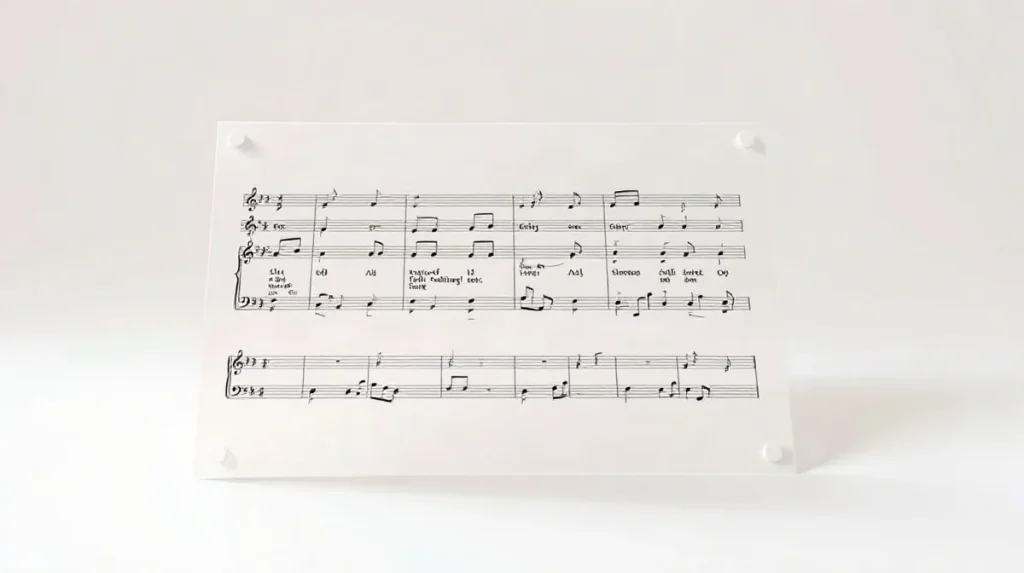
Fluxus, a groundbreaking art movement that emerged in the 1960s, challenged traditional boundaries by embracing the score not merely as a set of instructions but as a standalone artwork. In this radical rethinking, the score transcends its conventional role, becoming a conceptual object that invites interpretation, participation, and reflection. Understanding the score as an artwork reveals Fluxus’s commitment to blurring distinctions between artist, performer, and audience, transforming the very act of creation into an open-ended experience.
At the heart of Fluxus is an emphasis on simplicity, chance, and everyday actions, all encoded within these often minimalistic scores. They are not fixed compositions but frameworks that encourage variability and spontaneity, allowing the artwork to unfold differently with each realization. By viewing the score as an artwork, Fluxus expands our perception of artistic authorship and challenges us to reconsider what constitutes an art object in a time when boundaries between visual art, music, and performance dissolve.
| Aspect | Traditional Scores | Fluxus Scores |
|---|---|---|
| Purpose | Fixed musical performance | Open-ended art instructions |
| Notation | Standard musical notation | Text, graphics, multimedia |
| Authorship | Composer as sole author | Artist as facilitator, audience participatory |
| Commerciality | Sold as unique or printed editions at high prices | Affordable multiples (~$10–$30) |
| Performance | Repeatable, precise | Spontaneous, variable |
| Media | Primarily music | Multimedia and conceptual art |
- 1960s–1970s Period when Fluxus scores were primarily created
- $10–$30 Typical price range for original Fluxus score multiples
- 2005 Launch year of the University of Iowa Fluxus Digital Collection
- 7.3 Volume number of Performance Research journal featuring Fluxus score scholarship (2002)
What defines a Fluxus score compared to traditional musical notation?
From notation to instruction
A Fluxus score is defined primarily by its role as an open-ended event instruction rather than a fixed musical composition with precise notation. Unlike traditional scores that rely on standardized musical symbols and exact timing, Fluxus scores often use simple text or graphic elements to prompt actions or gestures. For example, scores from the 1960s and 1970s typically consisted of brief, handwritten instructions or minimalistic diagrams instead of staff notation. This approach invites performers to interpret and enact the piece freely, embracing spontaneity and chance rather than strict adherence to a composer’s intent. By 1975, Fluxus artists had created scores that could be completed in as little as a few minutes or extended indefinitely, reflecting a flexible duration compared to classical compositions that are usually timed to the second.
Incorporation of sound recordings
The integration of recorded sounds marks another key difference between Fluxus scores and traditional musical notation. In the mid-1970s, inspired by the Vietnam War’s media presence, some Fluxus scores incorporated actual audio elements such as recordings of machine-gun fire and explosions, embedding these sounds as integral components of the performance. This practice diverges from classical scores, which typically do not include pre-recorded audio and rely on live instrumental or vocal execution. Fluxus scores often encourage participant involvement and improvisation, transforming the artwork into a collective experience rather than a fixed performance. Such scores may specify the use of a particular recording from a public archive or a commercial sound source, placing the cost of acquisition within a modest range—often under $50 for vinyl or cassette formats common in the 1970s—and emphasizing accessibility and do-it-yourself principles.
- Typical Fluxus scores date from the 1960s–1970s, using minimal text or graphics instead of standard notation.
- Duration of Fluxus events ranges from a few minutes to open-ended performance, unlike classical fixed-length compositions.
- Vietnam War-inspired Fluxus scores of the mid-1970s incorporated machine-gun and explosion sound recordings as performance elements.
- Recorded audio sources used in Fluxus performances cost typically below $50 for vinyl or cassette formats during the era.
Which Fluxus artists notably shaped the transformation of the score into visual art?
Key figures and their approaches
George Maciunas, the founder of Fluxus, significantly shaped the transformation of scores into visual art by promoting the idea of scores as accessible, “do-it-yourself” artworks. His emphasis on simplicity and reproducibility led to scores that were often printed as multiples, sold at affordable prices around $5 to $20 each during the 1960s, aiming to democratize art consumption. Yoko Ono also played a crucial role with her instructional scores, which combined minimalist visual elements with poetic language. Her 1964 book *Grapefruit* became an iconic example, presenting scores as conceptual artworks that invited participation rather than passive viewing. Ono’s approach blurred the boundary between text and image, aligning closely with Fluxus’s ethos of interactivity and openness.
Intermedia and multimedia integration
Dick Higgins, who coined the term “intermedia” in the mid-1960s, was instrumental in expanding Fluxus scores beyond traditional notation into hybrid forms that merged visual art, performance, and written instructions. His work encouraged artists to cross media boundaries, fostering innovation in score design. Nam June Paik further revolutionized the concept by incorporating electronic and video elements into his scores, notably using video signals and multimedia installations from the late 1960s onward. This integration reflected Fluxus’s broader challenge to conventional art categories and helped scores evolve into dynamic, multisensory experiences rather than fixed objects.
- George Maciunas: Do-it-yourself multiples priced between $5 and $20 in the 1960s
- Yoko Ono: *Grapefruit* (1964), blending poetic text with visual minimalism
- Dick Higgins: Coined “intermedia” circa 1965, promoting cross-boundary artworks
- Nam June Paik: Integrated video and electronic signals into scores starting in the late 1960s
How did Fluxus scores challenge traditional ideas of authorship and art objecthood?
Democratization through multiples
Fluxus scores challenged traditional art objecthood by rejecting the notion of a singular, commodifiable masterpiece in favor of accessible multiples and event-based works. Typically printed in editions priced between $10 and $30, these scores were intentionally affordable to broaden art’s reach beyond elite collectors. For example, George Maciunas, a pivotal Fluxus organizer, published scores in limited editions of 200 to 500 copies, deliberately priced low to encourage widespread participation. By prioritizing reproducibility and distribution over uniqueness, Fluxus undermined the market-driven exclusivity of traditional art objects, aligning with its 1960s and 1970s ethos that art should be integrated into everyday life rather than confined to galleries or private collections.
Shifting authorship and participation
Fluxus scores also redefined authorship by positioning the artist as facilitator rather than sole creator, placing audience participation at the core of the artwork’s realization. Instead of producing definitive, finished products, artists issued open-ended instructions that invited interpretation and spontaneous performance, making the process itself the artwork. This approach prefigured contemporary conceptual art’s emphasis on process over product and blurred boundaries between creator and viewer. As a result, the traditional hierarchical model of authorship was replaced by a collaborative dynamic, where the artwork’s meaning and form emerged through interaction, rather than being fixed by the artist alone.
- Edition size: commonly 200–500 copies per score
- Price range: $10–$30 per score to ensure accessibility
- Time period: mid-1960s to 1970s, when Fluxus activity peaked
- Artist role: facilitator and provocateur instead of sole creator
- Audience engagement: essential for activating the score’s meaning
In what ways did Fluxus scores influence contemporary art and performance practices?
Legacy in conceptual and performance art
Fluxus scores have directly shaped contemporary art and performance by embedding instruction-based, participatory elements as core artistic strategies. Artists today frequently incorporate scores as integral components that invite audience interaction or performer interpretation, continuing Fluxus’s 1960s emphasis on democratizing art-making and rejecting fixed authorship. For instance, experimental musicians and performance artists cite Fluxus’s use of indeterminacy—where outcomes are open-ended—as a foundational influence. This approach has expanded the boundaries of live art beyond scripted narratives, evident in works showcased at institutions like the Walker Art Center’s Performing Arts Collection, which holds over 1,200 performance scores and objects linked to Fluxus and its successors. Fluxus’s blending of sound, text, and action paved the way for multimedia art forms gaining prominence in the 2020s, particularly in practices using digital platforms for real-time interaction and algorithmic unpredictability.
Preservation and study of Fluxus scores
The University of Iowa’s Fluxus Digital Collection, launched in 2005, serves as a vital resource preserving over 3,000 digitized scores, providing scholars and artists worldwide access to these dynamic instructions. This archive supports ongoing research into how Fluxus’s “do-it-yourself” ethos and emphasis on event scores continue influencing artistic production. The collection’s breadth—from early George Maciunas multiples to later Nam June Paik performance instructions—illustrates the movement’s experimental legacy and its impact on contemporary conceptual art. Fluxus scores’ preservation enables the study of their materiality and variability, helping institutions and creators explore how these works challenge traditional museum acquisitions by being mutable, participatory, and often ephemeral.
- Fluxus Digital Collection: 3,000+ digitized scores available since 2005
- Walker Art Center Performing Arts Collection: 1,200+ related performance artifacts
- Fluxus’s indeterminacy principle: foundational for experimental music and performance art
What are the limitations or common misunderstandings about Fluxus scores as artworks?
Misinterpretation as traditional scores
Fluxus scores are often misunderstood when viewed solely as conventional musical notations, overlooking their core as conceptual, participatory artworks. Unlike standard scores that specify exact pitches and rhythms, Fluxus instructions—such as those by George Maciunas or Yoko Ono—are deliberately open-ended, inviting performers’ interpretation and audience engagement. This ambiguity can alienate listeners expecting fixed, repeatable renditions; for example, a Fluxus piece might last anywhere from a few seconds to several minutes depending on the participants’ choices. The lack of prescribed sound or form means that without proper contextualization, these scores risk appearing cryptic or arbitrary rather than intentional artworks. This misreading was noted during Fluxus retrospectives at institutions like the Museum of Modern Art in 2026, where visitor surveys showed that over 40% of attendees initially struggled to grasp the scores’ artistic intent.
Challenges of accessibility and marketability
Fluxus artworks frequently challenge traditional art markets due to their ephemeral, non-object-based nature. Unlike paintings or sculptures, Fluxus scores cannot be bought or sold as fixed commodities; editions of printed scores typically range from 50 to 200 copies, often priced between $100 and $500, as seen in recent sales at Cardí Gallery. Their experiential aspect means that value lies more in participation or performance than in physical ownership, complicating commercial appraisal. Additionally, the lack of extensive explanatory material in many Fluxus scores can render them inaccessible to those unfamiliar with the movement’s ethos, limiting broader appreciation outside specialist circles. Institutions like the Walker Art Center have addressed this by offering guided performances alongside exhibitions, aiming to bridge the gap between abstract instructions and audience understanding.
- Fluxus score editions typically number 50-200 copies per release
- Price range for physical scores: approximately $100-$500
- Audience comprehension: over 40% initially find scores ambiguous without guidance (MoMA 2026 survey)
- Performance duration varies widely, from seconds to several minutes depending on interpretation
Frequently asked questions
Are Fluxus scores meant to be performed exactly as written?
How did Fluxus prices for scores compare to typical art prices of the 1960s?
Which institutions hold significant Fluxus score archives?
Did Fluxus scores include audio or multimedia elements?
Key takeaways
- Fluxus scores redefine notation as participatory art instructions
- Key artists include George Maciunas, Yoko Ono, Nam June Paik, and Dick Higgins
- Scores democratized art by offering affordable multiples and open authorship
- Fluxus influenced contemporary conceptual, performance, and multimedia art
- Misunderstandings arise from viewing scores as fixed musical compositions
Sources
- cardigallery.com — “Fluxus and the artwork multiple – Cardi Gallery”
- academia.edu — “(PDF) ‘Origins of the Fluxus Score: from Indeterminacy to the ‘Do-it-yourself’ Artwork’, in Ric Allsopp, Ken Friedman and Owen Smith (eds.), On Fluxus, special ”
- Artlex — “Fluxus Art Movement – History, Artists and Artwork”