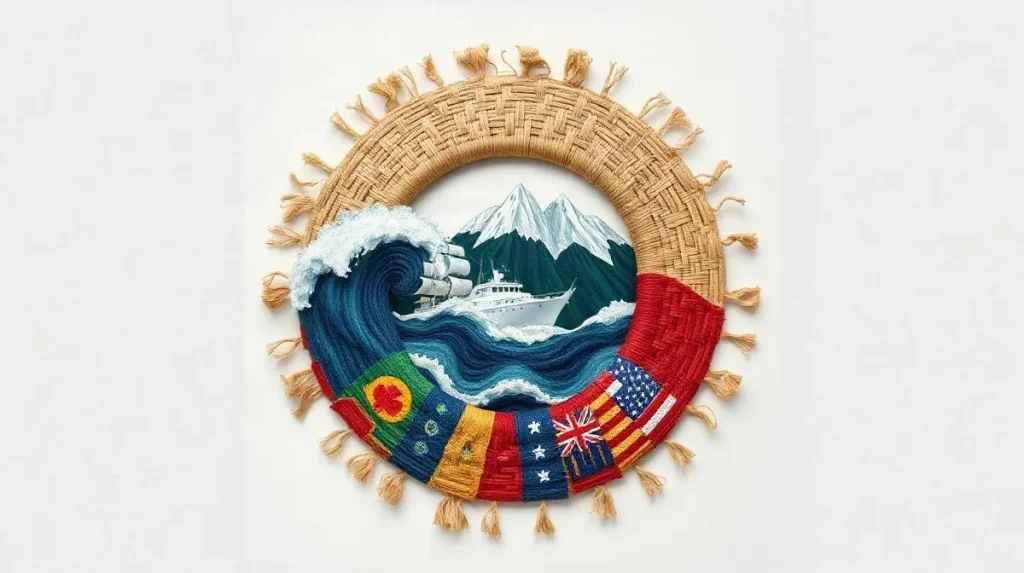
Tammy Nguyen will perform an aria from her opera Timaeus and The Teacher at the 2026 Venice Biennale’s closing programme on 13 and 14 November. Titled Timaeus and The Teacher: Foreword, the piece brings questions of nationhood and freedom into a Biennale whose main exhibition also includes Nguyen’s paintings. It offers a glimpse of a larger opera commissioned and produced by Wesleyan University in Connecticut.
An aria in the closing programme
The Biennale’s closing events will feature the aria across two dates, 13 and 14 November. The performance grew out of a conversation between Nguyen and the curatorial team for the 61st Biennale exhibition In Minor Keys, which was led by Koyo Kouoh. Nguyen’s paintings are also on view in the main show.
Nguyen is an associate professor at Wesleyan University, which commissioned and produced the opera. She developed the work with composer Neely Bruce and choreographer Jamal Jackson. The Venice presentation is a single aria from a project still in progress, rather than a staging of the complete opera.
Flags, trade and national belonging
The opera takes up the politics of flags and the idea of freedom of movement. Its background includes Nguyen’s research into “flags of convenience”: registering a ship under a country’s flag, making it subject to that country’s laws. The practice connects maritime commerce to national regulation, including labour rules and taxation.
Nguyen explored the subject in Timaeus and the Nations, an exhibition at Sarasota Art Museum in 2024–25. There she recombined phrases from national anthems and imagery from flags, transforming familiar symbols into new patterns. That investigation feeds into the opera’s wider contrast: goods can cross borders through global trade, while people’s movement is constrained by nationality.
A journey shaped by history
The libretto centres on the Teacher, a young Vietnamese man played by Brian Vu. In the story, he teaches English to Chinese gold traders before trying to escape Saigon by boat in 1977. His passage brings him into contact with other travellers seeking freedom and the uncertain conditions of sea travel.
The character is loosely based on Nguyen’s father, who fled as a refugee by sea. His boat’s engine failed in the South China Sea, a busy route for trade and marine traffic, and an American Sunoco oil tanker rescued the passengers. The tanker’s captain, a German Holocaust survivor, understood their predicament and helped them. The episode links the opera’s political questions to an individual journey across borders.
From Plato’s cosmos to the stage
The title invokes Plato’s Timaeus, a dialogue about the creation of the universe. Nguyen has said she used a Fibonacci module to obscure phrases in the libretto and shape the Teacher’s story. The character sings partly in broken English, with meaning emerging through the work’s logic of the universe.
A circular tapestry, inspired by the cosmological diagram in Plato’s text, anchors the set. Dancers fold, wrap, stretch and compress it, revealing shifting images that suggest sea, ship and mountain range. The changing fabric and movement blur the boundary between human and natural forms, echoing the opera’s question of whether political borders can hold against larger forces.
A work still being built
The Biennale aria is an advance look at an opera Nguyen has not yet completed. She has described the scale of production as demanding, with more work and significant fundraising still ahead. The November performances therefore present one part of a longer creative undertaking.
Music has been part of Nguyen’s practice since childhood: she grew up in San Francisco and studied through formal music programmes. She has connected that training to her visual art, saying the opera changed how she thinks about audiences and psychological connection. The Biennale performance brings those strands together in a work that joins music, choreography, painting and political inquiry.
Takeaway: Nguyen’s 13 and 14 November Biennale aria turns a developing opera about flags, migration and freedom into a focused encounter with the politics of belonging.
What this piece draws on
- theartnewspaper.com — “Venice Biennale closing celebration to feature aria from”
- alumni.yale.edu — “Yale Alumni Artists Shine at 61st Venice Biennale”
- wesleyan.edu — “Timaeus and The Teacher”
- andrewkreps.com — “News – Andrew Kreps Gallery”
- The Guardian — “What does a woman swimming in urine tell us about”
Topic guide: Exhibitions: The Complete Guide