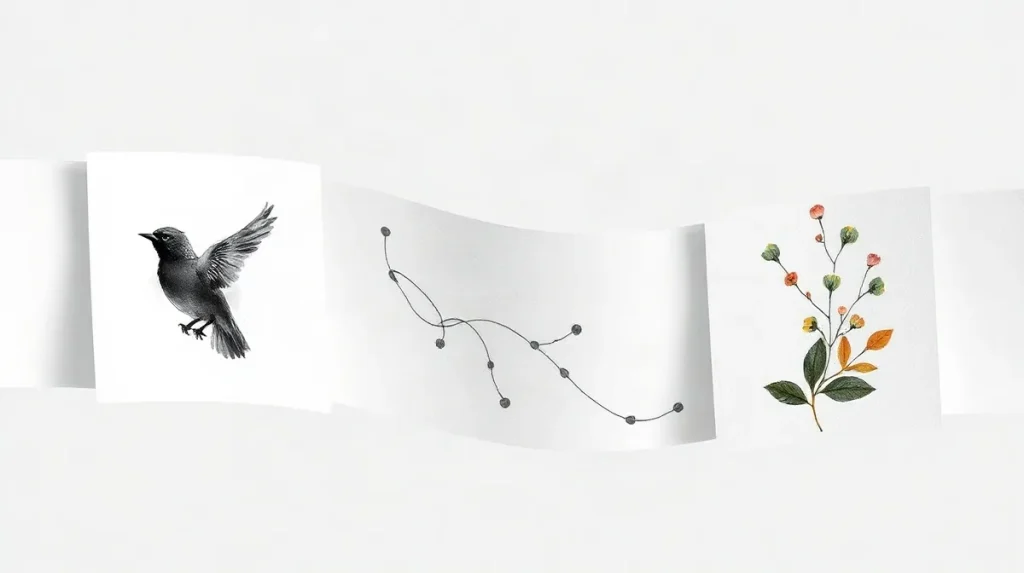
Gaia Alari’s animations are made frame by frame from thousands of handmade drawings on paper, bringing botanical forms, gestural bodies and birds into fluid motion. The current presentation highlights that labour-intensive process and the tactile marks of oil pastel and charcoal that remain visible as each image moves.
Drawing becomes movement
Each animation begins with individual drawings on paper rather than a single image made to move by another method. Their frame-by-frame construction means that motion emerges through a sequence of handmade marks, with each drawing contributing to the changes seen on screen.
The source describes thousands of drawings across Alari’s animated work, making repetition and small visual shifts central to the viewing experience. The process puts the physical act of drawing at the heart of the animation, rather than concealing it behind a seamless digital surface.
Pastel and charcoal stay visible
Oil pastel and charcoal give Alari’s moving images a distinct material quality. Their marks do not disappear into polished, uniform imagery; instead, the drawing remains perceptible as it changes from one frame to the next.
That visibility matters because it connects the animation to its paper origins. The screen carries traces of an artist’s hand, while the changing marks turn drawing into performance: the materials appear to shift and respond as the sequence unfolds.
Forms flow into loops
Botanical shapes, expressive bodies and birds recur in the work, moving through fluid loops rather than a fixed, linear scene. Their convergence gives the animations a rhythm that the source compares to a stream of consciousness, with one image seeming to lead into another.
The looping structure makes the work’s motion feel continuous, while the hand-drawn frames keep each passage tied to a sequence of distinct images. Instead of relying on a single subject, Alari brings together natural forms and bodily gestures to build animated compositions with their own visual stories.
Animation alongside illustration
Alari’s practice also includes static illustrations, as well as animations made through brand collaborations and personal explorations. Those different contexts sit alongside one another in the account of her work, which describes each piece as telling a distinct story.
The contrast between a still illustration and a frame-by-frame animation makes the role of time especially clear. A static image presents its marks at once; an animation reveals them successively, allowing the viewer to follow how forms develop and change across the sequence.
Where to watch
Alari’s animations can be watched on Vimeo, while Instagram offers a place to follow further explorations. These platforms provide ways to encounter the work beyond the exhibition presentation and to see how the artist’s visual language continues across different pieces.
The central point of the presentation is the process itself: thousands of drawings, made by hand, become moving images without losing the character of oil pastel and charcoal. Alari’s loops show how a frame-by-frame method can preserve the texture of drawing while giving it an animated rhythm.
Takeaway: Alari’s animations make their handmade construction part of the subject, turning drawings in oil pastel and charcoal into fluid, frame-by-frame motion.
What this piece draws on
- zippyframes.com — “The Last Song on Earth by Gaia Alari”
- Colossal — “Gaia Alari's Lilting Animations are Drawn Frame by Frame”
- creativeboom.com — “'I just love dogs': Gaia Alari on her wobbly, tactile drawings”
- latelybetter.com — “Lately, Better: How are we today, world?”

Topic guide: Exhibitions: The Complete Guide