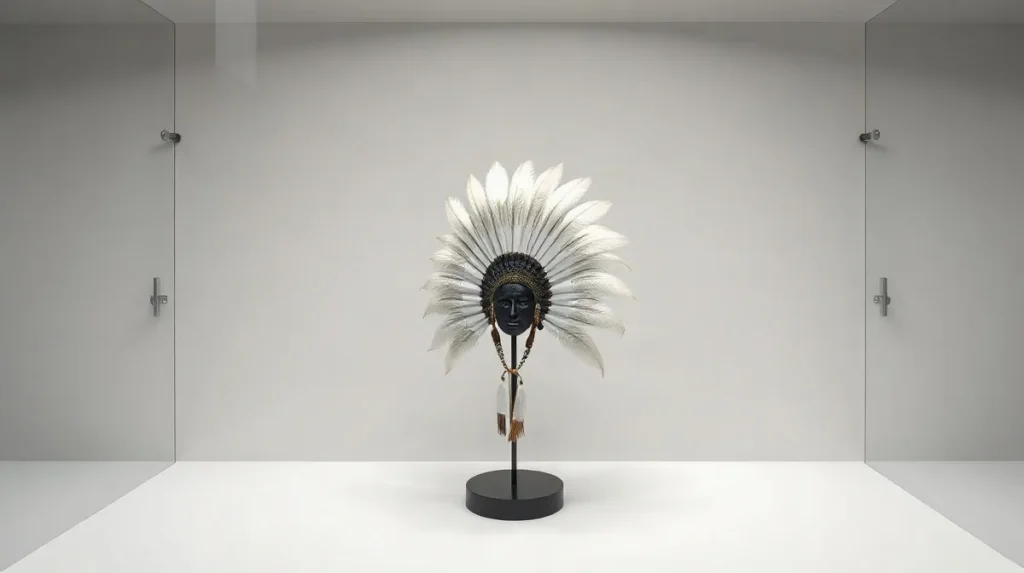
Austrian presidential hopeful Günther Fehlinger-Jahn has pledged to return Moctezuma’s 16th-century feather headdress to Mexico if elected in 2028. The object is held at Vienna’s Weltmuseum, after decades of unsuccessful Mexican efforts to secure its return. Fehlinger-Jahn proposes negotiations between Austria and Mexico, but an Austrian president cannot order restitution alone. His pledge puts a long-running dispute over cultural heritage into an election campaign.
A campaign promise, not a transfer decision
Fehlinger-Jahn, an economist whose independent candidacy remains unconfirmed, has framed the issue as one for bilateral negotiation. He has said the original headdress should ultimately belong to Mexico, while calling for a solution based on friendship rather than confrontation.
The distinction between a candidate’s promise and state policy is significant: even if elected in 2028, Austria’s president could not decide restitution unilaterally. Legislation that would enable the return of colonial-era objects in Austria is still pending, leaving the pledge without an established route to an immediate transfer.
The object at the centre of the claim
The headdress, also known as a quetzalapanecayotl, is the only known surviving example of its kind. It measures 1.3 metres high and 1.75 metres wide, and its original design included four zones of green, red, brown and blue feathers alongside gold ornaments. Its craftsmanship makes it an important example of Indigenous featherwork.
The name links the object to Moctezuma, the last Aztec ruler, but that association is not settled history. One theory holds that Moctezuma gave it to Spanish conquistador Hernán Cortés, who may have sent it to Charles V; experts largely agree, however, that Moctezuma did not wear it. Mexican historian Federico Navarrete says its origin is uncertain and the association came later.
Centuries of movement and claims
The first documented European reference to the headdress is from 1596, in an inventory at Ambras Castle in Innsbruck, where it was described as “a Moorish hat.” It was rediscovered in poor condition in the 19th century, identified as Indigenous Mexican and restored. In 1888 it went on view at Vienna’s Natural History Museum before entering the collection of what is now the Weltmuseum.
Mexico’s requests for its return date to the 1860s, when Maximilian, the Habsburg emperor of Mexico, sought the object. Efforts continued from the 1980s. The headdress has also become a recurring emblem in broader restitution debates, alongside the Benin Bronzes and the Parthenon Marbles.
Fragility and the failed loan request
A major recent dispute followed a 2020 request by Beatriz Gutiérrez Müller, wife of then-president Andrés Manuel López Obrador, to borrow the headdress for a 2021 exhibition marking 500 years since Tenochtitlán’s fall. Mexico offered Habsburg-era objects in exchange, including the gilded carriage of Maximilian and Carlota. Austria refused the loan, adding to diplomatic tensions.
Austria has cited the headdress’s fragility: a joint Mexico-Austria study conducted from 2010 to 2012 concluded that vibrations during transport could destroy it. Some experts dispute that assessment. Fehlinger-Jahn has suggested that ownership could be transferred while specialists work on a shared conservation and stewardship arrangement until transport is considered safe.
A national and international question
The claim is part of a wider debate about whether museums should retain objects acquired through colonial histories or return them to countries of origin. In Mexico, the recovery of pre-Hispanic heritage has been a priority under López Obrador and his successor, President Claudia Sheinbaum, because such objects are closely tied to national identity.
In July, Sheinbaum’s administration announced the recovery of 3,716 cultural objects. That figure gives the headdress dispute a concrete place in a broader Mexican repatriation effort, but it does not resolve this case: the Weltmuseum still holds the fragile object, and any return would require action beyond a campaign pledge.
Takeaway: Fehlinger-Jahn’s 2028 pledge raises the prospect of renewed negotiations, but the headdress remains in Vienna and its return is not guaranteed.
What this piece draws on
- theartnewspaper.com — “Austrian presidential hopeful pledges to return Moctezuma’s headdress to Mexico – The Art Newspaper – International art news and events”
- riotimesonline.com — “Moctezuma Headdress: Austrian Hopeful Pledges Return”
- upi.com — “Austrian candidate vows return of 'Moctezuma's Headdress' to Mexico – UPI.com”
- usaartnews.com — “Austrian Presidential Hopeful Pledges Headdress Return”
- theartnewspaper.com — “The Art Newspaper – International art news and events”
