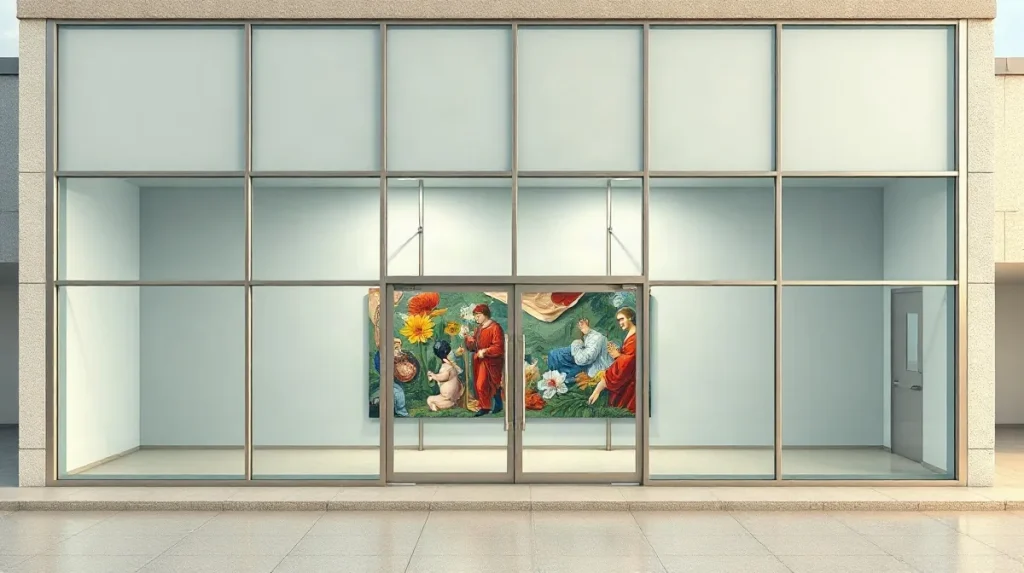
Three WPA-era murals at Harlem Hospital have completed conservation and are on display in the hospital’s indoor mural pavilion. The work, completed by NYC Health + Hospitals’ Arts in Medicine department on Wednesday, October 14, also covered a sculpture by John Rhoden. The restoration brings major New Deal-era works back into view, including Vertis Hayes’s eight-panel “Pursuit of Happiness” from 1937.
Works made under the Federal Art Project
The murals were created during the Great Depression, when the Works Progress Administration’s Federal Art Project opened public commissions to Black artists. Harlem Hospital’s commission was a notable opportunity in that period: in 1936, artists submitted designs that hospital administrators objected to as containing “too much black subject matter,” as Larissa Trinder, head of the Arts in Medicine program, recounted in a phone interview with Hyperallergic.
The artists publicly protested the rejection, and the hospital commissioner reversed the decision. The episode links the murals not only to the hospital’s history but also to a wider struggle over whose subjects and stories could appear in public institutions. Their conservation preserves works made within that contested moment.
Three murals, one sculpture
The completed conservation covered “Pursuit of Happiness” (1937), by Hayes, and Charles Alston’s paired murals “Magic in Medicine” and “Modern Medicine,” both dated 1940. Hayes’s work consists of eight panels and presents a visual account of African American history, migration, community and aspiration.
The project also included a sculpture by John Rhoden. Together, the three murals and the sculpture make the pavilion a setting where art and the history of medicine meet. The Alston works take medicine as their subject, while Hayes’s mural broadens the story toward the experiences and ambitions of African American communities.
Conservation and display
Conservation work on the murals involved stabilizing and cleaning both paint and plaster. Those steps address the condition of the works’ surfaces and support their continued display inside the hospital, rather than treating the murals as images to be replaced by reproductions.
The restored murals have been reinstalled in the indoor pavilion. Their return makes the original works accessible within the building, where patients, staff and visitors encounter them as part of the hospital environment. The conservation effort therefore preserves both historic artworks and their place in the institution that commissioned them.
A pavilion that carries the murals outward
The hospital’s new pavilion also uses digital enlargements of historic murals printed on its exterior glass facade. The design draws on Hayes’s “Pursuit of Happiness,” extending the mural imagery from the interior display to the building’s outside surface.
This glass treatment is a contemporary interpretation, distinct from the restored paintings themselves. It connects the hospital’s modernization to the WPA-era commission and makes the imagery visible beyond the pavilion’s interior. The restored panels retain their material presence inside, while the facade translates their visual language for the surrounding Harlem community.
Why the restoration matters
Harlem Hospital’s murals record a period when Black artists gained access to public commissions through the Federal Art Project, even as their proposals faced resistance. The reversal of the 1936 objection is part of that record: the hospital ultimately became the home of works by Hayes and Alston that place Black history and medical subjects in a public setting.
With conservation complete, the eight panels of “Pursuit of Happiness,” Alston’s two 1940 murals and Rhoden’s sculpture remain part of the hospital’s cultural life. The combination of restored originals indoors and mural-derived glass outside gives the pavilion two related roles: preserving the works and carrying their imagery into the building’s modern design.
Takeaway: Harlem Hospital has completed conservation of three WPA-era murals and a John Rhoden sculpture, restoring the works to display in its indoor mural pavilion.
What this piece draws on
- The New York Times — “At Harlem Hospital, Murals Get a New Life”
- generalglass.com — “Harlem Hospital Center Modernization – General Glass”
- columbia.edu — “Harlem Hospital WPA Murals – The Murals: Conserving”
- roosevelthouse.hunter.cuny.edu — “Healing Walls: Health and Art in New Deal New York – Roosevelt House Public Policy Institute at Hunter College”