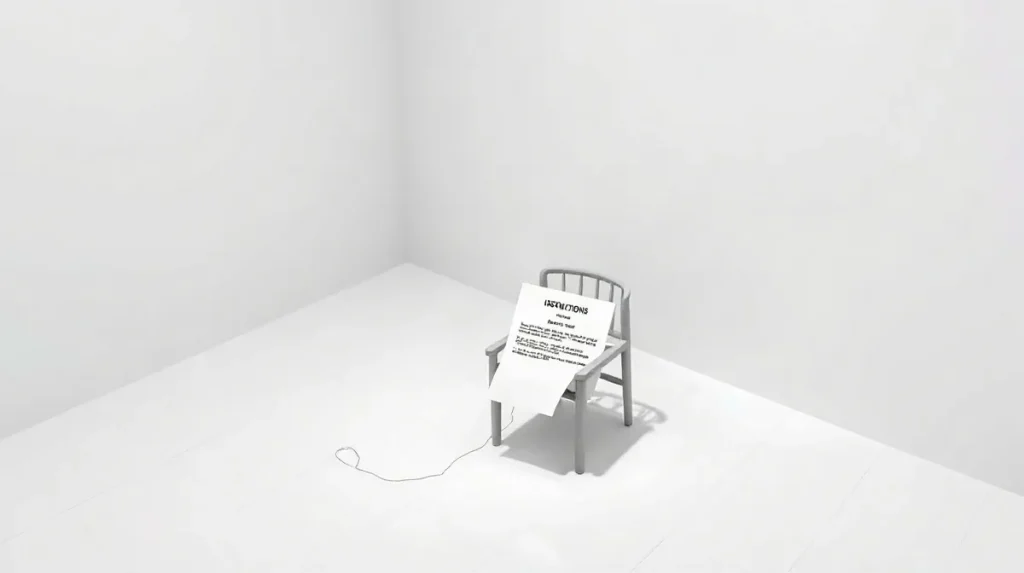
Conceptual art is art in which the idea is the central work, while an object, image, text or action may serve only to express it. The work can therefore be understood through the concept behind it, rather than judged chiefly by its appearance or physical form.
This shift changes what an artwork can be and how it is encountered: a written instruction or a thought made visible may matter as much as a crafted object. Conceptual art asks viewers to consider where the work resides—in its materials, its presentation, or the idea connecting them.
| Form | Concrete example | What to examine |
|---|---|---|
| Written statements | Sol LeWitt, Sentences on Conceptual Art (1969) | How the text frames art and its making |
| Instructions | Sol LeWitt’s Wall Drawings | How written directions relate to the wall drawing |
| Object, image and definition | Joseph Kosuth, One and Three Chairs (1965) | How chair, photograph and dictionary entry differ |
- 1965 Year of Joseph Kosuth’s One and Three Chairs
- 1969 Year of Sol LeWitt’s Sentences on Conceptual Art
- 3 Elements compared in One and Three Chairs: a chair, its photograph and a dictionary definition
What does “Conceptual art: the idea as the work” mean?
“Conceptual art: the idea as the work” means that the governing idea can matter more than the making of a unique, finely crafted object. Commonly associated with the 1960s and 1970s, conceptual art is not necessarily immaterial: an object, a text or an instruction can give viewers a way to encounter an idea.
How to read a conceptual work
A conceptual work may use a physical object not as an end in itself but as a means of making a proposition visible. A text can state an idea, while an instruction can set out a rule for carrying it through; in either case, the work’s meaning depends on what the idea asks the viewer to consider.
To identify a conceptual work, ask what proposition or rule its object makes visible, rather than judging it by craft alone. That question does not make technique irrelevant: it shifts attention from the object’s finish to the relationship between the object, the idea and the way the idea is encountered.
How can an instruction function as an artwork?
Read the rule before the result.
An instruction can function as an artwork by defining an action or conditions that may be carried out later, making the idea available before its performance or installation. In Sol LeWitt’s Sentences on Conceptual Art (1969), statements about making and interpreting conceptual art take text as their form: the work is encountered through propositions rather than a wall drawing.
LeWitt’s Wall Drawings make the distinction between rule and result tangible. Written directions provide the basis for drawings executed on walls, but the text and the installed drawing are related, not interchangeable: one specifies a way to make the work, while the other is its realised appearance at a particular site.
Compare wording and installation.
When looking at an instruction-based work, attend to both the direction and what has been installed. The difference between them is not necessarily a flaw or an incidental change; it can be part of the experience, prompting viewers to consider how a written rule becomes a visible work.
- Text: LeWitt’s Sentences on Conceptual Art (1969) presents ideas about art-making and interpretation as statements.
- Wall drawing: LeWitt’s written directions lead to a drawing executed on a wall; compare the prescribed process with the finished image.
Why can a document or ordinary object carry the idea?
Object, image and definition
A document or ordinary object can carry an idea when its selection, arrangement or wording records a concept or determines how the work is identified and encountered. In Joseph Kosuth’s One and Three Chairs (1965), a chair appears alongside a photograph of a chair and a dictionary definition of “chair.”
- Chair: the physical object.
- Photograph: an image of a chair.
- Dictionary definition: the verbal meaning of “chair.”
Set together, the three elements make their differences available for comparison: a thing is not its image, and neither is the word that defines it. The work’s subject is this relationship among object, representation and language—not simply the chair considered on its own.
A photograph, certificate, list or sheet of paper can likewise record a concept or establish how a work is recognised and encountered. An everyday object becomes conceptually significant not merely by appearing in a gallery, but when its chosen role or arrangement makes the idea legible.
How can you tell conceptual art from a random object?
Conceptual art is distinguishable from a random object when a named work, an artist’s statement, an instruction or other documentation connects the object to a specific idea. For Marcel Duchamp’s One and Three Chairs, the chair’s role is legible through its relationship to a photograph of the chair and a dictionary definition of “chair”: the work brings together an object and two ways of representing or defining it.
For an instruction-based work, look for a stated rule and evidence that the displayed result follows it or belongs to a documented series. A material object may be one realisation of that rule rather than the idea’s only possible form; without the instruction or documentation, however, a viewer may have no grounded reason to distinguish it from an unrelated object.
Test the relationship by asking what would change if the object were replaced while the instruction remained. If the idea survives substitution, the object may not be the work’s sole centre; in One and Three Chairs, removing the photograph or definition would also alter the specific relationship that makes the chair meaningful as part of the work.
When does the idea fail to come across?
Context is not decoration.
A conceptual artwork can fail to communicate when a viewer encounters its object without the instruction or context that makes its idea legible; that gap in presentation does not prove the work has no idea. A chair, for example, may look like an ordinary chair unless the work’s rule or proposition explains why it was selected and how it should be understood.
A wall label that calls an object “conceptual” names a category, not the work’s specific idea. To make the distinction clear, the label or accompanying material needs to identify the relevant proposition or rule; without it, viewers have little basis for telling an artwork from an everyday object simply placed in a gallery.
What the explanation can—and cannot—do
Found objects do not become conceptual art automatically: selection and context must connect the object to a discernible artistic idea. Documentation can supply that connection, but it should not be mistaken for the only permitted interpretation. The useful test is whether the material clarifies the work’s premise while leaving room to consider what the object and its presentation mean.
- Ordinary object: look for an instruction or context linking its selection to an idea.
- Wall label: look for the work’s actual rule or proposition, not just the word “conceptual.”
- Documentation: treat it as a guide to interpretation, not proof that its wording is the sole valid reading.
What should you do when viewing a conceptual work?
When viewing a conceptual work, read its title and accompanying text first, then identify what the object is meant to function as: a sculpture, a record, or an instruction. This matters in Sol LeWitt’s Wall Drawings, where the written directions and the drawing made on the wall are linked parts of the work, not separate things to assess in isolation.
Describe the relationship before interpreting it
- Sol LeWitt’s Wall Drawings: Compare the written directions with the drawing on the wall. Note what the instructions specify and how the visible drawing gives them form.
- Joseph Kosuth’s One and Three Chairs: Compare the chair, its photograph, and the dictionary entry. Ask how the three presentations relate, rather than treating them as unrelated objects.
For either work, begin with concrete observations: what is present, what rule connects the parts, and what question their arrangement raises. A chair, its photograph, and a definition, for example, make a specific comparison between an object and ways of representing or describing it. Reach for a broad label only after you have described those details.
Frequently asked questions
Is conceptual art always immaterial?
Can an instruction itself be an artwork?
How do I recognise conceptual art in a gallery?
Does an ordinary object become art just because it is in a gallery?
Key takeaways
- Conceptual art makes an idea central, but it may still use physical objects.
- Sol LeWitt’s Sentences on Conceptual Art dates to 1969.
- Joseph Kosuth’s One and Three Chairs dates to 1965 and compares an object, its image and its definition.
- An ordinary object is not automatically conceptual art: look for the idea or rule connecting it to the work.
