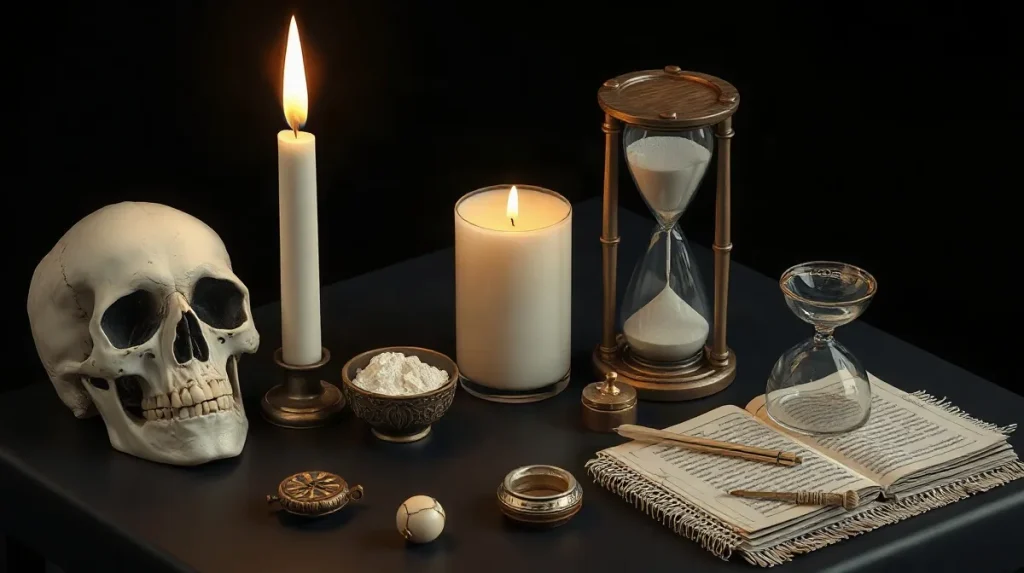
Vanitas is an art tradition that uses symbols of death and passing time to remind viewers that life, beauty and earthly possessions are temporary.
Skulls, wilting flowers, extinguished candles and objects associated with learning or wealth can turn a still life into a meditation on mortality. The images do not merely confront death: they ask what remains meaningful when status, pleasure and knowledge cannot last. Understanding vanitas means reading these objects as a visual language—and considering how its warning changes across art and time.
| Symbol or term | What it points to | How it relates to vanitas |
|---|---|---|
| Skull | Mortality | A memento mori symbol used in vanitas still lifes |
| Extinguished candle | Life’s brevity and fragility | A recurring vanitas symbol |
| Hourglass | Passing time | A visual reminder of life’s transience |
| Memento mori | Remembering that one must die | A closely related artistic tradition |
| The Book of Vanitas | A mysterious book in a vampire story | A fictional use of the name, separate from the art term |
What does vanitas mean in art?
In art, vanitas is the idea that worldly things are ultimately futile or worthless, a meaning connected to the Latin word for vanity. A vanitas painting makes that idea visible through objects that suggest death, passing time and the limits of earthly pleasure.
How vanitas works in still life
Vanitas still life uses arranged objects, rather than a narrative scene, to invite close inspection. A skull points to death, while an hourglass suggests time passing; together, such objects prompt viewers to consider how possessions and pleasures cannot last.
The objects are not merely symbols to identify: their careful arrangement brings the contrast into view. Things valued for beauty or enjoyment sit within a composition that also recalls mortality, making the limits of worldly life the still life’s central idea.
Which objects make a painting a vanitas?
A vanitas painting uses objects such as a skull, an extinguished candle, an hourglass and worldly possessions to remind viewers that life is brief and material pleasures do not last.
Symbols of death and time
A skull signals mortality and serves as a familiar memento mori: a reminder that life ends. An extinguished candle makes the same point through an image of a light that has gone out, suggesting life’s fragility and brevity.
An hourglass gives passing time a visible form within the composition. Its measured flow connects the objects in the painting to the viewer’s own awareness of life’s limits.
Symbols of worldly pleasure
Worldly pleasures and possessions can include the attractive things people value or enjoy. In a vanitas painting, their presence is not simply decorative: they remind viewers that material attractions are temporary.
- Skull: mortality and the memento mori.
- Extinguished candle: life’s fragility and brevity.
- Hourglass: passing time made visible.
- Pleasures and possessions: worldly attractions that do not last.
How is vanitas related to memento mori?
Vanitas is related to memento mori because both use images to remind viewers that life is short and fragile. The Latin phrase *memento mori* means “remember you must die,” and it describes artworks built around that reminder.
Vanitas still lifes share this visual language: a skull or an extinguished candle can make mortality visible in the objects arranged alongside it. But vanitas adds a specific emphasis: it presents worldly possessions and pleasures as futile or temporary, rather than focusing only on the fact of death.
The terms therefore overlap, but they are not interchangeable. A skull may signal memento mori; in a vanitas still life, it can also underscore the impermanence of the wealth and pleasures surrounding it.
How does The Case Study of Vanitas use the name?
The Case Study of Vanitas uses “Vanitas” as a character’s name in a fantasy story about vampires and a mysterious book called The Book of Vanitas. The name connects the anime to its own supernatural plot, rather than defining the art-historical meaning of vanitas still life.
In The Case Study of Vanitas, Noé and Vanitas work to cure vampires of Malnomen, a disease spread by Naenia, an unknown ethereal entity. Their effort to treat the affliction places the name within a story of curses, illness and vampire lore.
That fictional use differs from vanitas in art history: vanitas still lifes use objects such as skulls and hourglasses to evoke life’s brevity and the impermanence of worldly pleasures. The anime’s title belongs to fantasy storytelling; it should not be mistaken for the name of that artistic tradition.
Why can the name Vanitas be confusing?
The name Vanitas can be confusing because it refers both to an art tradition and to works and characters beyond visual art. In vanitas still-life painting, skulls, extinguished candles and other objects form a composition about mortality and the impermanence of worldly pleasures; elsewhere, the same name appears in music and popular culture.
Use the surrounding clues
In music, Vanitas is connected with a piece by Robert Schumann and an album by Anaal Nathrakh. In the Kingdom Hearts franchise, Vanitas is a character name, while the anime The Case Study of Vanitas features vampires and a mysterious book. Those details point to different uses of the word, not to a single artwork.
The General Data Protection Regulation (GDPR) is also mentioned in connection with Vanitas, showing how a search for the term can lead beyond art history. To identify the context, look at the surrounding words: skulls, candles and still-life composition signal the visual-art tradition; vampires and a mysterious book point to the anime.
When does a skull still life not qualify as vanitas?
A skull still life does not qualify as vanitas simply because it contains a skull; the objects must work together to suggest life’s transience and the futility of worldly possessions or pleasures. A skull beside an hourglass or an extinguished candle can reinforce mortality, but interpretation depends on the composition’s wider meaning, not a single emblem.
A memento mori still life may remind viewers that life is brief without making vanitas’s broader critique of earthly attachments its central idea. The distinction lies in emphasis: a work focused on death’s inevitability can be memento mori, while a vanitas arrangement also calls attention to the impermanence of what people value, pursue or enjoy.
When “Vanitas” means something else
“Vanitas” is also used beyond art history, so the word alone does not identify a vanitas painting or theme. It names the first movement of Robert Schumann’s 5 Pieces in a Folk Style, for cello and piano, and appears in The Case Study of Vanitas, an anime series involving vampires and a mysterious book. In each case, the surrounding work—not the title by itself—determines what “Vanitas” means.
Frequently asked questions
What is vanitas in painting?
What does a skull mean in vanitas art?
Is vanitas the same as memento mori?
What is The Case Study of Vanitas about?
Key takeaways
- Vanitas still lifes turn mortality and impermanence into visible symbols.
- Skulls, extinguished candles and hourglasses are recurring objects, each pointing to death or passing time.
- Vanitas overlaps with memento mori but also questions the lasting value of worldly pleasures.
- The Case Study of Vanitas uses the name in a separate vampire story about Malnomen and Naenia.
Sources
- crunchyroll.com — “Watch The Case Study of Vanitas”
- Google Arts & Culture — “An Exploration of Vanitas: The 17th Century and the Present”
- Animation, Fantasy, Horror — “The Case Study of Vanitas (TV Series 2021–2022) ⭐ 7.6”
- vsbattles.fandom.com — “Vanitas no Shuki – VS Battles Wiki – Fandom”