Rimma Gerlovina and Valeri Gerlovin, known together as Gerlovin & Gerlovina, are a Russian-American artist duo who have worked collaboratively since 1971. Associated with Moscow Conceptualism, they made books, photographs, objects, installations and performances. Their practice brings language, perception and systems of classification into playful, often philosophical relation.
Key facts
- Members: Rimma Gerlovina; Valeri Gerlovin
How did the duo develop?
The Gerlovins were active in Moscow’s unofficial exhibition scene before emigrating to the United States in 1979. They live and work in New York. Their collaboration does not erase the distinction between the two artists: they described working both separately and together, with each remaining themselves while also becoming, in a sense, the other.
Their work is linked to Moscow Conceptualism through its attention to how ideas are framed, named and understood. Rather than treating an artwork as a fixed image alone, many of their projects make the viewer consider the rules that shape interpretation. Words, objects and actions become parts of a structure that can be tested or rearranged.
What characterises their work?
Across the duo’s practice, familiar categories become unstable. An object may be given an unexpected function; a label can suggest an identity without settling it; and a book can operate as an interactive arrangement rather than simply a container for text. Their works draw on symbolic references associated with Judaism and Christianity, Zen Buddhism, classical mythology and American popular culture, allowing different readings to coexist.
In Semantics of Possible Worlds (1977), photographs and captions play with the idea that matter can assume different forms. The images present Rimma as a kind of module, while the accompanying descriptions make the pictures sound like fragments from an invented system. The work combines visual documentation with language that unsettles the authority of a straightforward caption.
The Theory of Free Transfer of Functions (1978) invites viewers to move photographs among labelled pockets in a fabric arrangement. The labels name roles, qualities and places, while the images can be recombined. The work turns classification into an activity: viewers encounter a system with rules, but can also make new groupings within it.
Why are touch and participation important?
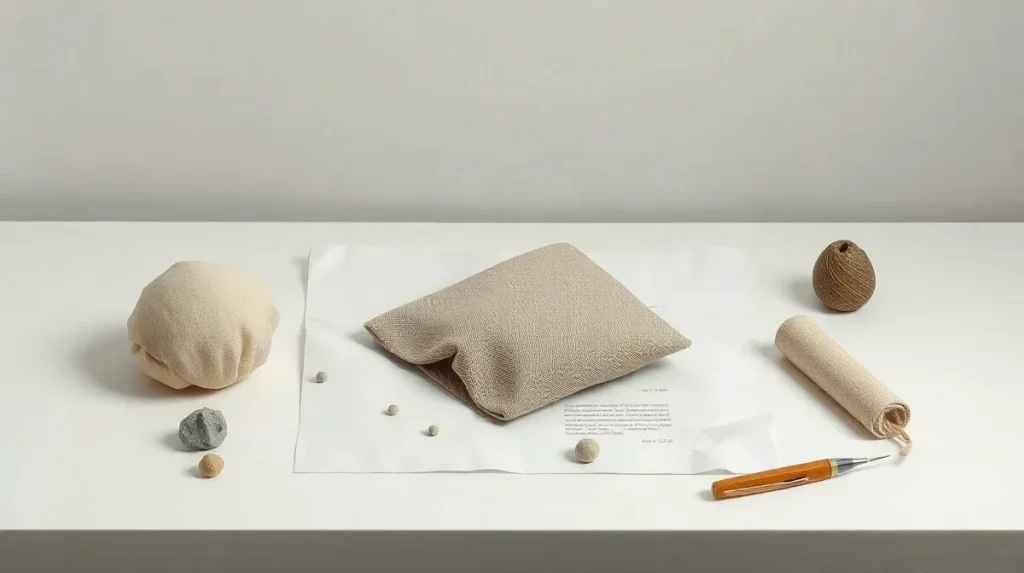
Some early objects ask viewers to explore by touch rather than sight. Who Is Who (1977), for example, takes the form of a bag containing soft fabric cushions marked with different self-descriptions. Their varied labels contrast with the shared material from which the cushions are made. Identity appears multiple, while the object quietly points to a common physical basis.
In A Horse in the Form of a Worm (1977), objects are concealed in compartments along a long, dark form and can be examined by touch. The experience makes knowledge partial: the viewer can feel an object without seeing it, and a label may guide interpretation without fully resolving what is encountered. This interest in the limits of perception connects tactile works to the duo’s broader questioning of how things acquire meaning.
How did they use performance and photography?
In the late 1970s, the Gerlovins also made performances, many outdoors and with friends taking part. Winter–Summer (1976–1977) placed the artists in the same location and clothing in winter and summer photographs. The contrast between their repeated appearance and the changing surroundings makes time and transformation visible through a simple change of season.
For Solar Clock (1977), Rimma took the role of a human pointer in a sundial drawn on the ground. Photographs recorded her position as the shadow shifted. The performance turns the body into a measure of time, while the photographs preserve a sequence that would otherwise pass.
Where can their work be seen?
Works by the Gerlovins are held in museum collections, and their work has appeared in exhibitions at international venues. Their photographs have also been featured on magazine covers.
- The State Tretyakov Gallery
- J. Paul Getty Museum
- The Museum of Fine Arts, Houston
- Art Institute of Chicago
- International Center of Photography, New York
Their exhibition history includes the Venice Biennale, the Smithsonian American Art Museum, the Bundeskunsthalle and the Museum of Modern Art in Paris. In addition to their visual practice, the Gerlovins published Russian Samizdat Art in New York in 1986, with an article by John Bowlt; a Polish edition followed in 1990.
Frequently asked questions
Who are Gerlovin & Gerlovina?
When did they move to the United States?
What kinds of work do they make?
An independent reference profile prepared by intart.org from public biographical records. intart.org is not affiliated with the artist, their estate or their galleries.
More artist profiles

Topic guide: Artists: The Complete Guide