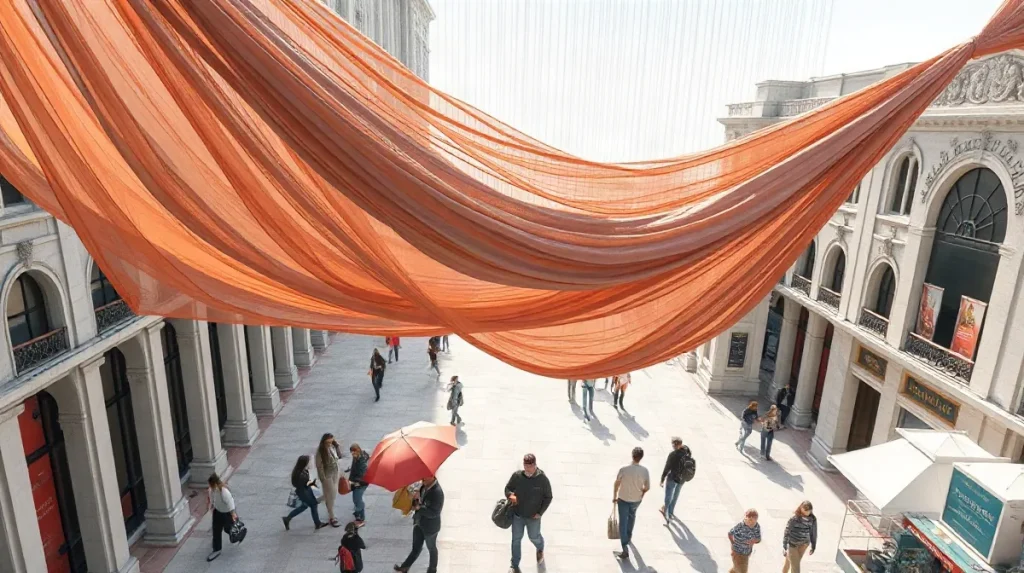
Janet Echelman’s sculptural innovations transform air, form, and space into immersive, dynamic experiences by weaving massive, flowing nets that respond to wind and light. Her work redefines the boundaries of sculpture, blending art, architecture, and environment to create ethereal, ever-changing installations that engage viewers on multiple sensory levels.
By harnessing lightweight materials and intricate engineering, Echelman’s sculptures float and shift above urban landscapes, inviting reflection on the relationship between natural forces and human creativity. These monumental forms challenge traditional notions of solidity and permanence in sculpture, introducing a new vocabulary of movement and transparency that expands the possibilities of public art.
For those interested in how sculptural forms interact with cultural symbolism and space, further reading is available in our detailed analysis of Prada Marfa Sculpture: Cultural Iconography and Artistic Context. This piece complements the exploration of Janet Echelman’s work by offering insight into how iconic sculptures embed themselves within broader cultural and environmental narratives.
| Criteria | Janet Echelman | Prada Marfa |
|---|---|---|
| Material | Ultra-high-molecular-weight polyethylene nets | Adobe bricks, metal, glass |
| Scale | Up to 50 m diameter, 2,000+ m² aerial area | Approx. 24 m² footprint |
| Permanence | Temporary, months to years | Permanent, since 2005 |
| Interaction with environment | Dynamic movement with wind (5–15 km/h) | Static, desert environment |
| Installation cost | Up to $750,000 USD | Estimated under $100,000 USD initially |
- 50 meters Maximum diameter of Echelman’s textile sculptures
- 3 GPa Tensile strength of polyethylene fibers used
- 750,000 USD Approximate installation cost of a major sculpture
- 5–15 km/h Typical urban wind speeds for sculpture movement
- 24 square meters Footprint area of Prada Marfa sculpture
How does Janet Echelman use textile materials to create her sculptures?
Material selection
Janet Echelman employs advanced textile materials such as ultra-high-molecular-weight polyethylene fibers, notably those produced by DSM Dyneema, which offer tensile strengths exceeding 3 gigapascals (GPa). This choice enables her netted sculptures to withstand significant tension while remaining lightweight and flexible, essential for their expansive aerial forms.
Scale and weight considerations
Echelman’s sculptures can reach massive dimensions, with works like the 2023 Boston installation As If It Were Already Here spanning up to 50 meters in diameter. The materials used have a low weight of approximately 0.5 kilograms per square meter, allowing these large-scale sculptures to be suspended without requiring heavy or bulky supporting infrastructure, making them appear to float effortlessly in the air.
What role does air and environmental interaction play in Echelman’s sculptures?
Wind-driven motion
Janet Echelman’s sculptures rely fundamentally on interaction with air currents, designed to move dynamically within wind speeds of 5 to 15 km/h. This range allows the sculptures to shift continuously, creating fluid, ever-changing forms that respond directly to environmental conditions. To optimize this interaction, Echelman employs computational fluid dynamics (CFD) modeling, utilizing software such as Autodesk CFD to simulate how airflow will affect each piece before installation. This technology enables precise adjustments in the sculpture’s design to ensure maximum movement and structural integrity within typical urban wind thresholds.
Environmental impact
The movement of Echelman’s sculptures also contributes to improving urban microclimates by enhancing air circulation beneath and around the installations. This increased airflow can moderate pedestrian comfort in public spaces, particularly in warmer months or congested areas. By promoting ventilation, the sculptures help reduce heat accumulation and create a more pleasant environment. These effects underscore how Echelman’s work transcends aesthetics, integrating environmental functionality into public art through deliberate design and engineering choices.
How do Echelman’s works contrast with the permanence of the Prada Marfa installation?
Material permanence
The Prada Marfa installation embodies material permanence through its construction from adobe bricks and metal, designed to endure the harsh desert environment indefinitely. Completed in 2005, this architectural sculpture spans approximately 24 square meters and is fixed in place, reflecting a commitment to long-lasting public art that resists natural decay and human interference.
In contrast, Janet Echelman’s sculptures utilize lightweight, flexible materials such as knotted fiber nets suspended in open air, which are not built for permanence. These nets are engineered to respond dynamically to wind and weather, intentionally embracing impermanence and continual transformation rather than resisting it.
Temporal nature and scale
Echelman’s installations are inherently temporary, often installed for periods ranging from several months up to a few years, emphasizing change and the fleeting quality of experience. This temporality contrasts sharply with Prada Marfa’s indefinite presence, which is meant as a static landmark.
- Prada Marfa’s footprint: approximately 24 square meters
- Echelman’s suspended nets: covering areas exceeding 2,000 square meters
- Typical duration of Echelman’s works: several months to a few years
Furthermore, Echelman’s volumetric spatial presence engages viewers in an immersive experience that shifts with environmental conditions, unlike the fixed, architectural solidity of Prada Marfa.
What are the engineering challenges in installing large-scale textile sculptures?
Load-bearing requirements
The engineering challenges in installing large-scale textile sculptures primarily involve ensuring structural supports can safely bear loads up to 5 tons while accommodating dynamic wind forces. This requires collaboration with engineers specializing in tensile structures who calculate load distribution and select materials accordingly. The steel cables and anchors must meet standards such as ASTM A586 for high-strength wire ropes to guarantee safety and durability under stress.
Installation logistics
Installation periods typically last between 10 and 30 days, demanding coordination of cranes, rigging specialists, and strict compliance with local building codes, including OSHA regulations for worker safety. Maintenance protocols mandate inspections every three months to monitor fiber wear and adjust tension, maintaining the sculpture’s integrity throughout the display. Companies like Mammoet provide heavy lifting equipment tailored to these complex rigging needs, while ongoing upkeep uses tension monitoring systems to detect fiber fatigue early.
When might Echelman’s aerial textile sculptures be less effective or impractical?
Environmental limitations
Janet Echelman’s aerial textile sculptures face significant challenges in regions prone to extreme weather, where their delicate materials risk damage or safety hazards. For example, installations must withstand hurricane-force winds exceeding 74 mph or heavy snowfall loads surpassing 20 kg per square meter, conditions that can tear or collapse the netting. Such vulnerabilities limit their feasibility in coastal zones or mountainous areas with severe seasonal storms.
Site and budget constraints
Urban settings without adequate vertical clearance or robust structural anchors cannot support Echelman’s expansive works, which often span tens of meters in height and width. Additionally, the high costs involved—like the $750,000 USD expenditure for “Her Secret Is Patience” in Phoenix—reflect the expense of specialized materials such as ultra-high-molecular-weight polyethylene fiber and custom fabrication labor. These financial and spatial demands can restrict project opportunities in cities with limited infrastructure or tight municipal budgets.
- Required vertical clearance typically exceeds 15 meters to accommodate large-scale aerial forms.
- Material costs include advanced textile fibers that can cost several hundred dollars per kilogram.
- Installation budgets often surpass $500,000 USD, factoring in engineering, fabrication, and anchoring systems.
- Extreme weather thresholds: wind speeds >74 mph (hurricane level) and snow loads >20 kg/m² pose risks.
Frequently asked questions
What materials does Janet Echelman use for her sculptures?
How long do Echelman’s sculptures typically remain on display?
How does Echelman ensure her sculptures respond to wind safely?
What is the approximate cost range for installing one of Echelman’s large sculptures?
Key takeaways
- Echelman uses ultra-strong polyethylene fibers enabling large, lightweight aerial nets.
- Her sculptures dynamically interact with urban wind, enhancing public spaces.
- Unlike the permanent Prada Marfa, her works emphasize temporality and movement.
- Engineering large textile sculptures requires advanced structural and safety planning.
- Environmental conditions and budget constraints can limit installation feasibility.