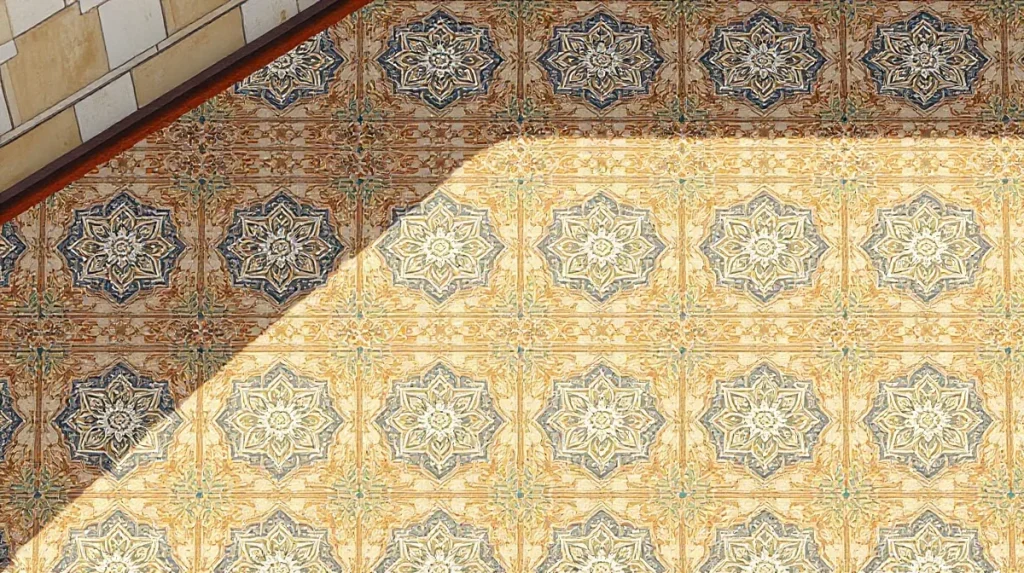
Geometric ornament in Islamic art stands as a testament to the enduring fascination with symmetry, complexity, and abstract beauty that has shaped artistic traditions across centuries. Far from mere decoration, these intricate patterns reveal a deep engagement with mathematical principles and spiritual symbolism, reflecting a unique cultural synthesis that transcends regional boundaries. This article explores the rich variety and significance of geometric ornament in Islamic art through a comparative lens, examining how different regions and periods have interpreted and transformed these motifs.
By analyzing the distinctive styles and techniques found in architectural elements, ceramics, textiles, and manuscripts, we gain insight into the ways geometric ornament functions both as a visual language and a manifestation of religious and philosophical ideals. From the star patterns of the Middle East to the interlaced designs of North Africa and the vibrant tessellations of Central Asia, this comparative study highlights the shared foundations and diverse expressions of geometric ornament in Islamic artistic heritage.
| Region | Century | Characteristic Motifs | Artistic Medium |
|---|---|---|---|
| Al-Andalus (Spain) | 14th | Interlaced circles and squares | Architecture (Alhambra tiles) |
| Mamluk Egypt | 14th | 16-pointed star polygons | Stone and wood carving |
| Timurid Central Asia | 15th | Combined geometric and calligraphic | Ceramics and architecture |
| Safavid Persia | 16th | 8-pointed stars and tessellations | Mosque tilework and textiles |
| Ottoman Empire | 16th | Repeating tessellations with vegetal motifs | Silk textiles and ceramics |
- 14th century Date of Alhambra’s notable geometric tilework
- 30 artisans Number of craftsmen involved in 16th-century Iznik tile production
- 8-pointed star Common geometric motif in Persian Safavid art
- 16-point star Typical star polygon in 14th-century Mamluk Egypt patterns
What are the fundamental geometric shapes used in Islamic ornamentation?
Basic shapes
Fundamental geometric shapes in Islamic ornamentation primarily include circles and squares, which serve as the essential building blocks for more intricate designs. Circles often symbolize unity and the infinite nature of creation, while squares represent stability and order. These shapes are systematically combined, duplicated, and interlaced to form complex tessellations and patterns that emphasize balance and harmony. Alongside circles and squares, eight-pointed stars and hexagons also play a crucial role, frequently appearing in Islamic art to introduce symmetry and variety. For example, the eight-pointed star is a recurring motif symbolizing cosmic order, often constructed from overlapping squares or circles with precisely measured angles of 45 or 60 degrees to achieve exact repetition and alignment.
Examples in historic sites
Notable historical examples showcase these fundamental shapes in breathtaking compositions. The 14th-century tilework of the Alhambra Palace in Granada, Spain, prominently features interlocking circles and squares that create visually stunning patterns across walls and ceilings. This palace’s geometric ornamentation demonstrates the use of shapes measured with precision, often within a grid of approximately 40 by 40 centimeters per tile, allowing artisans to achieve seamless repetition. Similarly, 15th-century Timurid ceramics from Samarkand, Uzbekistan, highlight the use of eight-pointed stars and hexagons to generate complex interlaced designs. These ceramics often incorporate star patterns spanning up to 15 centimeters in diameter, emphasizing the mathematical sophistication and artistic mastery of that era.
- Circle diameters in Alhambra tilework: approx. 40 cm
- Eight-pointed star size in Timurid ceramics: up to 15 cm across
- Angles used in star construction: typically 45° or 60°
How do Islamic geometric patterns symbolize unity and divine order?
Symbolic meanings
Islamic geometric patterns symbolize unity and divine order primarily through their emphasis on infinite repetition and symmetrical balance, reflecting the theological concept of Tawhid, or the oneness of God. The endless tessellations found in these designs illustrate the infinite nature of the divine, seen for instance in the mosaics of the 9th-century Giralda tower in Seville, Spain, which feature interlocking star polygons repeated continuously across surfaces. By combining fundamental shapes such as circles and squares, these patterns generate complex wholes that express cosmic harmony and spiritual unity. The precise symmetry and proportion in these motifs also suggest a universe governed by order and balance, mirroring the divine structure underlying creation.
Historical manifestations
Throughout history, geometric ornamentation has been central to architectural decoration, especially in monumental religious buildings. The 16th-century Safavid mosques in Persia, including the Shah Mosque in Isfahan, exemplify this with their use of symmetrical quatrefoil and eight-pointed star patterns that embody cosmic harmony. These designs were carefully calculated to maintain balance, often adhering to strict geometric rules that ensured proportional relationships across tiled surfaces spanning hundreds of square meters. Such ornamentation was not only aesthetic but also a visual theology, reinforcing the divine order through mathematical precision. In both the Giralda and Safavid examples, the cost of producing these intricate tileworks was substantial, with some projects historically documented to exceed thousands of gold dinars, reflecting their cultural and spiritual significance.
- Use of repetitive star polygons in Giralda mosaics dating from 850–900 CE
- Symmetrical quatrefoil and eight-pointed star patterns in Safavid mosque decorations, circa 1600 CE
- Tile surface areas ranging upwards of 500 square meters in major mosque projects
- Historical tilework costs reaching thousands of gold dinars, evidencing investment in symbolic art
In which art forms and regions are Islamic geometric patterns most prominently featured?
Architecture
Islamic geometric patterns are most prominently featured in architectural elements such as muqarnas, tilework, and carved stone screens across regions from Iran to North Africa. For example, the 15th-century Shah Mosque in Isfahan, Iran, showcases muqarnas vaulting composed of hundreds of interlocking geometric cells, each precisely carved to form a three-dimensional honeycomb effect. These patterns not only decorate but also symbolize cosmic unity and divine order. In the Alhambra palace of 14th-century Granada, Spain, the extensive use of eight-pointed stars and complex interlaced polygons in stucco and tile demonstrates the sophisticated mathematical principles underlying these designs. Architectural geometric ornamentation often covers large surface areas, sometimes exceeding 500 square meters, emphasizing infinite repetition and balance.
Ceramics
In ceramics, Islamic geometric patterns are especially prominent in tilework from Turkey and Persia. The 14th-century Iznik tiles from Ottoman Turkey are renowned for their vibrant cobalt blue and turquoise geometric motifs arranged in star and polygonal patterns. These tiles often measure around 20 by 20 centimeters each and were produced in large quantities for mosque decoration, with some surviving panels containing over 100 tiles. Similarly, Persian ceramic pieces from the Safavid period (16th century) frequently incorporate tightly interwoven geometric designs combined with vegetal elements, reflecting a regional synthesis of form and symbolism. The precision of these patterns on ceramics highlights the artisans’ mastery of geometry, symmetry, and color coordination.
- Architectural surface coverage: Up to 500+ square meters of geometric ornamentation (e.g., Shah Mosque muqarnas)
- Ceramic tile dimensions: Typical Iznik tiles measure approximately 20 x 20 cm
- Geometric motifs: Common forms include eight-pointed stars, interlaced polygons, and honeycomb structures
- Regional periods: 14th-century Ottoman Iznik tiles, 15th-century Iranian muqarnas, 16th-century Safavid ceramics
What are the technical methods used to create these geometric patterns?
Traditional tools
The creation of geometric patterns in Islamic art primarily relied on precise compass and straightedge construction techniques. These traditional tools enabled artisans to generate complex designs by systematically combining basic shapes such as circles, squares, and polygons. For example, the intricate zellij tile patterns of the 14th-century Alhambra palace in Granada, Spain, demonstrate the use of a compass to draw repeated circular arcs and a straightedge to establish symmetrical lines, ensuring exact measurements across the entire surface. Craftsmen typically worked within a modular grid system, often subdividing a square into 16 or more units, with each unit precisely measured in centimeters to maintain proportional harmony throughout the design. The reliance on these manual instruments allowed for the replication of motifs with an accuracy that was crucial before the advent of mechanical drafting tools or computer-aided design, underscoring the technical skill required in this artistic tradition.
Mathematical principles
Mathematics plays a fundamental role in structuring Islamic geometric decoration, particularly through concepts of self-similarity and fractal geometry. John Bonner’s 2003 research at the University of Granada analyzed 14th- and 15th-century patterns, revealing the systematic use of recursive subdivision where a motif repeats at progressively smaller scales, creating visual complexity and infinite extension. For instance, certain star polygons and rosette patterns were constructed with iterative steps that reduced segment lengths by exact ratios, such as one-half or one-third, to maintain consistency and harmony. This approach aligns with fractal principles, where self-similarity extends across multiple scales, contributing to the symbolic representation of the infinite nature of the divine. Additionally, artisans adhered to mathematical thresholds, such as angle measures fixed at multiples of 15 or 22.5 degrees, which ensured geometric balance and aesthetic coherence across diverse media including tilework, wood carving, and metal inlay.
- Compass radius typically ranged between 5 and 20 centimeters for tile designs
- Subdivision grids often used 16, 32, or 64 modular units per square
- Angle increments frequently set at 15°, 22.5°, or 30° to standardize pattern elements
- Self-similarity ratios commonly included 1:2 or 1:3 to create fractal repetition
- Tile sizes in zellij work averaged 10×10 cm, demanding precise geometric layout
When do geometric patterns in Islamic art face limitations or challenges?
Religious constraints
Geometric patterns in Islamic art face limitations primarily due to religious prohibitions on figural representation, which intensified after the 8th century following Quranic injunctions discouraging the depiction of living beings. This led to a predominance of abstract geometric and vegetal motifs to avoid idolatry and maintain spiritual focus. For example, the 10th-century Alhambra palace incorporates complex star and polygonal patterns specifically designed to reflect divine unity without depicting human or animal forms. Such constraints mandated that artists rely on a limited set of geometric shapes, such as circles and squares, which were combined to symbolize cosmic order and infinite repetition. This religious framework effectively restricted the palette of permissible motifs, shaping the distinctive abstract aesthetics of Islamic ornamentation.
Production difficulties
The complexity of geometric patterns also posed significant challenges in their creation, often requiring extensive labor and collaboration. Iznik tiles from 16th-century Ottoman Turkey, renowned for their intricate designs, exemplify this: producing a single complete tile set could involve up to 30 artisans working over several weeks to complete the precise geometric interlacings and color applications. Such labor-intensive processes raised production costs, with a full Iznik tile panel sometimes valued at hundreds of Ottoman gold coins (akçe) during that period. Additionally, maintaining strict geometric precision demanded specialized tools and skills, limiting large-scale replication and increasing the time required for architectural decoration projects. These production thresholds often dictated the scale and complexity of patterns employed in mosques and palaces.
- 8th century: Quranic injunctions against figural art
- 16th century: Iznik tile production involving 30 artisans
- Weeks-long labor for a single tile set
- Geometric motifs limited to circles, squares, and polygons
- Costs reaching hundreds of Ottoman gold coins (akçe) per tile panel
How do Islamic geometric patterns compare across different cultural contexts?
Regional variations
Islamic geometric patterns differ markedly across cultural contexts, reflecting distinct regional artistic priorities and historical influences. For example, Mamluk Egypt in the 14th century favored star polygons with 16 points, a notable contrast to the Persian Safavid designs of the 16th century, which predominantly featured 8-pointed stars. This difference illustrates a preference in Mamluk art for more complex star forms, while Safavid artists emphasized simpler, symmetrical star motifs. Meanwhile, Central Asian Timurid patterns from the 15th century integrated geometric shapes with calligraphic elements more fluidly, blending text and ornamentation in ways that differed from Ottoman designs, which stressed strict repetition and tessellation to create infinite, balanced compositions.
Stylistic differences
Stylistic distinctions in Islamic geometric ornamentation are evident in the interplay between complexity and repetition. Ottoman patterns, often employed in architectural tilework, prioritize tessellation and systematic repetition, maintaining consistent rhythm across surfaces. In contrast, Timurid artisans combined geometry with calligraphy, creating patterns where script curves weave seamlessly through polygons, thereby enhancing visual dynamism. This approach contrasts with the Mamluk preference for star polygons with higher point counts, which emphasize intricate polygonal geometry over text integration. The criteria distinguishing these styles include:
- Star polygon points: 16 in Mamluk Egypt vs. 8 in Persian Safavid motifs
- Integration of calligraphy: fluid in Timurid vs. minimal in Ottoman patterns
- Emphasis on tessellation repetition: high in Ottoman, moderate in Timurid
Frequently asked questions
Why are geometric patterns so common in Islamic art?
What tools did artisans use to design these patterns historically?
Are geometric patterns unique to Islamic art?
What challenges did craftsmen face producing these patterns?
Key takeaways
- Islamic geometric patterns primarily use circles, squares, and stars.
- Patterns symbolize unity and divine order, reflecting Tawhid.
- Prominent in architecture, ceramics, and textiles from 9th to 16th centuries.
- Craftsmanship relies on compass and straightedge methods.
- Religious and technical constraints shaped the use of patterns.
Sources
- Springer Nature Link — “Geometry in Islamic Art”
- metmuseum.org — “Geometric Patterns in Islamic Art – The Metropolitan Museum of Art”
- e-journal.citakonsultindo.or.id — “[PDF] Symbolism in Islamic Art: An Analysis of Ornamentation and Arabic”
- ajmesc.com — “Symbolism İn Islamic Art: An Analysis Of Ornamentation And Arabic”
- Study.com — “Islamic Geometric Patterns & Design | Overview & Examples – Video”