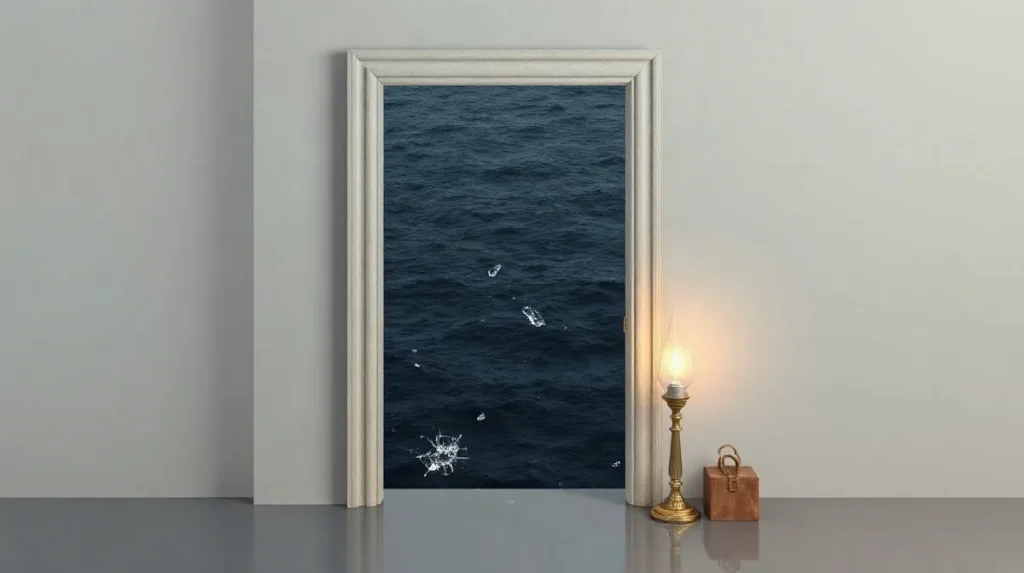
Symbolism is the use of an image, object, gesture or other sign to suggest meaning beyond its literal form. In art, it can give visible shape to inner states—such as longing, fear or memory—by connecting them to things viewers can recognise and interpret.
A symbol does not always carry one fixed meaning: its force can shift with the artwork, its cultural context and the viewer’s experience. This introduction to symbolism explores how artists turn private feelings and abstract ideas into signs, and why those signs can remain open to more than one reading.
| Approach | What it asks | Main caution |
|---|---|---|
| Visual description | What object or setting is present? | Do not infer meaning too early |
| Contextual reading | How does the image relate to its surroundings? | Avoid removing it from the work |
| Emotional reading | What feeling might the image make tangible? | Treat the reading as a possibility |
| Fixed-code reading | What does this image always mean? | Risks imposing a universal definition |
- 2 states named in the supplied psychotherapy summary for symbolic processing: waking and sleeping
- 3 example emotional images named in the material: storm, bridge and broken glass
- 1 fixed meaning is not guaranteed for any image across all works
What does symbolism mean in art?
In art, symbolism means using a tangible image, object or setting to suggest an abstract idea or inner feeling rather than depicting it directly. A storm, bridge, shard of broken glass or ocean can make an emotional state visible, but none carries the same meaning in every artwork: context shapes what each image suggests.
Symbolic images work as indexes of inner states: they point toward a quality or experience without simply naming it. A storm might suggest turmoil in one work and renewal in another; an ocean may evoke fear, distance or possibility. The image invites interpretation, but it does not settle that interpretation on its own.
Suggestion, not a fixed code
In Symbolist art, suggestion matters more than a visual code with a single translation. A bridge is not automatically a symbol for transition, just as broken glass does not always mean loss; the work’s surrounding images and setting help establish their force. Reading a symbol therefore means considering what it brings to mind in that particular work, rather than applying a universal key.
How do recurring images make inner states visible?
Recurring images make inner states visible by giving abstract feelings a concrete form, while their meaning develops through the context of each appearance. A bridge can suggest passage or connection, and broken glass can suggest rupture, but neither image has a universal definition. What each suggests depends on its place in the work and its relation to the images around it.
Image and context
In a painting, story or dream, a repeated image is not a fixed code: its surroundings help shape its meaning each time. A bridge appearing beside an image of separation might emphasize a hoped-for connection; appearing in a scene of departure, it may suggest a transition instead. The object recurs, but its emotional significance can shift with the context.
Emotional symbolism makes feelings easier to consider by translating them into things that can be pictured: a storm, an ocean, a bridge or broken glass. A storm might give fear or agitation a visible setting, while an ocean might evoke a different feeling depending on the work. These are possible readings, not rules. The concrete image offers a way to approach an inner state without reducing it to a single, universal meaning.
Why do Symbolist settings feel dreamlike?
Symbolist settings feel dreamlike because they loosen the usual connection between an object and its everyday use, allowing it to carry emotional or imaginative associations instead. A room, landscape or familiar object can remain recognisable while its role becomes uncertain; that gap encourages the viewer to consider what the scene might express rather than simply what it depicts.
The psychotherapy paper Understanding Spontaneous Symbolism in Psychotherapy Using Embodied Thought discusses dreams as transforming unprocessed experience into workable thoughts and memories. Its summary also notes that early psychoanalytic accounts considered this transformation in both waking and sleeping states, linking dream processes to a broader account of how experience can become thinkable.
Interpretation, not a fixed code
That framework offers one way to approach a dreamlike Symbolist scene: as an invitation to interpret how its objects and setting shape an inner state. It does not establish that every detail has a hidden, predetermined meaning. The scene’s ambiguity matters precisely because it leaves room for associations without turning them into a universal code.
How does suggestion differ from a fixed symbol code?
A fixed symbol code assigns an image one stable meaning; Symbolist suggestion lets its context and associations shape what it may mean. A storm, for example, can suggest emotional turmoil, but the image alone does not settle that reading: its place and function in a particular work matter.
Association is not a universal key
In the account of symbols developed by Murray Stein, a symbol is the best available expression of a pattern that remains partly unconscious—not a completed explanation. That distinction matters: a symbol may point towards something not yet fully understood, while a fixed code treats interpretation as settled in advance.
Jungian analysis offers a specific therapeutic framing, not a universal rule for art history: it turns symbols into signs to help free consciousness from autonomous complexes. To test an interpretation of an artwork, ask whether it accounts for the image’s setting and role in the work, rather than relying on a dictionary-like definition alone:
- Fixed code: assigns the image a stable meaning before considering its role in the artwork.
- Symbolist suggestion: considers how the image’s setting and associations open up possible meanings.
- Therapeutic reading: treats turning symbols into signs as part of Jungian analysis, not as a rule for every artwork.
When does a symbolic reading become a mistake?
A symbolic reading becomes a mistake when it treats an image as proof of a fixed meaning, detached from the artwork’s particular context. An ocean, storm or bridge may suggest an inner state, but none has a universal translation; the same bridge can be a route, a barrier or simply part of the scene. Reading every detail as a concealed message risks turning an open-ended image into a claim the visible work cannot support.
For a careful reading, separate what is visible from what you infer. First name the object and its setting; then describe what it may suggest and acknowledge what remains uncertain. For example, identify a storm in a painting before proposing that it evokes emotional turmoil: the suggestion is an interpretation, not an observable fact.
Interpretation is not proof of intention
A psychological interpretation can explain how an image affects a viewer without establishing what the artist intended. Emotional symbolism can use tangible objects or environments—including a storm, bridge or ocean—to represent abstract feelings, but that possibility does not make any single reading conclusive. In psychotherapy, spontaneous symbolism may help turn unprocessed experience into workable thoughts; that therapeutic use is not evidence that an artwork’s details encode a specific message.
How can you interpret a Symbolist image carefully?
A four-step reading
Interpret a Symbolist image by separating what it visibly shows from what it might suggest, then checking possible meanings against repetition, contrast and context. First, name the objects, colours and setting without assigning them a meaning: a storm, a bridge or broken glass, for example, can be described before being read as an emotional sign. Such concrete imagery can make an abstract feeling perceptible, but the image alone does not establish one fixed interpretation.
Next, look for recurrence and contrast within the image or across an artist’s body of work. If an object or colour returns, note that repetition as evidence that the association matters in that context—not proof that it always means the same thing. Then ask what emotional or conceptual quality the scene makes perceptible, and test that reading against the work’s context rather than treating a personal response as the artist’s definitive intention.
Finally, keep more than one plausible interpretation in view when the image does not settle the question. A storm might suggest turmoil, but its role depends on what else the scene shows and how the storm recurs or contrasts with other elements. This cautious approach also fits the psychological account of symbolism: a tangible image can give form to an inner state without making that state fully explicit or reducing the symbol to a single answer.
Frequently asked questions
Does a symbol have one correct meaning?
What is the difference between a symbol and a sign?
Why are dreams relevant to symbolism?
How can I avoid overinterpreting a painting?
What this piece draws on
- scienceabbey.com — “Semiotics Across Civilizations: How Signs, Symbols, and Rituals Shape Human Belief and Power – Science Abbey”
- huntingtonbeachmentalhealth.com — “Emotional Symbolism: Understanding Feelings Through Meaningful Images”
- pmc.ncbi.nlm.nih.gov — “Understanding Spontaneous Symbolism in Psychotherapy Using Embodied Thought”
- Murray Stein — “Symbols and the Transformation of the Psyche”
- journals.sagepub.com — “Momentary symbols: Tracing the visual expressions of collectives – Emil Bakkensen Johansen, Nicole Milman Doerr, Mathias Wullum Nielsen, 2026”
