LACMA is a Los Angeles museum where visitors can explore collections spanning art from around the world, move through a campus of galleries and public spaces, and plan a visit around the works and buildings they most want to see. This guide introduces the collections, campus and practical choices that shape a museum visit.
LACMA’s scale and changing campus make it useful to consider both what is on view and how the site is arranged. For a closer look at its planned contemporary-art building and its role on campus, read our related article, “LACMA’s New Museum of Contemporary Art: Design, Purpose, and Place on Campus.”
| Part of LACMA | Concrete example | What it offers |
|---|---|---|
| Permanent collection | Weeping Woman with Handkerchief | A named Picasso work among holdings spanning centuries and continents |
| Artistic range | Latin American Modernism; Roy Lichtenstein | Works from distinct traditions and movements |
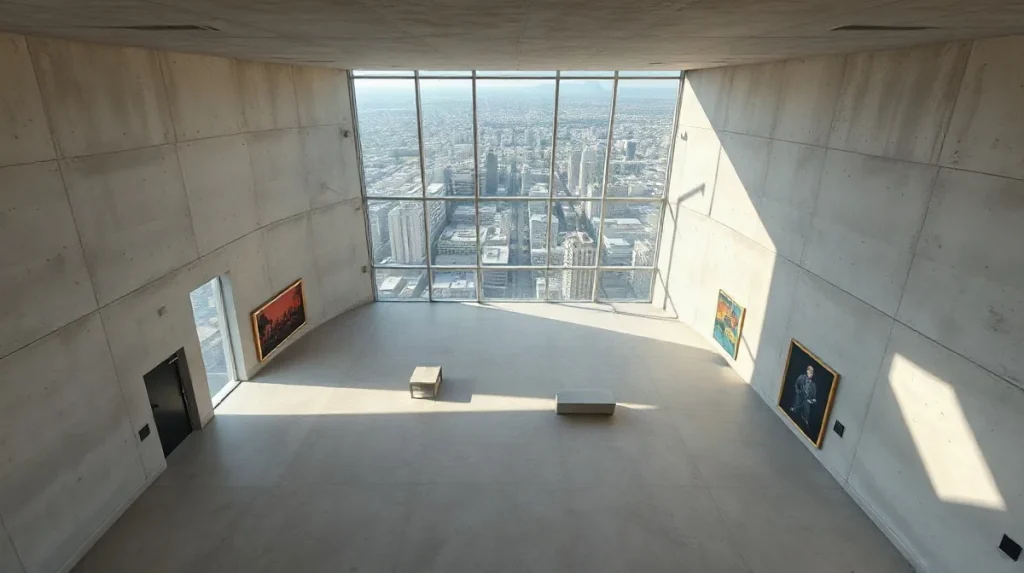
| David Geffen Galleries | Architectural concrete and glass | Single-level galleries and a 360-degree view |
| Outdoor campus | Three Quintains (Hello Girls) | A restored Alexander Calder mobile sculpture |
| Museum Row neighbors | La Brea Tar Pits; Petersen Automotive Museum; Academy Museum of Motion Pictures | Separate institutions next to LACMA |
- 20 acres Size of LACMA’s campus on Museum Row
- 360 degrees View of Los Angeles and the campus from the new David Geffen Galleries
- 1 level The David Geffen Galleries’ single-level gallery floor
What does the LACMA museum collect?
LACMA collects art from different periods and continents, making it an encyclopedic museum rather than one focused on a single region or era. Its permanent collection includes Latin American Modernism, works by Roy Lichtenstein, and pieces by Pablo Picasso, Kunisada and Andy Warhol.
From Latin American Modernism to Pop Art
The collection’s range is visible in the contrast between Latin American Modernism and Lichtenstein’s work, alongside art by Japanese artist Kunisada and American Pop artist Warhol. These holdings bring distinct artistic traditions into one museum collection instead of limiting the visitor’s view to one movement or place.
Among the specific works to look for is Pablo Picasso’s Weeping Woman with Handkerchief. Its presence, together with works by Kunisada and Warhol and the museum’s Latin American Modernism holdings, offers a concrete sense of the collection’s breadth across artists, styles and continents.
What makes the David Geffen Galleries different?
The David Geffen Galleries differ through an organic form built from architectural concrete and glass, a single-level gallery floor, and a 360-degree view linking the art with Los Angeles and the LACMA campus. Together, these features pair an open architectural setting with a different way to present the museum’s broad collection.
A single-level gallery floor
The David Geffen Galleries place their gallery floor on one level, a design intended to support an egalitarian experience across the museum. Rather than making the visitor’s route depend on moving between gallery levels, the layout brings the collection into a shared plane.
The galleries’ 360-degree view connects the interior with the city and LACMA’s campus, making the surrounding place part of the experience. Their layout also reflects a new curatorial approach: works from across LACMA’s broad collection can be presented through a different overall arrangement, rather than treated only as separate collections.
What can visitors see across LACMA’s campus?
Outdoor art and nearby museums
LACMA’s 20-acre campus on Museum Row gives visitors outdoor art to encounter before entering the galleries, with the La Brea Tar Pits, Petersen Automotive Museum and Academy Museum of Motion Pictures nearby along Wilshire Boulevard. These named sites make the campus part of a larger museum-and-culture district in Los Angeles.
Outdoor sculpture is one of the campus’s visible features: Alexander Calder’s restored mobile Three Quintains (Hello Girls) is an example of an artwork given new life. Visitors can see it as part of the outdoor experience, rather than treating the galleries as the only place to encounter art at LACMA.
- At LACMA: outdoor artworks across the 20-acre campus, including Calder’s Three Quintains (Hello Girls).
- Nearby: La Brea Tar Pits, Petersen Automotive Museum and Academy Museum of Motion Pictures, all on Museum Row along Wilshire Boulevard.
How do LACMA’s exhibitions and public purpose fit together?
LACMA’s exhibitions connect its permanent collection to a public purpose: making art a place of reflection, expression and empathy for everyone. The collection spans centuries and continents, including Latin American Modernism and works by Roy Lichtenstein, Andy Warhol and Kunisada; that breadth gives the museum material for exhibitions that bring different artistic traditions into view.
A campus designed for shared looking
LACMA describes its long-term effort as finding ways to embrace the communities of Los Angeles County while honoring the world’s artistic traditions. The David Geffen Galleries make that ambition tangible through a single gallery level, where visitors can look across collections without having to move between stacked floors. Their organic form in architectural concrete and glass also opens views across the city and the museum campus.
That arrangement links access with interpretation: the galleries present works from a broad-ranging collection in a shared viewing space, rather than treating the museum’s public purpose as separate from the exhibition experience. The idea is not simply to display many traditions, but to invite visitors to encounter them alongside one another.
What should visitors know before planning a LACMA visit?
Before planning a LACMA visit, check current opening hours, admission prices, ticket rules and access to specific spaces: the available information confirms the campus location and nearby museums, but does not establish those visitor details. LACMA’s campus covers 20 acres, but that figure does not mean every gallery or outdoor artwork is accessible at all times.
Check access details before you go.
Plan around confirmed access rather than assuming the entire campus is open. Before setting an itinerary, verify whether the galleries and outdoor works you want to see are available on your visit date; the campus’s 20-acre size is not a schedule or an admission policy.
Separate LACMA from Museum Row.
LACMA is one destination on Los Angeles’ Museum Row, alongside the La Brea Tar Pits, Petersen Automotive Museum and Academy Museum of Motion Pictures. These are separate institutions, so admission to LACMA should not be taken to mean entry to its neighbors; check each destination’s own visitor arrangements.
Read more about the new building.
For a focused account of the David Geffen Galleries—their design, purpose and place on the campus—read “LACMA’s New Museum of Contemporary Art: Design, Purpose, and Place on Campus”.
Frequently asked questions
Where is the LACMA museum?
What are the David Geffen Galleries?
Which artists are represented in LACMA’s collection?
What museums are near LACMA?
What this piece draws on
- Visit California — “What to See at the Los Angeles County Museum of Art”
- Unframed — “Everything You Need to Know About LACMA’s New David Geffen Galleries”
- LACMA — “Building LACMA”
- latimes.com — “How to navigate LACMA’s new David Geffen Galleries? Get lost – Los Angeles Times”
- tripadvisor.com — “Los Angeles County Museum of Art – All You SHOULD Know Before Going (2026 Reviews)”
