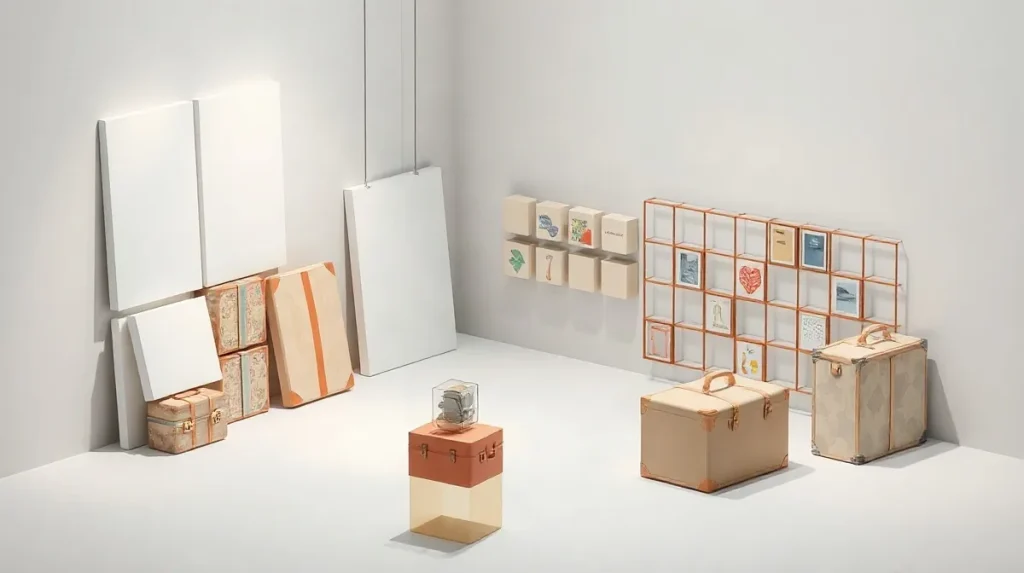
Maia Ruth Lee’s solo exhibition Double Vision at Tina Kim Gallery treats translation as a physical condition, using motifs of migration that change form as they move across the gallery. The works draw on family archives, Kathmandu airport luggage patterns and invented-looking glyphs, asking viewers to encounter the unsettled space between languages, places and identities. The exhibition’s central proposition is not that translation resolves difference, but that it can be felt as something carried, altered or lost.
Translation as a lived condition
Lee’s point of departure is personal history: her parents were Bible translators who moved to Nepal and developed a written alphabet for Sherpa, an oral language. That background gives the exhibition’s attention to translation a concrete basis, linking the transformation of language to migration and the making of new forms of communication.
Rather than presenting translation as a clean passage from one stable meaning to another, Double Vision frames it as an experience viewers can probe. The interval between one language or place and another becomes an active space, where parts of an identity persist while others shift. This approach makes displacement legible through the exhibition itself, not only through its subject matter.
Motifs that travel through the gallery
A grid pattern associated with luggage at Kathmandu airport recurs alongside illegible glyphs and images drawn from Lee’s family archive. These elements appear across canvas, latex and steel, media that let a visual motif acquire different textures and weights. Their repeated appearance creates continuity, while each change of material prevents the image from settling into a single, fixed meaning.
The motifs also seem to migrate within the exhibition: they reappear in altered forms rather than remaining attached to one object. That movement gives the gallery a role in the work’s argument. Visitors encounter familiar signs again, but their context has changed, echoing how memory and identity can travel while being reshaped by a new place.
Stacking, from play to burden
The B.B. Tetris canvases, all dated 2026, use modular forms to make stacking feel playful. Their structure suggests pieces that can be rearranged, with the possibility of another configuration always present. The series turns a familiar logic of fitting parts together into a visual language for movement and adaptation.
In Expandable Luggage (2026), stacking takes on a different character. Its increasing height suggests the weight of a migration that has become laborious rather than light. Set beside the modular canvases, the work makes the same formal action carry contrasting emotional implications: accumulation can be inventive, but it can also register as effort and burden.
What carries and what is left behind
The exhibition’s materials and recurring imagery connect translation to the movement of people and memories. A sign can be carried into a new context, but it does not necessarily keep its original force. In Lee’s work, the gap between what travels and what changes is part of the subject, rather than a problem the artwork claims to solve.
Family-archive images sit within that tension. They provide specific traces of inheritance, while their placement among grids, glyphs and shifting materials means that memory appears as something encountered in the present, not as a complete record restored unchanged. The result gives viewers a way to consider belonging and dislocation through visual relationships rather than a single explanatory narrative.
Why the interval matters
Double Vision brings together language, migration and material transformation without treating them as separate themes. Lee’s family history grounds the inquiry; the airport-inspired grid and archival imagery give it recurring forms; and the 2026 works show how those forms can take on different emotional weight. Together, they make the interval between places and meanings central to the exhibition’s experience.
That emphasis also clarifies the invitation to embody the interval. Viewers move among motifs that repeat but do not remain identical, encountering translation as a process of carrying, changing and relinquishing. The exhibition makes uncertainty tangible through the movement of images and materials across its rooms, rather than offering a final answer about where identity belongs.
Takeaway: In Double Vision, Maia Ruth Lee turns translation into a material, shifting experience of migration—one in which what travels is never entirely unchanged.
What this piece draws on
- First Pass — “Arts institutions face pressure over support, access and cultural authority | Arts and Culture”
- anatebgi.com — “Biographies Archive – ANAT EBGI GALLERY”
- divacorp.net — “DIVA CORP USA”
- artsinsociety.com — “TheArts in Society”
- penland.org — “Gallery Exhibitions – Penland School of Craft”

Topic guide: Artists: The Complete Guide