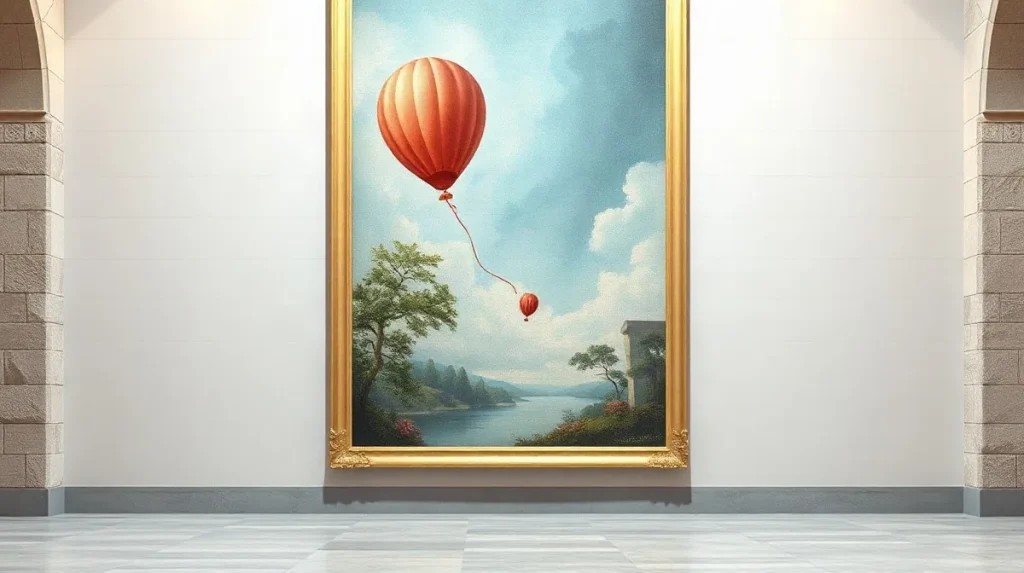
The Lucas Museum of Narrative Art has made murals a major part of its collection display, with a dedicated gallery on the fifth floor featuring works by Banksy, Judith Baca and Diego Rivera. The space places politically charged public art alongside preparatory drawings and studies, making mural-making a central strand of the museum’s narrative-art vision.
A gallery built for murals
The gallery sits on the museum’s fifth floor, above the second-floor galleries, and has ceilings 25 feet high. Its scale suits large works, while the display also includes preparatory renderings and sketches that show how murals take shape before they reach a wall.
The collection’s mural focus is not limited to a single artistic tradition. Drawings and paintings by John Biggers, Dean Cornwell and Charles White appear alongside the larger projects, connecting the gallery’s monumental works to the artists and processes behind them.
Banksy enters an institutional setting
The adjoining gallery contains 12 Banksy works, including pieces reproduced in the artist’s studio and two on loan. Their presence is notable because Banksy has generally steered clear of museum exhibitions; information about the works was kept so tightly controlled that most museum staff did not know what the rooms would contain until the media preview.
Among the recognisable images is Girl with Balloon, based on the stencil image that began appearing on London walls in 2002. The display also includes a maquette for Flag Man, whose suited figure carries a large flag, and a second-floor installation of two ornamental lion sculptures, titled Pair of ornamental garden Lions with added parts (2026).
Rivera and the politics of public art
A large reproduction of Diego Rivera’s 1933 Rockefeller Center mural stands near the gallery entrance. Rivera’s pro-worker work was demolished at Nelson Rockefeller’s direction; the museum’s reproduction is based on the smaller version Rivera later made in Mexico City.
The work’s political content distinguishes the mural gallery from much of the museum’s other displays. Its subject and history make visible how public art can become contested, while the gallery’s setting gives visitors room to consider the mural as both an image and a statement made for a broad audience.
Baca’s long view of Los Angeles history
Colour studies for Judy Baca’s The Great Wall of Los Angeles face the Rivera reproduction. Begun in 1974 along the Tujunga Wash in the San Fernando Valley, the project was created during summers by students and community members to tell a people’s history of Los Angeles.
The mural’s next phase has a defined horizon: a 2021 Mellon Foundation grant of $5 million is supporting an extension of the work’s history from the 1960s through 2019. Completion is due in 2028, in time for the summer Olympic Games, carrying Baca’s public-history project into a new period.
Narrative as a public form
The museum’s senior curator, Ryan Linkof, describes murals as a form of illustration that can communicate histories and social concerns clearly to a broad public. That approach ties the gallery to the institution’s wider interest in storytelling, while giving public-facing art a distinct place within its collection.
The displays also bring different kinds of evidence together: finished mural imagery, studies, sketches and works associated with urban settings. Banksy’s London-derived images, Rivera’s New York commission and Baca’s Los Angeles project show how murals can carry stories across locations and into museum galleries.
Takeaway: By giving murals a dedicated fifth-floor gallery, the Lucas Museum places Banksy, Rivera and Baca at the heart of its narrative-art programme.
