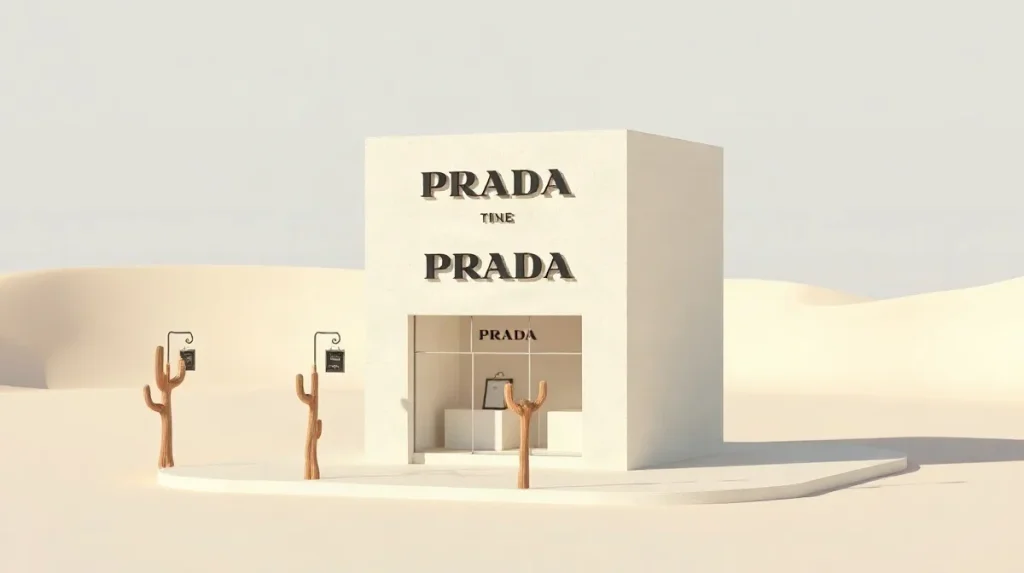
The Prada Marfa sculpture is a permanent art installation that merges minimalist design with landscape to create a striking icon of contemporary art and cultural commentary. Situated in a remote Texas desert, it functions both as a standalone sculpture and a site-specific installation, challenging traditional boundaries between art, commerce, and environment.
Conceived in 2005 by artists Elmgreen and Dragset, Prada Marfa resembles a luxury boutique yet serves no commercial purpose, inviting reflection on consumerism and the desert’s vast emptiness. Its unique presence in the landscape elevates it beyond mere sculpture, making it a landmark that blurs art and place, and a compelling study in installation art that interacts with natural surroundings.
For those interested in the broader significance of installation sculpture, our detailed examination “Installation Sculpture: Defining the Art Form Through Prada Marfa” offers further insight. Additionally, exploring the relationship between sculpture and installation in “Sculpture and Installation: Exploring Their Interrelation in Contemporary Art” and “Sculpture and Installation Art: Historical Contexts and Modern Interpretations” can deepen understanding of how works like Prada Marfa fit into evolving artistic traditions. Readers fascinated by environmental engagement might also appreciate “Janet Echelman Sculpture: A Study in Large-Scale Installation and Environmental Engagement” and the dynamic qualities discussed in “Kinetic Rain Sculpture: Movement and Meaning in Contemporary Installations.”
| Work | Year Installed | Location | Size (ft) |
|---|---|---|---|
| Prada Marfa | 2005 | Texas Desert, USA | 15 x 9 x 25 |
| Kinetic Rain Sculpture | 2012 | Singapore Changi Airport | 33 x 20 x 10 (approx.) |
| Janet Echelman Sculpture | 2010 | Boston, USA | Varies, up to 300 ft span |
| The Lightning Field | 1977 | New Mexico, USA | 1 mile x 1 km area |
- 15 feet wide Width of Prada Marfa sculpture
- 2005 Year Prada Marfa was installed
- 1.5 miles Distance from U.S. Highway 90 to Prada Marfa site
- 25 feet long Length of Prada Marfa sculpture
- 9 feet high Height of Prada Marfa sculpture
What is the origin and physical composition of the Prada Marfa sculpture?
Creation and Location
The Prada Marfa sculpture was created in 2005 by the Danish-Norwegian artist duo Elmgreen & Dragset as a site-specific installation near Valentine, Texas. It is situated approximately 1.5 miles from U.S. Highway 90, positioned to resemble a permanent storefront in the remote desert landscape of the American Southwest. This deliberate placement gives the artwork its distinctive interaction with the surrounding environment, emphasizing themes of consumerism and luxury in an unexpected locale.
Materials and Size
The structure is composed primarily of stucco and steel, built over a concrete foundation to ensure durability as a permanent installation. It measures about 15 feet in width, 9 feet in height, and extends 25 feet in length, mimicking the scale of a small retail boutique. The use of these materials allows the sculpture to withstand desert conditions while maintaining the aesthetic qualities of a high-end fashion storefront, integral to its conceptual impact.
How does Prada Marfa function as both sculpture and installation art?
Blurring Sculpture and Installation
Prada Marfa functions simultaneously as sculpture and installation art by embodying a physical, three-dimensional form that replicates a Prada boutique storefront while being non-functional as a commercial space. Measuring approximately 15 feet wide and 9 feet tall, the structure features real Prada products such as the iconic Galleria bag displayed behind glass, emphasizing its sculptural qualities. However, its intentional placement in a remote desert setting transforms it into an immersive installation, inviting viewers to experience art beyond traditional gallery confines.
The building’s fixed presence and tangible materials align with sculpture, but its engagement with environmental context and viewer interaction reflect installation art principles. Unlike typical retail spaces, Prada Marfa’s lack of operational infrastructure—no doors or staff—underscores its conceptual nature, distancing it from commerce and positioning it as a site-specific artwork that challenges conventional art presentation.
Site-Specificity
Installed in 2005 near Valentine, Texas, Prada Marfa’s location is crucial to its identity, integrating the surrounding Chihuahuan Desert landscape into the artwork’s meaning. Situated more than 30 miles from the nearest town, its remote positioning emphasizes isolation and consumer culture critique, turning the barren environment into a backdrop that contrasts sharply with luxury branding. This site-specific approach redefines audience engagement by making travel and context integral to the experience.
- Location: 1.5 miles from U.S. Route 90, Valentine, TX
- Installation date: October 2005
- Dimensions: Approximately 15 ft wide × 9 ft tall
- Products displayed: Genuine Prada Galleria bag and shoes behind glass
What cultural and artistic messages does Prada Marfa convey?
Consumerism and Branding
Prada Marfa critiques consumerism and luxury branding by placing a high-end boutique replica in the isolated Texas desert, far from any commercial center. The installation, created in 2005 by Elmgreen & Dragset, features real Prada products including the iconic Prada Cahier bag, each retailing between $2,000 and $4,000 in 2026. By situating these luxury items in a non-commercial context, the sculpture highlights the absurdity of branding detached from traditional marketplaces and questions the value consumers assign to such goods.
The artwork also draws attention to the intersection of art, commerce, and landscape by juxtaposing permanent steel and concrete construction with the ephemeral nature of fashion trends. Prada Marfa’s remote location near Valentine, Texas, approximately 50 miles from Marfa, underscores the tension between the permanence of art and the transient lifecycle of consumer products. This contrast is a deliberate commentary on how luxury brands like Prada, which invests millions annually in marketing, rely heavily on location and context to create desirability.
Conceptual Themes
Prada Marfa invites discussions on authenticity, value, and the role of art in public spaces by blurring lines between commercial display and artistic expression. Its non-functional storefront challenges the traditional purpose of retail spaces, encouraging viewers to reconsider what constitutes genuine value beyond monetary price tags or brand prestige.
- Authenticity: The sculpture’s fixed, unchanging state contrasts with Prada’s seasonal collections, emphasizing art’s enduring nature versus fashion’s fleeting appeal.
- Value: By removing the possibility of purchase, Prada Marfa questions the consumerist equation of value based solely on price, which for Prada handbags ranges up to $5,500.
- Public Art: Located on private land but accessible to visitors, the installation raises debates about art’s accessibility outside conventional galleries and museums.
How does Prada Marfa relate to broader trends in sculpture and installation art?
Installation and Sculpture Interrelation
Prada Marfa exemplifies the merging of architecture and sculpture characteristic of site-specific installations, aligning with trends that blur traditional boundaries. Unlike monumental kinetic sculptures such as Alexander Calder’s mobiles, Prada Marfa is static and modest in scale, measuring approximately 15 feet wide. Its permanent placement in the Texas desert recalls works like Christo and Jeanne-Claude’s 1976 “Running Fence,” which also engaged directly with landscape over a 24.5-mile stretch, highlighting how installation art uses physical context as a core element.
Environmental and Conceptual Art
The sculpture connects with environmental art movements by embedding cultural commentary within its remote setting, prompting audience interaction and reflection on consumerism. It parallels the conceptual approaches of artists like Barbara Kruger, who critiques commercial narratives, and questions luxury branding through its imitation Prada storefront valued at around $60,000 for materials. Prada Marfa’s presence in a rural environment resonates with contemporary art’s exploration of place, culture, and economic symbolism, echoing installations that challenge viewers to reconsider cultural meaning beyond gallery walls.
- Site-specific scale: Prada Marfa’s 15-foot width contrasts with large-scale public installations spanning miles.
- Material investment: Approximately $60,000 reflects dedication to authenticity in commercial mimicry.
- Environmental engagement: Remote Texas desert location emphasizes interaction with landscape and cultural isolation.
What are the practical challenges and controversies surrounding Prada Marfa?
Preservation and Security
The Prada Marfa installation faces significant challenges from vandalism and weathering due to its remote desert location near Valentine, Texas. Since its completion in 2005, the site has endured repeated graffiti attacks and physical damage, requiring restoration efforts costing between $5,000 and $15,000 per incident. Exposure to extreme temperature fluctuations and sandstorms accelerates deterioration of the building’s original Prada products and structural materials. Maintenance responsibility is divided: the original artists Michael Elmgreen and Ingar Dragset coordinate with local Brewster County authorities to fund and manage upkeep, though funding is irregular and often relies on donations and grants.
Artistic vs. Commercial Identity
Prada Marfa’s status as a non-commercial art installation conflicts with its visual identity as a branded boutique stocked with luxury goods. Though intended as a critique of consumerism, the sculpture’s association with the Prada brand fuels debates about its preservation legitimacy and public perception. Key points include:
- The building is officially classified as a work of public art, not a retail space, exempting it from many commercial regulations.
- Yet, Prada’s trademark and the display of authentic Prada merchandise complicate its interpretation, blurring lines between corporate branding and artistic expression.
- Efforts to maintain the original stock, including Prada shoes and handbags, have to navigate intellectual property considerations and brand image policies.
Such tensions shape ongoing conversations about whether Prada Marfa should be preserved primarily as a conceptual artwork or as a brand icon vulnerable to commodification.
Where can readers find deeper analysis of related sculpture and installation topics?
Recommended In-Depth Articles
Readers seeking deeper analysis of sculpture and installation themes related to Prada Marfa can explore several focused articles that clarify the art form’s definitions, historical contexts, and contemporary interpretations. These resources examine installation sculpture through measurable frameworks, such as spatial dimensions and material usage, offering detailed insights beyond surface appreciation.
- Installation Sculpture: Defining the Art Form Through Prada Marfa — This article investigates installation sculpture with Prada Marfa as a case study, discussing its 15-foot-wide structure and the $100,000-plus budget range typical for large-scale works in remote environments.
- Sculpture and Installation: Exploring Their Interrelation in Contemporary Art — It highlights contemporary artists who blend forms, noting that installations often exceed 200 square meters in footprint while incorporating sculptural elements, reflecting trends exhibited in major biennials like the Venice Biennale since 2024.
- Sculpture and Installation Art: Historical Contexts and Modern Interpretations — This overview traces developments from early 20th-century sculpture to post-2000 installation art, referencing landmark exhibitions at institutions such as the Tate Modern and the Museum of Modern Art spanning 2000–2025.
- Kinetic Rain Sculpture: Movement and Meaning in Contemporary Installations — Focused on kinetic works, this article analyzes installations with motorized components weighing up to 500 kilograms and budgets ranging from $50,000 to $250,000, exemplified by projects commissioned by museums like the Smithsonian in recent years.
- Janet Echelman Sculpture: A Study in Large-Scale Installation and Environmental Engagement — It explores Echelman’s expansive net sculptures that cover areas exceeding 1,000 square meters and often involve multi-year planning cycles, illustrating the scale and community involvement typical of major environmental installations.
Frequently asked questions
When was Prada Marfa installed and who created it?
Is Prada Marfa a functioning retail store?
How large is the Prada Marfa sculpture?
What makes Prada Marfa a site-specific artwork?
What are some challenges in maintaining Prada Marfa?
Key takeaways
- Prada Marfa exemplifies site-specific installation blending sculpture and landscape.
- The work critiques consumer culture through its isolated luxury storefront.
- Its physical dimensions are modest but impactful within its Texas desert setting.
- Challenges include preservation and balancing art with brand associations.
- It connects to broader trends in installation and environmental art.