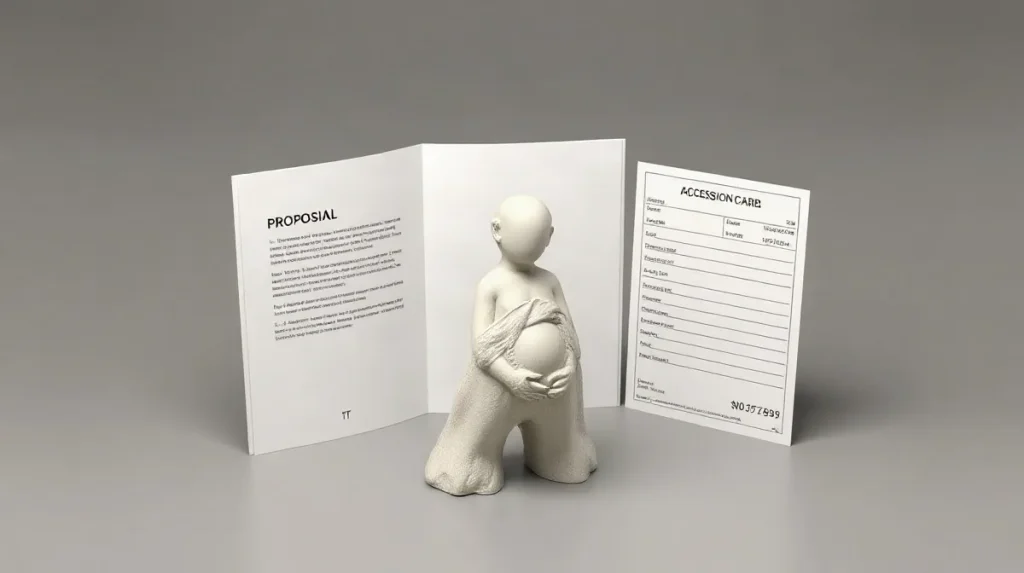
Museum accession turns an artwork into part of a collection by formally accepting it into the museum’s care and recording it as an institutional holding. The process establishes its identity, ownership and documentation, creating a lasting record that guides how the work is stored, researched and made available to the public.
Accession is more than adding an object to an inventory: it gives the work a defined place within the museum’s responsibilities and history. Understanding how that decision is made reveals how a museum collection takes shape—and why the paperwork, stewardship and long-term commitment matter as much as the artwork’s arrival.
| Stage | What it does | What it does not establish by itself |
|---|---|---|
| Offer | Presents a work for consideration | Museum acceptance |
| Due diligence | Reviews the proposed work and its provenance | Committee approval |
| Committee approval | Makes an institutional decision | Completed accession |
| Documentation | Records the work being added | A universal record format |
| Accession | Formally adds the work to the collection | A guarantee that every offer will be accepted |
- 5 stages The process named in the brief: offer, due diligence, committee approval, documentation and accession.
- 1 ownership history Provenance records the history of a work’s ownership; this is a definition, not a statistic.
- 0 stated days The supplied material gives no fixed review or accession timetable.
What does accession mean in a museum?
Museum accession is the formal recording of an object as part of a museum’s collection, establishing its institutional status rather than simply noting an offer or recommendation. A sculpture, installation or other object may be proposed for a museum without yet being accessioned.
From offer to collection record
The sequence in “How Museum Accession Turns Art Into Collection” separates two decisions: whether to accept a work and whether to record it as part of the collection. An offer begins consideration; due diligence and committee approval address whether the museum should accept it; documentation and accession establish and record its collection status.
Accession therefore names a formal step, not an artistic category or the committee’s recommendation. A committee can recommend a sculpture, for example, before the museum completes the documentation that makes it part of the collection.
What happens after an artist or owner offers a work?
An offer is not an acceptance.
An artist’s or owner’s offer starts a museum’s consideration; it does not, by itself, mean the museum has accepted or acquired the work. The distinction matters: a proposal is a request for review, not proof that the artwork has become part of the collection.
For due diligence, the proposal should identify the artwork and its creator or source, and explain the basis on which it is offered. For an installation, it should also clarify what constitutes the work itself; a temporary display or documentation of that display is not automatically equivalent to the artwork.
Ask what the museum requires.
Submission procedures are set by the receiving museum, so applicants should ask that institution how to make a proposal and what supporting material it needs. There is no universal submission form or review timetable established here.
- Artwork: identify the specific work being offered.
- Creator or source: provide the information needed to establish what is being considered.
- Basis of offer: explain why the artist or owner is entitled to offer it.
- Installation: distinguish the proposed work from a temporary display and its documentation.
What does due diligence check before approval?
Due diligence checks whether a museum can responsibly accept a particular work by examining its ownership history, the basis of its transfer and, where relevant, what the work physically comprises. An offer alone does not establish how the work came to the seller or whether the museum can adequately identify and document what it is considering.
Provenance is the record of a work’s ownership history and a key part of reviewing a proposed acquisition. The museum needs to assess that history alongside the stated basis for transfer; the offer itself does not settle either question. The specific questions and evidence required depend on the museum considering the work.
Identifying the work
For a sculpture or installation, reviewers also need to establish what the work comprises so the object under consideration can be described and documented. That may require clarifying which elements belong to the work, rather than treating an uncertain group of components as a fully defined object. No named institution, checklist, legal rule or required document list is specified here, so the museum considering the offer must confirm its own requirements.
Who approves an acquisition, and what does approval mean?
Ask what the committee’s decision authorises.
A committee approves an acquisition by making an institutional decision after preliminary review; that approval does not, by itself, complete accession. In the proposed route, committee approval sits between preliminary review and accession, so it marks a decision point rather than the final act of adding a work to the collection.
Clarify whether approval is advisory or final.
The material provided does not identify a particular museum or committee, or specify a voting rule, approval threshold or meeting schedule. These details vary by institution, so applicants should ask what the committee’s decision authorises and whether another institutional step is required before accession.
- Advisory recommendation: Ask which further decision or authorisation must follow before the work is accessioned.
- Final committee approval: Confirm what documentation and formal accession steps remain; approval does not replace them.
What records make an accession legible?
Accession records make an artwork legible by documenting the work the museum is adding after approval and distinguishing it from the proposal that came before it. A record therefore needs to identify the accessioned object or installation, rather than leave its identity implicit in the acquisition paperwork.
What the record needs to distinguish
For a single object, the record should make clear which artwork has been accepted; for an installation, it should clarify which components belong to the work. If those components are left unspecified, the record can leave uncertain what the museum has actually accessioned.
The information available here does not establish a universal accession-number format, database standard, mandatory field list or retention period. Those details should not be presented as fixed requirements: the grounded point is the sequence—approval first, documentation afterward—and the need for a record that identifies the work and, where relevant, its components.
When can an offer fail to become an accession?
Keep proposal, approval and accession distinct.
An offer can fail to become an accession if the museum declines it, leaves it under consideration, or approves it without completing the later accession steps. Submission alone does not secure committee approval or add the artwork to the collection.
Unresolved provenance can prevent due diligence: until the museum establishes the work’s ownership history, it cannot complete that assessment. A proposal may also be hard to evaluate when it does not clearly define what is being offered; for an installation, that means identifying the work’s components rather than relying on the title alone.
- Under consideration: the offer remains open, but it has not been approved.
- Declined: the museum does not proceed with the proposal.
- Approved, not accessioned: a committee recommendation or positive discussion is not the completed accession; documentation and accession follow approval in the stated process.
Frequently asked questions
Does offering a work mean the museum has acquired it?
What is provenance in an acquisition review?
Does committee approval complete accession?
How long does museum accession take?
Key takeaways
- An offer is not an acquisition; due diligence and approval still follow.
- Provenance means the artwork’s ownership history.
- Committee approval precedes documentation and accession in the stated process.
- No universal timetable, committee rule or accession-number format is established here.
