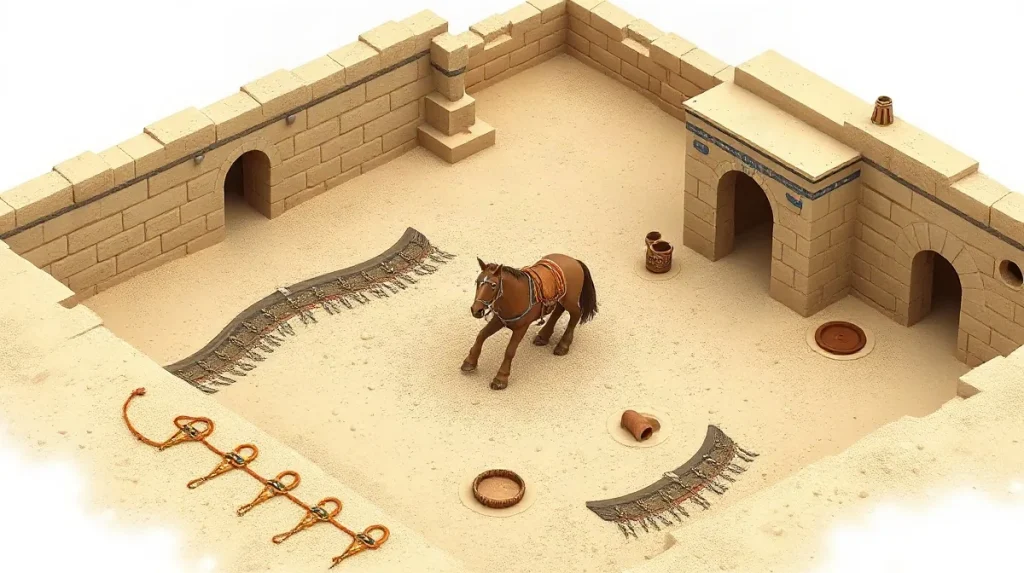
Rare Ceremonial Horse Burial Discovered at Tell Al-Abqain
Archaeologists working at the ancient Egyptian fortress of Tell Al-Abqain in Beheira recently uncovered a ceremonial burial of a young male horse, a rare find that highlights ritual practices during the New Kingdom period (1570–1069 BCE). The horse’s intact remains and decorative harness pieces suggest an honorific interment, likely linked to its military use, possibly in chariotry or rapid maneuvers.
This discovery was announced by Egypt’s Ministry of Tourism and Antiquities in September 2026, emphasizing the burial’s significance as it sheds light on the symbolic and practical role of horses within the fortress’s military and ceremonial culture.
Fortress Reveals Urban Planning and Resource Management
The excavation exposed a large mud brick residential complex adjoining the southern entrance of the fortress, featuring a main street running east-west intersected by a north-south road. This layout indicates a deliberate level of urban planning within the military fortification, a notable feature for a New Kingdom-era fortress.
Within this complex, archaeologists found grain storage silos and cylindrical pottery ovens used for baking, alongside residential chambers near wells in the southeastern corner. These elements demonstrate organized resource management, essential to sustaining the fortress’s inhabitants and military personnel.
Stelae Link Site to Prominent New Kingdom Pharaohs
Among the finds are limestone stelae fragments bearing inscriptions tied to the Nineteenth Dynasty rulers. One stela references Merneptah, son of Ramesses II, with hieratic script extolling his might in comparison to the god Seth, underscoring the fortress’s political importance during his reign.
Another fragment displays the birth name, throne name, and Horus name of Ramesses II, known as Ramesses the Great. A third stela depicts a bound Libyan prisoner identified as a Meshwesh tribe member, highlighting the fortress’s role in defending against Libyan incursions.
Artifacts Illuminate Military, Religious, and Daily Life
The site yielded scarabs inscribed with names of kings and gods and a variety of amulets symbolizing protection, fertility, and strength, reflecting the intertwined religious and political ideologies of the New Kingdom period. These artifacts demonstrate the spiritual dimensions of the fortress’s occupants.
Additionally, everyday objects such as pottery vessels, loom weights, and jewelry provide insight into the civilian lifestyle within Tell Al-Abqain. These finds help reconstruct the social fabric and cultural practices of both military and non-military residents living inside the stronghold.
Significance for Understanding New Kingdom Egypt
Collectively, the discoveries at Tell Al-Abqain enrich understanding of the fortress’s dual role as a military bastion and a vibrant community hub during the New Kingdom. The ceremonial horse burial in particular offers rare evidence of ritual honor accorded to animals integral to warfare.
These findings, announced in late 2026 by Egypt’s Ministry of Tourism and Antiquities, contribute to a more nuanced picture of military strategy, social organization, and belief systems in ancient Egypt’s northern frontier regions during a period marked by external threats and internal consolidation.
Takeaway: The ceremonial horse burial and associated discoveries at Tell Al-Abqain offer unprecedented insight into New Kingdom military rituals and daily life within an ancient Egyptian fortress.