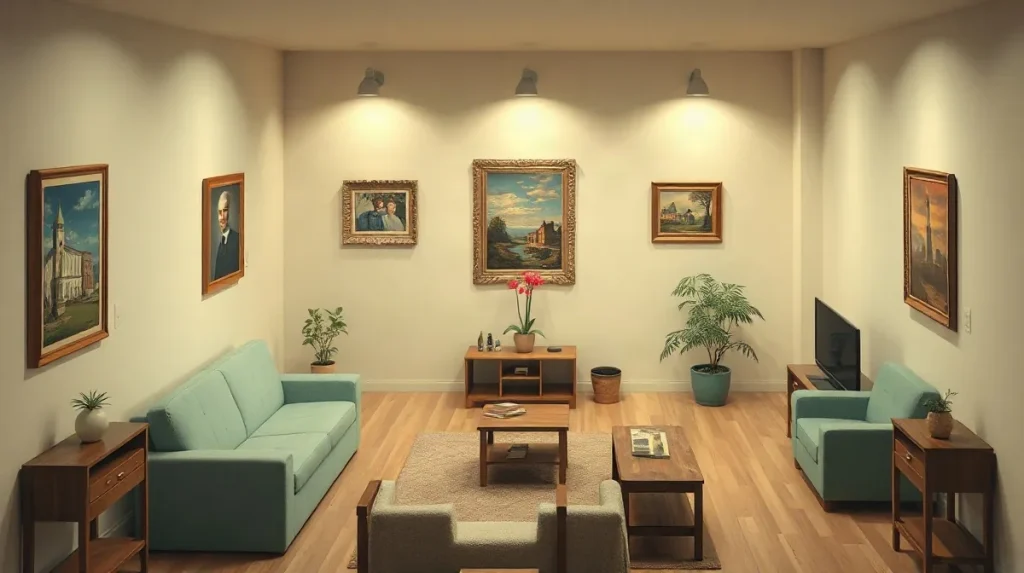
Soviet apartment exhibitions redefined painting spaces by transforming private living rooms into alternative galleries, challenging traditional art venues and expanding how art was displayed and experienced. These intimate, domestic settings allowed for a more personal engagement with contemporary art outside official institutions.
Amid the constraints of state-sanctioned art and limited public exhibition opportunities, these informal shows emerged as vital platforms for nonconformist artists. By hosting exhibitions in their own apartments, artists circumvented censorship and created vibrant, experimental spaces that blurred the boundaries between everyday life and artistic expression.
This shift not only altered the physical context in which paintings were viewed but also reshaped the social dynamics of art appreciation in the Soviet Union. The phenomenon of apartment exhibitions reveals how creativity and resistance coexisted within the private sphere, leaving a lasting impact on the display and reception of art in constrained environments.
| Venue Type | Average Size (m²) | Lighting Standard | Legal Status |
|---|---|---|---|
| Official Galleries | Over 200 | 300 lux minimum | State-approved |
| Apartment Exhibitions | 40–60 | Improvised, ~40 watts bulbs | Illegal, underground |
| Museum Exhibits (post-1980s) | 150–300 | Professional museum lighting | Legal, sanctioned |
- 40–60 m² Typical size of apartments used for exhibitions
- 30–50 Number of paintings shown per apartment exhibition
- 150–300 rubles Fines faced by artists for illegal exhibitions
- 100–500 rubles Price range for artwork sold privately at apartment shows
- 40 watts Common incandescent bulb wattage used for lighting exhibitions
What was the role of apartment exhibitions in Soviet nonconformist art?
Historical context
Apartment exhibitions played a crucial role as unofficial platforms allowing Soviet nonconformist artists to bypass state censorship and display their work during the 1960s and 1970s. These private shows emerged after official restrictions, such as the 1934 Union of Soviet Artists’ control over exhibitions, limited access for avant-garde and experimental creators. The 1974 Bulldozer Exhibition’s violent suppression in a Moscow suburb galvanized underground artistic activity, leading to a surge in informal displays within private apartments. These exhibitions often lasted mere days and took place in modest living rooms, where artworks were shown to small, invited audiences, circumventing the state’s formal channels and enabling creative freedom unavailable in sanctioned venues.
Key figures
Influential artists and collectives were central to the apartment exhibition movement. Ely Belyutin, founder of the New Reality artistic group, fostered spaces for experimental painting outside official institutions. Meanwhile, the Moscow Conceptualists, including figures like Ilya Kabakov and Komar and Melamid, used private settings to present works that challenged socialist realism and engaged with philosophical themes. These artists often operated with limited resources, and their exhibitions were typically organized without formal funding or commercial backing, relying instead on networked support within the artistic community.
- 1974 Bulldozer Exhibition: Catalyst event leading to increased underground shows in apartments.
- Ely Belyutin: Promoter of nonconformist art through private exhibitions.
- Moscow Conceptualists: Key group utilizing apartment spaces to present conceptual art.
- 1960s–1970s: Decades marking the rise of apartment exhibitions as alternatives to state venues.
How were domestic spaces adapted for exhibiting unofficial paintings?
Spatial constraints
Soviet apartment exhibitions adapted domestic spaces, typically ranging from 40 to 60 square meters in Khrushchyovka buildings, by clearing living rooms of furniture to create temporary galleries. These apartments often featured compact layouts, so artists maximized about 10 to 15 linear meters of wall space per room. Exhibitors arranged 30 to 50 paintings per show, frequently using salon-style clusters to fit the artworks densely without damaging walls, as permanent fixtures were forbidden by housing regulations dating from the 1950s.
Lighting and display techniques
Due to limited electrical infrastructure in Khrushchyovkas, lighting was improvised with 40-watt incandescent bulbs or portable lamps, often from brands like Svet or Luch, to illuminate artworks adequately. Exhibitors positioned these light sources strategically to compensate for the absence of gallery-grade fixtures. Paintings were hung using nails or wire hooks, emphasizing flexibility and minimal wall damage. The combination of constrained wall space and modest lighting required careful curation to highlight key works while maintaining an inviting atmosphere despite the modest setting.
- Apartment size: 40–60 square meters typical of Khrushchyovkas
- Number of paintings: 30–50 per exhibition, arranged salon-style
- Lighting: 40-watt incandescent bulbs or portable lamps, brands such as Svet and Luch
- Wall space: approximately 10–15 linear meters per room
- Regulatory constraint: no permanent wall fixtures as per 1950s Soviet housing rules
What were the challenges and risks of hosting exhibitions in private apartments?
Hosting exhibitions in private Soviet apartments entailed significant legal and social dangers, including potential KGB raids, steep fines, and ostracism from official cultural circles. These risks required careful precautions such as restricting attendance to trusted guests, often fewer than 20 people, to avoid detection and repercussions.
Legal risks
Apartment exhibitions were explicitly illegal under Soviet law, exposing hosts and artists to fines ranging from 150 to 300 rubles, equivalent to several months’ average salary at the time. The KGB actively monitored and raided such gatherings, making covert security measures essential. Invitations were tightly controlled to trusted individuals only, minimizing the risk of infiltration or denunciation. The threat of fines and police intervention meant that even a single event could lead to substantial financial loss and legal trouble.
Social consequences
Beyond legal penalties, hosts and participating artists faced social ostracism, including loss of official employment and housing permissions, which were vital for survival in the Soviet system. The state’s control over cultural production meant that unauthorized exhibitions could result in exclusion from professional art unions or galleries. Maintaining anonymity and limiting attendees to a small circle helped mitigate these dangers, but the risk of being blacklisted or surveilled remained a constant pressure.
- Fine range: 150–300 rubles per offense
- Typical guest list limited to fewer than 20 people
- Risk of losing official housing permits and art union membership
- KGB surveillance and raid threat during exhibitions
How did apartment exhibitions influence the Soviet art market and collectors?
Apartment exhibitions fostered a clandestine art market in the Soviet Union, enabling artworks to be sold privately at prices typically ranging from 100 to 500 rubles, thereby bypassing state galleries and official appraisal systems. This underground economy emerged as a distinct channel for artists and collectors, challenging the centralized control over art distribution and valuation.
Pricing and sales
Artworks featured in apartment exhibitions were often exchanged through informal transactions, including barter and private sales, with prices fluctuating between approximately 100 and 500 ₽ depending on the artist’s notoriety and the piece’s uniqueness. These sales occurred despite official prohibitions, illustrating a parallel market where supply and demand were dictated by collector interest rather than state mandates.
Collector profiles
Collectors included foreign diplomats and Western journalists, whose purchases provided rare inflows of hard currency into the Soviet art world. Their involvement not only elevated certain artists’ profiles but also contributed to the exhibitions’ role as hubs for cultural exchange and economic activity beyond Soviet borders.
- Price range: 100–500 ₽ per artwork
- Primary buyers: foreign diplomats and Western journalists
- Transaction forms: barter and private sales circumventing official appraisal
- Market distinct from: state galleries and sanctioned exhibitions
When and why did apartment exhibitions decline or transform in the USSR?
Political liberalization
Apartment exhibitions in the USSR declined mainly during the late 1980s as glasnost and perestroika reforms expanded official opportunities for artists. By the mid-1980s, the easing of censorship and cultural controls allowed nonconformist artists to showcase work beyond private homes, reducing reliance on clandestine apartment shows. For example, the Moscow Museum of Nonconformist Art, established in 1987, began providing formal venues for alternative artistic expression, marking a key shift away from informal domestic spaces.
Institutional changes
The emergence of galleries with standardized exhibition conditions accelerated the decline of apartment exhibitions. Official spaces offered larger rooms and controlled lighting, adhering to standards such as a minimum illumination level of 300 lux, which apartments could not safely or consistently provide. This professional environment attracted artists seeking wider audiences and better display conditions. However, underground apartment exhibitions continued sporadically into the 1990s, particularly in peripheral Soviet republics where institutional infrastructure remained limited.
- Moscow Museum of Nonconformist Art founded in 1987
- Exhibition lighting standard: minimum 300 lux
- Glasnost and perestroika reforms implemented mid-1980s
- Persistence of underground shows in peripheral republics through the 1990s
What are the limitations and common misconceptions about apartment exhibitions?
Physical and social constraints
Apartment exhibitions in the Soviet era were far from fully autonomous creative spaces; artists contended with both external censorship and internal self-censorship, shaping their work and presentation. These shows often took place in cramped living rooms or communal apartments where humidity levels frequently exceeded 60%, accelerating the deterioration of canvases and paper works. Lighting was typically inadequate, relying on standard Soviet ceiling lamps like the Люминесцентная лампа ЛБ-40 (LB-40 fluorescent lamp), which provided uneven illumination and distorted color perception. Additionally, overcrowding—sometimes with over 20 visitors in a 15-square-meter room—compromised both viewing comfort and artwork safety. Unlike official galleries that adhered to the Soviet Union’s art exhibition standards established in the 1957 Ministry of Culture decree, apartment exhibitions could not control environmental factors or security, leading to frequent damage and loss.
Public reach
While apartment exhibitions offered an alternative to state-sanctioned venues, their semi-private nature drastically limited public exposure and reinforced exclusivity. Invitations were often circulated within trusted circles to avoid attracting unwanted attention from authorities, restricting attendance to a few dozen people at most. Unlike large museums such as the Tretyakov Gallery, which hosted thousands of visitors monthly, these shows could not replicate the scale or technical standards required for broader cultural impact. The lack of official catalogues, professional framing, and climate control made it impossible for apartment exhibitions to match the prestige or influence of formal institutions, restricting their ability to reshape the Soviet art scene beyond their immediate urban networks.
- Humidity exceeding 60% in typical apartment spaces
- Over 20 visitors in rooms averaging 15 m²
- Use of Soviet LB-40 fluorescent lamps for lighting
- Official 1957 Ministry of Culture exhibition standards unmet
- Attendance capped at a few dozen per exhibition
Frequently asked questions
Why were Soviet artists forced to exhibit in apartments instead of official galleries?
How many paintings were typically shown in a single apartment exhibition?
What risks did artists and hosts face by holding apartment exhibitions?
Did apartment exhibitions have any impact on the Soviet art market?
When did apartment exhibitions begin to decline in the USSR?
Key takeaways
- Apartment exhibitions were vital nonconformist galleries during Soviet censorship
- Typical Soviet apartment exhibitions displayed 30–50 paintings in 40–60 m² spaces
- Artists faced legal fines around 150–300 rubles and KGB surveillance risks
- Private sales of unofficial art ranged from 100 to 500 rubles, often to foreign collectors
- Glasnost reforms in the mid-1980s led to decline of apartment exhibitions