Ai Weiwei’s Mushrooms: A Monumental New Installation
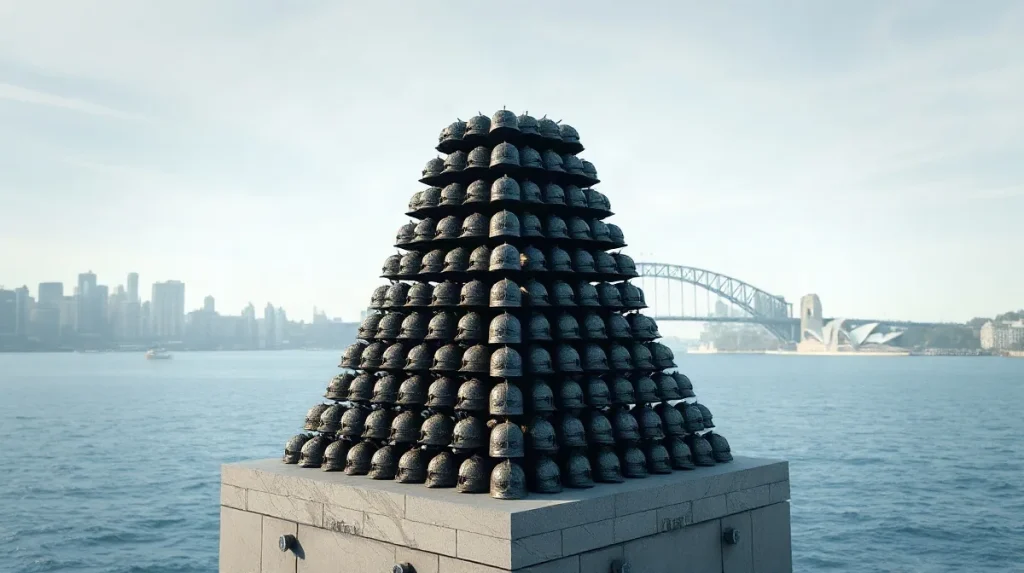
On September 25, 2026, acclaimed Chinese artist Ai Weiwei unveiled Mushrooms, a large-scale installation consisting of 500 cast-iron combat helmets arranged in ten orderly rows. The work occupies Tallawoladah Lawn, a prominent green space adjacent to the Museum of Contemporary Art Australia in Sydney, spanning 131 feet in length and positioned on an elevated platform bisected by a pedestrian walkway. This placement ensures high visibility to daily visitors and locals, highlighting the installation’s physical and conceptual prominence.
Mushrooms evokes the imagery of 20th-century military helmets, complete with inner padding, and symbolizes themes of conflict, memory, and the cyclical nature of war and peace. The title references nuclear mushroom clouds and, in Chinese, implies endless delays, underscoring the complex interplay between growth in darkness and stalled progress. Ai Weiwei aims to use this piece to encourage contemplation on the persistent tensions defining contemporary global society.
Context and Political Resonance
The installation draws indirect inspiration from a 2022 controversy surrounding Germany’s response to Russia’s invasion of Ukraine. Rather than supplying weapons, the German government sent approximately 5,000 helmets, a gesture derided by Kyiv as insufficient and symbolically hollow. Ai Weiwei explicitly distances Mushrooms from being a political joke, instead framing it as a critique of the superficial grasp many political leaders have of human suffering and geopolitical futures.
By invoking this incident, Mushrooms serves as a powerful reminder of the inadequacy and dissonance often present in state actions during conflict. The installation’s 500 helmets represent a fraction of the actual military equipment discourse yet carry heavy symbolic weight in questioning leadership priorities and societal consequences tied to warfare.
The Neil Balnaves Tallawoladah Lawn Commission
This work is the second commission under the Neil Balnaves Tallawoladah Lawn program, named to honor the late Australian philanthropist and businessman Neil Balnaves, who died in 2022 at age 77. Balnaves was known for his support of the arts, and the commission aims to present ambitious contemporary artworks in Sydney’s urban landscape for extended public engagement.
The inaugural commission in 2025 was awarded to British sculptor Thomas J. Price, whose piece Ancient Feelings—a more than 10-foot-tall golden-bronze head—invited reflection on universal human emotions from its vantage overlooking Sydney Harbor. Mushrooms continues this legacy of public art designed to provoke thought and dialogue around pressing cultural and social issues.
Symbolism and Artistic Intent
Ai Weiwei’s installation uses the familiar yet haunting form of combat helmets to evoke collective memory of conflict and the fragility of peace. The 500 cast-iron helmets, each an object of weight and permanence, contrast with the ephemeral nature of peace and human life. The elevated platform and pedestrian walkway integration invite viewers to physically navigate the tension between order and disruption.
The choice of cast iron as a material is significant, suggesting durability yet also heaviness, reinforcing the burden of war and history. Ai Weiwei’s statement that war and peace interchange roles in shaping our era underscores the installation’s thematic core, pressing viewers to reckon with ongoing global instability.
Exhibition Duration and Public Engagement
Mushrooms will remain on display for seven months beginning September 2026, providing ample opportunity for local residents and tourists to engage with the work in Sydney’s bustling cultural precinct. Its location adjacent to the Museum of Contemporary Art Australia situates it within a nexus of contemporary artistic discourse and public education.
The installation’s scale and visibility are likely to stimulate public interest and dialogue on the roles of memory, leadership, and the human cost of conflict. As a work by one of the most internationally recognized contemporary artists, Mushrooms enhances Sydney’s reputation as a city committed to provocative public art and global cultural conversations.
Takeaway: Ai Weiwei’s Mushrooms installation uses 500 cast-iron helmets to confront viewers with the persistent realities of war and the complexities of peace in today’s world.