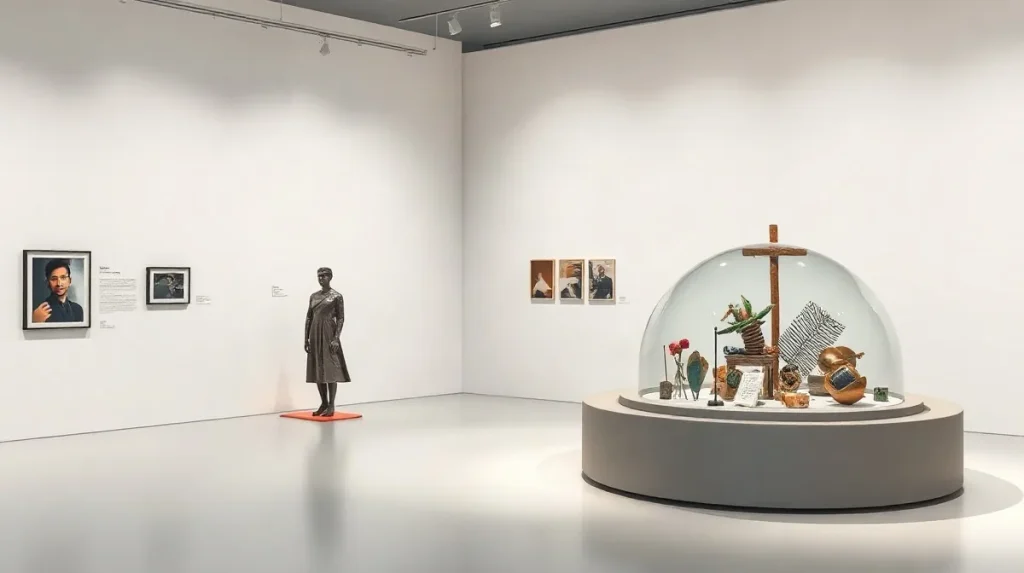
Sculpture and installation art differ primarily in their spatial engagement and viewer interaction: sculpture typically presents a singular, often self-contained three-dimensional form, while installation art creates immersive environments that encompass and transform the surrounding space. Both share a focus on physical presence but diverge in scale, intent, and sensory experience.
Understanding these distinctions clarifies what makes each form unique yet overlapping. Sculpture, rooted in traditional practices, emphasizes materiality and form as discrete objects, whereas installation art invites viewers into a constructed setting, often integrating multiple media and encouraging active exploration. This article unpacks the key differences and points of convergence between sculpture and installation art to deepen appreciation of both.
For a broader exploration of how sculpture can challenge and expand cultural narratives, see our detailed analysis «Prada Marfa Sculpture: Cultural Significance and Artistic Context». This context enriches the discussion of how sculptural practices influence contemporary art forms, including installation art, which frequently builds on sculptural foundations to engage audiences in novel ways.
| Aspect | Sculpture | Installation Art |
|---|---|---|
| Material | Bronze, marble, wood | Mixed media, digital, found objects |
| Scale | Up to several cubic meters | Can cover entire rooms or outdoor sites |
| Viewer Interaction | Passive observation | Immersive, participatory |
| Duration | Often permanent | Frequently temporary or ephemeral |
| Institutional Status | Collected and auctioned | Commissioned and site-specific |
- Over $1 million Typical high-end auction price for contemporary sculptures
- 1960s–1970s Period marking the rise of installation art as a distinct practice
- Hundreds of square meters Scale that some installation artworks occupy in gallery or outdoor spaces
What materials and physical forms distinguish sculpture from installation art?
Materiality in Sculpture
Sculpture is distinguished by its use of traditional, durable materials such as bronze, marble, and wood, which have been prevalent since antiquity. For instance, the 2026 Venice Biennale featured bronze sculptures by Thomas Houseago, underscoring the medium’s classical materiality. Sculptures generally occupy a fixed physical volume, often ranging from small tabletop sizes up to several cubic meters, and are typically freestanding or relief works designed for permanence and longevity.
- Bronze: a classical alloy widely used for its durability and historical significance, exemplified at the 2026 Venice Biennale.
- Marble: valued for its solidity and aesthetic qualities, common in sculptural traditions.
- Wood: a versatile organic material, also historically significant in sculpture.
- Physical scale: sculptures usually occupy volumes up to several cubic meters in three-dimensional space.
Materiality in Installation Art
Installation art is marked by its incorporation of diverse, often nontraditional materials, including digital media, found objects, and sound, expanding beyond the physical boundaries typical of sculpture. Olafur Eliasson’s 2026 immersive light installation at Tate Modern exemplifies this material diversity and experiential quality. Installations can occupy entire rooms or outdoor environments, sometimes covering hundreds of square meters, and are frequently site-specific and temporary, contrasting with sculpture’s usual permanence as noted by the Museum of Modern Art (MoMA).
- Digital media and light: used in Olafur Eliasson’s 2026 immersive installation at Tate Modern.
- Found objects and sound elements: common in installation art to create multisensory experiences.
- Spatial scale: installations can cover entire rooms or outdoor sites, sometimes hundreds of square meters.
- Temporal nature: installations are often temporary and site-specific, as defined by MoMA.
How do viewer interaction and spatial engagement differ between sculpture and installation art?
Sculpture as Object
Sculpture primarily invites viewers to observe from the outside, with physical interaction usually restricted or discouraged. Classical works like Michelangelo’s David maintain a fixed viewing distance, often protected by barriers to preserve delicate surfaces. For example, sculptures displayed at the 2026 Biennale of Sydney were commonly set behind protective enclosures to prevent tactile engagement, underscoring their status as discrete, self-contained objects occupying a defined volume within gallery spaces.
Installation as Environment
Installation art, in contrast, often requires or encourages immersive participation, transforming the viewer’s role into that of an active participant. Yayoi Kusama’s Infinity Mirror Rooms, which allow visitors to enter and experience the work’s infinite reflections firsthand, exemplify this approach. The 2026 Biennale of Sydney highlighted installations designed explicitly for tactile engagement, inviting visitors to interact physically with the artwork and thereby altering the perception of the surrounding architectural space on a larger scale than traditional sculpture.
- Installation art can transform entire galleries, creating enveloping environments rather than occupying discrete volumes.
- At the 2026 Biennale of Sydney, installations were often designed for tactile interaction, while sculptures remained behind protective barriers.
What are the historical and institutional contexts shaping sculpture and installation art?
Tradition and Market
Sculpture has a long-established historical and market tradition dating back thousands of years, firmly embedded in major museums such as the Louvre and the National Gallery of Art. Contemporary sculptures can command prices regularly exceeding $1 million per piece, reflecting their status as collectible artworks with significant market value. In contrast, installation art emerged prominently in the 1960s and 1970s within avant-garde circles, breaking from traditional forms and gaining institutional recognition through landmark events like Documenta and the 2026 Whitney Biennial. Installations often function as site-specific works, shifting the market focus from ownership to experience and commissioning.
Institutional Adaptation
Museums and funding bodies have adapted differently to sculpture and installation art, reflecting their distinct material and conceptual natures. Sculptures are commonly acquired for permanent collections, while installations are frequently commissioned and supported by grants from institutions such as the National Endowment for the Arts (USA). Installation art’s ephemerality challenges conventional museum conservation models, leading to the adoption of new preservation strategies outlined in the 2025 International Council of Museums (ICOM) guidelines. These include documentation, re-installation protocols, and material conservation standards tailored to the temporal and immersive qualities of installations.
- Sculpture acquisition prices: regularly over $1 million per piece
- Installation art institutional recognition: Documenta and 2026 Whitney Biennial
- Funding sources: National Endowment for the Arts grants for installations
- Conservation standards: 2025 ICOM guidelines addressing ephemerality
When do sculpture and installation art overlap or blur boundaries in contemporary practice?
Hybrid Artistic Practices
Contemporary artists frequently blur the lines between sculpture and installation art by creating hybrid works that merge physical form with immersive environments. Anish Kapoor’s monumental pieces, such as his 2026 “Cloud Gate” iteration displayed in Chicago, exemplify this overlap by combining freestanding sculptural presence with spatial engagement inviting physical interaction. Similarly, teamLab’s digital installations incorporate sculptural elements enhanced by projection mapping and kinetic components, transforming static forms into dynamic, multisensory experiences that resist traditional classification.
These hybrids often incorporate multimedia or moving parts, expanding the definition of sculpture beyond solid, fixed objects to include time-based and technologically augmented elements. This trend reflects a broader shift in contemporary art practice toward experiential and participatory works that emphasize viewers’ spatial relationship to the piece.
Curatorial Strategies
Museums and galleries increasingly present sculpture and installation art in shared exhibitions and departments due to their mutual focus on materiality and space. For example, at the 2026 Art Basel Miami Beach, several artists showcased works that defied strict categorization, prompting curators to design displays that highlight the dialogue between sculptural form and environmental context.
- Art Basel Miami Beach 2026 featured over 200 exhibitors with numerous hybrid works combining sculpture and installation.
- Institutions often group these media within the same curatorial departments to streamline thematic exhibitions centered on spatial experience and material interaction.
What limitations or challenges arise in defining or presenting sculpture versus installation art?
Defining and presenting sculpture versus installation art involves challenges related to their differing natures: sculpture’s fixed, permanent form limits audience interaction in a digital era demanding immersive engagement, while installation art’s site-specificity and temporality complicate preservation and institutional classification.
Preservation Challenges
Sculpture’s traditional permanence contrasts with installation art’s often ephemeral existence, as many installations last only days or weeks before disassembly. This temporality necessitates detailed reinstallation protocols, complicating efforts to maintain the work’s integrity over time. For example, the Museum of Modern Art requires specific condition reports and documentation for reinstalling site-specific installations, sometimes decades later. Preservation budgets must accommodate these complexities, unlike sculptures that can often be conserved with standard techniques for decades or centuries.
Market and Institutional Constraints
- Large-scale installation costs can exceed $1 million, covering materials, production, and installation logistics, as seen with major biennials like the Venice Biennale.
- Space limitations in galleries and museums restrict installation size, while sculptures, typically smaller or modular, face fewer spatial constraints.
- Some institutions prioritize sculpture as a ‘fine art’ due to its historical classification, influencing funding decisions and critical reception, which can disadvantage experimental installation art.
Frequently asked questions
How is installation art typically funded compared to sculpture?
Can sculptures be interactive like installations?
Do museums collect installation art like sculptures?
Key takeaways
- Sculpture traditionally uses durable materials like bronze and marble, while installation art employs varied media including digital and found objects.
- Installation art emphasizes immersive, participatory experiences contrasting with sculpture’s external viewing.
- Institutional approaches differ: sculpture is collected as permanent objects, installation art often commissioned and ephemeral.
- Boundary-crossing works blur categories, challenging curators and audiences alike.
- Preservation and funding pose key challenges for installation art compared to sculpture.