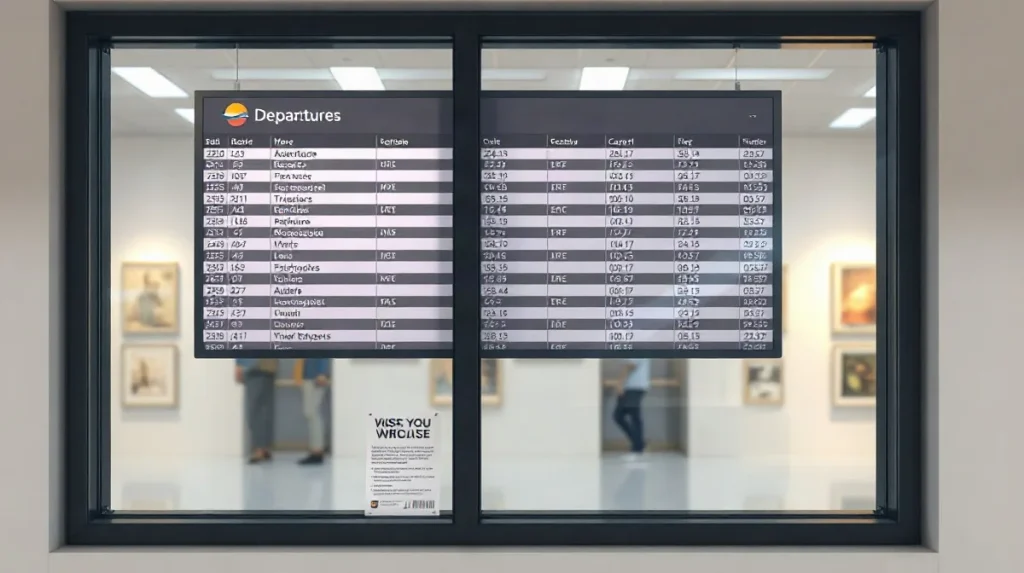
A visitor-access plan for airport closure alerts should tell people where to check for updates, how to confirm whether access has changed, and what to do before travelling to the airport. Treat each alert as a prompt to verify current instructions rather than assume that an earlier route or entry arrangement still applies.
This guide sets out a practical way to respond to airport closure alerts, keeping the focus on visitor access and clear next steps. For the broader overview in this series, see “Houyin Screen-Printing Mesh Counts: A Technical Framework for Sculpture and Installation”.
| Source | Useful for | Does not establish |
|---|---|---|
| Airport operator notice | Airport, terminal, affected area and stated status | Whether a particular visitor’s flight is operating |
| Airline flight-status information | Status of an individual flight | Whether the venue is open |
| Venue website | Opening status and visitor-access instructions | Airport or flight status unless separately verified |
| Ticketing page or visitor message | Consistent visit changes and where to check again | Facts absent from the verified airport or venue notice |
- September 24, 2026 Date specified in the supplied airport-closure news prompt
- 0 named airports Airports identified in the supplied prompt
- 0 reproduced notices Official airport-closure notices included in the supplied research
- about 900 words Requested length for the planned article
What does the September 24, 2026 prompt actually confirm?
The September 24, 2026 prompt confirms only the date of the news prompt; it does not confirm that any airport closed. The supplied material names no airport, terminal, affected flight or closure duration, so none of those details can be stated as fact in a visitor notice.
An airport closure, a flight cancellation and a disruption to one route are different events with different implications for access. A cancelled flight does not by itself establish that an airport or terminal is closed, while a route disruption does not confirm that other flights or airport services have stopped.
No venue name or venue statement is provided, so the venue’s operational status has not been verified in the material available here. The airport, terminal, affected flight and duration remain unknown; until the venue confirms those details, describe the September 24 prompt as an unconfirmed alert, not breaking news or proof that visitors cannot reach the venue.
How can a sculpture venue describe access without overpromising?
A sculpture venue should describe access by stating separately whether the site is open and whether visitors can reach a particular sculpture or installation. An open venue does not confirm that every space, route or artwork is accessible; the notice should identify any confirmed restriction rather than imply that site entry guarantees access throughout.
For an outdoor sculpture venue, name the site and state whether it is open, then specify any confirmed restriction on entry or movement. If no restriction has been confirmed, do not suggest that one exists: distinguish what is known about the site from what has not been confirmed about access to an individual work.
For a gallery installation, say whether the issue affects the building, a particular gallery or a scheduled visit; avoid the imprecise phrase “access changed.” Keep the notice about visitors’ ability to enter or move through the venue, not artwork-shipping logistics. The separate technical framework is covered in “Houyin Screen-Printing Mesh Counts: A Technical Framework for Sculpture and Installation.”
When can an access-update plan mislead visitors?
Common source mismatch
An access-update plan can mislead visitors when an undated social post outlives a change in airport or venue status, or when a flight update is mistaken for an opening notice. Pair any social post with a dated notice on the venue’s website, so visitors can check whether the access information is current. An airline flight-status page concerns a particular flight; it does not establish whether a museum, gallery or sculpture venue is open.
- Social post: check whether it shows an update time, then compare it with the venue’s dated website notice.
- Airline flight-status page: use it for flight information, not as evidence that a cultural venue is open.
The September 24, 2026 prompt names no airport, routes or visitor itineraries, so a blanket warning that “all visitors” are affected would go beyond the available details. Keep the notice specific to what is actually confirmed rather than implying that every journey or venue is disrupted.
When details are unknown
If a reopening time has not been confirmed, say so plainly and direct visitors to the venue’s website for the next dated update. Do not supply an estimated time or present an old social post as confirmation: the useful distinction is between information verified now and information still awaiting confirmation.
What should staff record before the next visitor update?
Staff should record the source checked, the time and time zone, the confirmed status, and the person or team responsible for the next review. Keep these fields together in a short incident record so the next reviewer can distinguish a verified update from an assumption; use the source’s wording for the status rather than inferring what it means for access.
The venue website should serve as the reference notice for visitors. After updating it, check that the ticketing page and visitor email carry the same status and access wording, so people booking or checking their inbox do not receive conflicting instructions. Record that these three channels were checked alongside the incident entry.
When the status changes, replace the previous notice or label it superseded, and make the current notice clear on the venue website, ticketing page and visitor email. For this article plan, September 24, 2026 is the date of the supplied prompt, not evidence of an airport’s status on that date; include later airport information only after it has been independently verified, and keep its verification time and time zone in the record.
Frequently asked questions
Does the September 24, 2026 prompt identify an airport that closed?
Which information should a venue verify before changing its visitor notice?
Should a museum close if an airport reports a closure?
Where should visitors look for the venue’s latest access information?
Key takeaways
- The September 24, 2026 prompt names no airport; treat it as an alert to verify, not confirmation of a specific closure.
- Check the airport operator’s notice and the individual airline flight status before describing travel impacts.
- Separate airport status, flight status and venue opening status in every visitor update.
- Use the venue website as the reference notice and show its update time and time zone.
- Keep visitor-access advice separate from the technical subject of “Houyin Screen-Printing Mesh Counts: A Technical Framework for Sculpture and Installation.”
