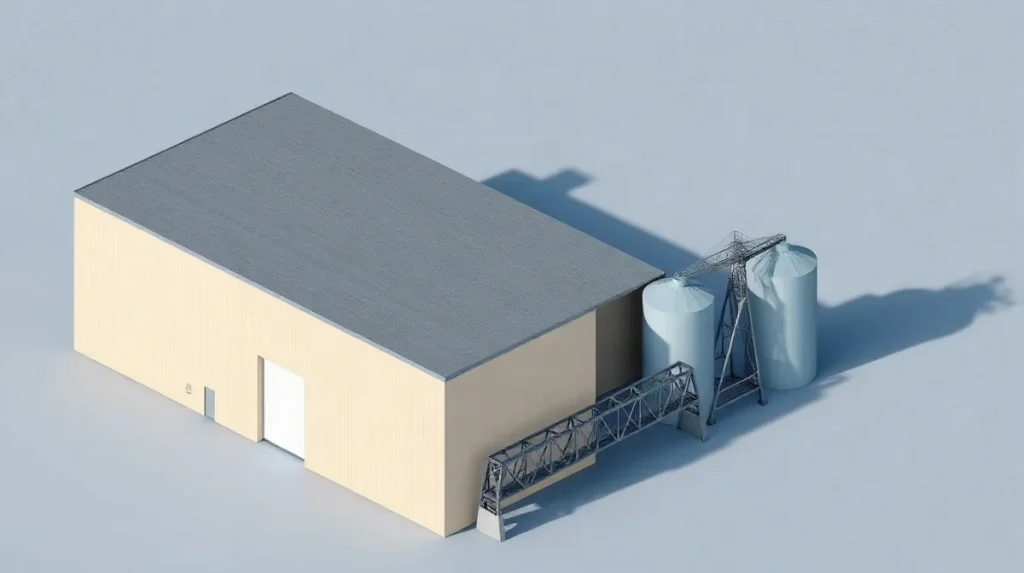
Precisionism was an American art movement that made factories, machines and engineered landscapes central subjects, rendering them in sharply defined forms and clean, ordered compositions. Its artists turned the structures of the Machine Age into images of both modern power and visual restraint.
Rather than treating industrial scenes as mere records of progress, Precisionist painters shaped them into carefully composed worlds: smokestacks, mills and urban architecture become patterns of line, light and mass. This article explores how Precisionism found a distinctive language for an era increasingly built around the machine.
| Work | Artist | Subject |
|---|---|---|
| Upper Deck (1927) | Charles Sheeler | Ship’s deck and metal forms |
| American Landscape (1930) | Charles Sheeler | Ford’s River Rouge complex |
| My Egypt (1927) | Charles Demuth | Grain elevators |
| The Shelton with Sunspots (1927) | Georgia O’Keeffe | The Shelton Hotel |
- 1920s–1930s Period in which Precisionism developed
- 1927 Year of Charles Sheeler’s Upper Deck
- 1930 Year of Charles Sheeler’s American Landscape
- 1927 Year of Charles Demuth’s My Egypt
What was Precisionism, and when did it emerge?
Precisionism was an American art movement that emerged in the 1920s and continued into the 1930s, turning factories, bridges, skyscrapers and other engineered forms into subjects of carefully ordered compositions. Its defining visual tendency was the use of clean contours and simplified geometry, which made industrial structures appear monumental rather than crowded with workers or activity.
A shared style, not a formal group
Charles Sheeler and Charles Demuth are central artists associated with Precisionism, while Georgia O’Keeffe also made paintings with related hard-edged forms. These artists’ connections lie in their treatment of modern architecture and industry through sharp edges and simplified shapes, not in a stated collective programme.
The name Precisionism describes that shared visual tendency; it does not identify an organisation with a single manifesto or membership list. Its emergence in the 1920s and 1930s therefore marks a period and a recognizable approach to industrial subjects, rather than the founding of a formal group.
How did Charles Sheeler turn factories into modern images?
Charles Sheeler turned factories into modern images by treating industrial architecture as a subject in its own right: sharply defined planes, repeated structures and controlled viewpoints make buildings and machinery read as carefully composed forms. His paintings and photographs make industrial order visible without reducing it to a generic backdrop.
American Landscape and River Rouge
In American Landscape (1930), Sheeler depicts the Ford Motor Company’s River Rouge complex in Dearborn, Michigan. Smokestacks, conveyors and industrial buildings identify a specific site of automobile production; their arrangement connects Precisionism’s crisp geometry to the workings of a modern factory.
Sheeler’s Upper Deck (1927) offers a related but distinct approach: its subject is a ship’s deck, structured by intersecting metal forms and strong diagonals. Rather than presenting machinery merely as equipment, the painting makes those forms an abstract arrangement. Together, the two works show how Sheeler could make industrial and mechanical structures legible both as real places and as compositions.
What did other Precisionist artists do with industrial form?
Precisionist artists applied industrial form to grain storage, factories and commercial architecture, making modern structures the subjects of carefully organised compositions. In Charles Demuth’s 1927 painting My Egypt, grain elevators become stacked rectangles with sharply outlined surfaces; the title gives this ordinary infrastructure an imposing, almost ancient scale without changing its industrial subject.
Charles Demuth’s grain elevators and Charles Sheeler’s factory complex represent two ways Precisionism looked at industry, while Georgia O’Keeffe turned to urban architecture. Her 1927 painting The Shelton with Sunspots takes New York’s Shelton Hotel as its subject, framing the modern building through simplified vertical forms.
Together, Demuth’s 1927 elevators, Sheeler’s factory complex and O’Keeffe’s 1927 hotel show that Precisionism encompassed more than machinery alone. Grain storage and a city hotel could share the movement’s interest in monumental scale, geometric structure and sharply defined surfaces.
How did Precisionist style make technology look orderly?
Geometry, repetition and viewpoint
Precisionist style made technology look orderly by reducing complex industrial structures to clear lines, cylinders and planes. In Charles Sheeler’s American Landscape, the River Rouge complex becomes a composition of simplified forms: a conveyor can register as a line, while a smokestack reads as a cylinder. Smooth surfaces and straight edges make the factory visually legible without explaining every part of its operation.
Repeated windows and beams turn industrial architecture into a visual rhythm, echoing the repetition of production. The open space around the buildings gives their geometric forms greater visual weight. In American Landscape, the River Rouge complex is the subject, but workers are not the focus; the composition directs attention to the built system rather than the people within it.
That emphasis makes Sheeler’s painting a visual interpretation of technology, not a neutral record of working conditions or a complete account of how a factory operates. Its order comes from the artist’s choices: which structures to simplify, which repetitions to stress and which human details to leave outside the main focus.
What are Precisionism’s limits as an image of work?
What the clean lines leave out
Precisionism’s limits as an image of work are that its polished surfaces can make industrial production look seamless, excluding the labor, noise, danger and economic conflict that accompany it. In Charles Sheeler’s American Landscape, the named subject is the Ford Motor Company’s River Rouge plant, but the emphasis falls on the industrial landscape, not on individual workers.
Sheeler’s painting makes visible the factory as a designed visual order; that order is an artistic choice, not evidence that real factories or working lives were orderly. The distinction matters: a striking image of industrial architecture cannot, by itself, show the conditions or conflicts of production.
What qualifies as Precisionism
A building painting is not automatically Precisionist: the movement is identified by the combination of American industrial subjects, crisp form and simplification. Those criteria separate Precisionism from a broader category of images that happen to depict factories or other buildings.
- Subject: American industry, as in Sheeler’s Ford Motor Company River Rouge plant.
- Form: crisp edges and simplified shapes, which can impose visual order while leaving workers and working conditions outside the frame.
Why does Precisionism still matter to contemporary views of technology?
Precisionism still matters because Charles Sheeler’s River Rouge image and Charles Demuth’s My Egypt show how pictures can make industrial technology look like national modernity while leaving its human costs unresolved. Sheeler’s view of River Rouge invites viewers to ask how a production system becomes a public image of the nation. Demuth’s My Egypt makes infrastructure monumental through composition alone: its scale and arrangement elevate industrial forms without adding a literal monument.
What the frame reveals—and conceals
Precisionist paintings offer a useful counterpoint to today’s images of automated production: both make technology visible, but neither image by itself explains who performs the work or who owns the system. A close reading therefore asks what the frame includes and excludes. In Sheeler and Demuth, look for buildings, machinery and repeated forms; then consider the relative absence of people and the conditions of work that the image does not show.
Frequently asked questions
Which artists are associated with Precisionism?
When did Precisionism develop?
What is Charles Sheeler’s American Landscape about?
Does Precisionism show what factory work was really like?
Key takeaways
- Precisionism developed in the 1920s and 1930s around American industrial subjects.
- Sheeler’s 1930 American Landscape depicts Ford’s River Rouge complex in Dearborn, Michigan.
- Demuth’s 1927 My Egypt turns grain elevators into a monumental geometric composition.
- Precisionist clarity can make industrial systems legible while leaving workers and working conditions out of view.
