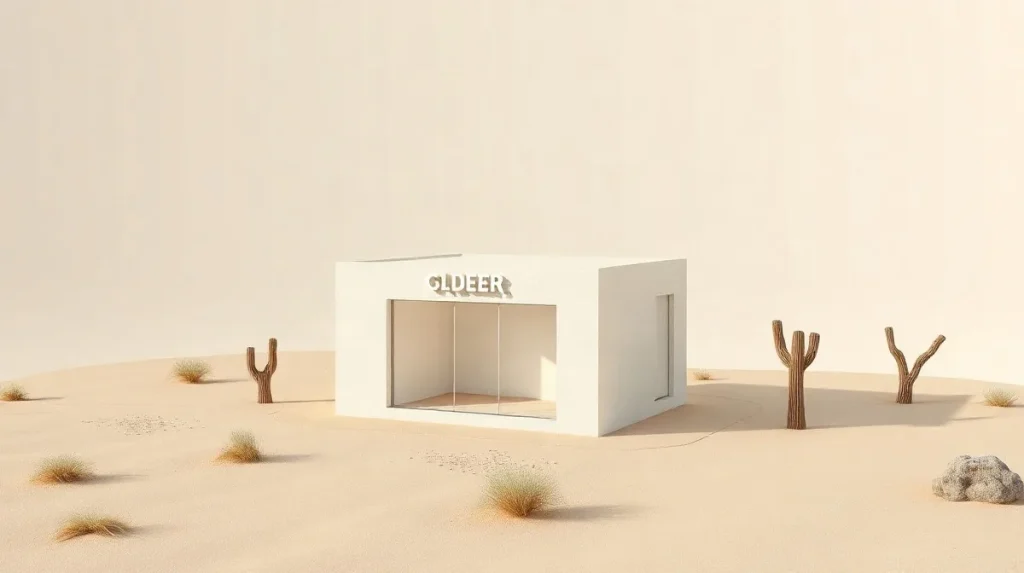
Prada Marfa Sculpture is a permanent, site-specific installation that merges art, consumer culture, and landscape in a provocative dialogue, challenging conventional boundaries between commercial branding and fine art. It stands as a striking example of how installation sculpture can embody cultural critique through minimalist form and unexpected placement.
Located in the remote desert near Marfa, Texas, this work by artists Elmgreen and Dragset transforms a storefront into a sculptural statement, blending architectural elements with conceptual art. The Prada Marfa Sculpture invites viewers to reconsider notions of luxury, consumerism, and the role of art outside traditional urban or gallery settings, making it a landmark in contemporary installation art. This exploration connects deeply with broader themes discussed in our article «Installation Sculpture: Understanding the Form and Impact Through Prada Marfa».
As an influential piece, Prada Marfa Sculpture exemplifies the intersection of sculpture and installation art, a relationship further examined in «Sculpture and Installation: Intersecting Practices in Contemporary Art» and «Sculpture and Installation Art: Exploring Hybrid Forms and Their Cultural Resonance». For readers interested in how movement and spatial engagement shape contemporary installations, insights from «Kinetic Rain Sculpture: Movement and Materiality in Contemporary Installation» and «Janet Echelman Sculpture: Innovations in Scale and Space within Installation Art» offer complementary perspectives.
| Artwork | Location | Material | Conceptual Focus |
|---|---|---|---|
| Prada Marfa | Valentine, Texas | Concrete, wood, aluminum | Consumerism critique through luxury branding |
| Kinetic Rain Sculpture | Singapore Changi Airport | Aluminum raindrops, motors | Movement and materiality in installation |
| Janet Echelman Sculpture | Various global sites | Netting and fibers | Scale and spatial innovation in installation art |
- 2.5 meters tall Height of Prada Marfa sculpture
- 7 meters wide Width of Prada Marfa sculpture
- October 2005 Date of Prada Marfa unveiling
- 1.5 miles Distance from Valentine, Texas to Prada Marfa
What is the origin and physical composition of the Prada Marfa sculpture?
Creation and Location
The Prada Marfa sculpture was created in October 2005 by the artist duo Elmgreen & Dragset as a permanent art installation. It is situated approximately 1.5 miles from the center of Valentine, Texas, in a remote desert area, emphasizing its conceptual contrast between luxury retail and rural isolation. The choice of this location near Valentine is integral to the work’s commentary on consumerism and place.
Materials and Dimensions
The structure is built primarily from concrete, wood, and aluminum, ensuring durability in the harsh desert environment. Its physical dimensions measure about 2.5 meters in height, 7 meters in width, and 2.7 meters in depth. These measurements give the installation the scale of a small storefront, reinforcing its illusion as a lifelike boutique facade rather than just a sculpture.
How does Prada Marfa function as an artwork within sculpture and installation art?
Conceptual Framework
Prada Marfa functions as an artwork by merging sculpture with site-specific installation, creating a non-commercial, static “store” in a remote Texas desert that critiques consumerism and luxury branding. Installed in 2005, this 15-foot-wide structure mimics a Prada boutique yet remains permanently closed, emphasizing its role as conceptual art rather than retail.
The piece challenges traditional retail dynamics by placing luxury goods—like Prada’s Classic Leather Handbag and the iconic Pradamalia shoes—behind glass with original price tags intact, ranging from $800 to $1,200. This juxtaposition questions the value and accessibility of designer culture, making Prada Marfa a physical symbol of the tension between desire and inaccessibility inherent in consumerist society.
Material and Consumer Elements
- Architectural mimicry: The building’s scale and design replicate a Prada boutique façade, measuring approximately 15 feet wide and 9 feet high, blending sculpture with architectural elements.
- Product display: Features authentic Prada merchandise, such as handbags priced around $1,000 and shoes costing about $900, preserved behind glass with price tags visible, reinforcing the installation’s commentary on commodification.
- Non-functional retail: The installation has never operated commercially, reinforcing its identity as a conceptual artwork rather than a functioning store, a key factor distinguishing it within sculpture and installation art.
What cultural and artistic significance has Prada Marfa accrued since its unveiling?
Art Historical Impact
Prada Marfa has gained recognition as a pivotal work in contemporary art for its conceptual fusion of sculpture and installation, redefining site-specific art since its unveiling in 2005. It has been prominently featured in academic discussions and museum exhibitions worldwide, including a 2011 retrospective at the Museum of Contemporary Art in Chicago and thematic exhibitions at Tate Modern in 2014. The sculpture’s engagement with luxury branding—embodied by the 2005 Prada storefront façade and original Prada products installed inside—has influenced artists exploring the interplay between consumer culture and spatial context. This hybridity has sparked discourse on the boundaries of public art, inspiring a wave of installations that blend commercial aesthetics with critical commentary.
Cultural Resonance and Public Reception
As a landmark in the West Texas landscape, Prada Marfa has become a significant cultural icon and tourist destination, attracting thousands of visitors annually and contributing to regional art tourism development. Its remote location near Marfa, Texas, approximately 30 kilometers from the town center, has made it a unique pilgrimage site, impacting local businesses and cultural programming. The sculpture’s status has also permeated popular culture and social media, amplifying its visibility beyond traditional art audiences. This widespread recognition has fostered local pride and placed Marfa on the map as a nexus for contemporary art, with related events and exhibitions often referencing Prada Marfa’s influence on place-making and cultural identity.
In what ways does Prada Marfa connect to broader trends in sculpture and installation art?
Hybrid Art Forms
Prada Marfa exemplifies the fusion of sculpture and installation art by integrating a permanent sculptural structure with its physical environment, emphasizing spatial context as essential to its meaning. Erected in 2005 as a faux boutique measuring approximately 15 by 25 feet, the work’s fixed location along Texas State Highway 90 challenges traditional notions of gallery-bound sculpture. This approach parallels large-scale installations like Janet Echelman’s aerial net sculptures, which also explore spatial dynamics and materiality on a monumental scale, often spanning hundreds of feet in public spaces. Prada Marfa’s use of durable materials such as adobe bricks and metal storefront components further highlights the tactile qualities central to contemporary sculptural practice.
Contemporary Artistic Dialogues
- Engagement with Consumer Culture: Prada Marfa critiques luxury branding and consumerism, a theme common in installation art since the 1990s.
- Site-Specificity: Its remote West Texas placement aligns with trends in site-specific installations, underscoring environment as a co-creator of meaning.
- Interaction with Audience: Unlike kinetic sculptures that emphasize movement, Prada Marfa invites reflection through its static presence, comparable to other conceptual installations that prioritize viewer interpretation over physical change.
- Material and Scale: The sculpture’s modest footprint contrasts with larger installations like Echelman’s works, yet both foreground the relationship between scale, space, and materiality in contemporary art.
What are the challenges and limitations of Prada Marfa as a permanent installation?
Environmental and Conservation Issues
Prada Marfa faces significant challenges from its harsh desert environment, necessitating consistent conservation to prevent material degradation. The installation’s steel and aluminum components are exposed to temperature swings exceeding 40°C between day and night, accelerating metal fatigue and paint peeling. Maintenance efforts by the Chinati Foundation have included repainting every 3–5 years at a cost of approximately $15,000 per restoration cycle to preserve the artwork’s visual integrity. Additionally, the intense UV radiation and occasional sandstorms contribute to surface erosion, requiring protective coatings that must balance durability with minimal visual impact.
Audience and Security Constraints
The remote location of Prada Marfa—approximately 26 miles west of Marfa, Texas—limits visitor accessibility, reducing direct public engagement. The site’s isolation discourages casual visits, which can restrict experiential interaction yet simultaneously reduces foot traffic that might cause wear. Security challenges have arisen due to vandalism and theft, notably with the original Prada shoes stolen within months of installation in 2005. Since then, periodic security measures have included remote camera monitoring and reinforced window glass, with operating costs estimated around $5,000 annually. The static, immobile nature of the sculpture contrasts with kinetic installations that evolve over time, limiting its dynamic appeal and interaction possibilities.
Frequently asked questions
Who created the Prada Marfa sculpture and when?
Does Prada Marfa operate as an actual retail store?
What materials were used to construct Prada Marfa?
How has Prada Marfa influenced contemporary sculpture and installation art?
Key takeaways
- Prada Marfa exemplifies site-specific installation merging sculpture and architectural mimicry
- The piece critiques consumerism by situating luxury products in a remote desert context
- It has influenced contemporary discourse on hybrid sculpture-installation forms
- Maintaining the artwork demands ongoing conservation due to environmental exposure
- Its non-commercial nature challenges traditional retail and art boundaries