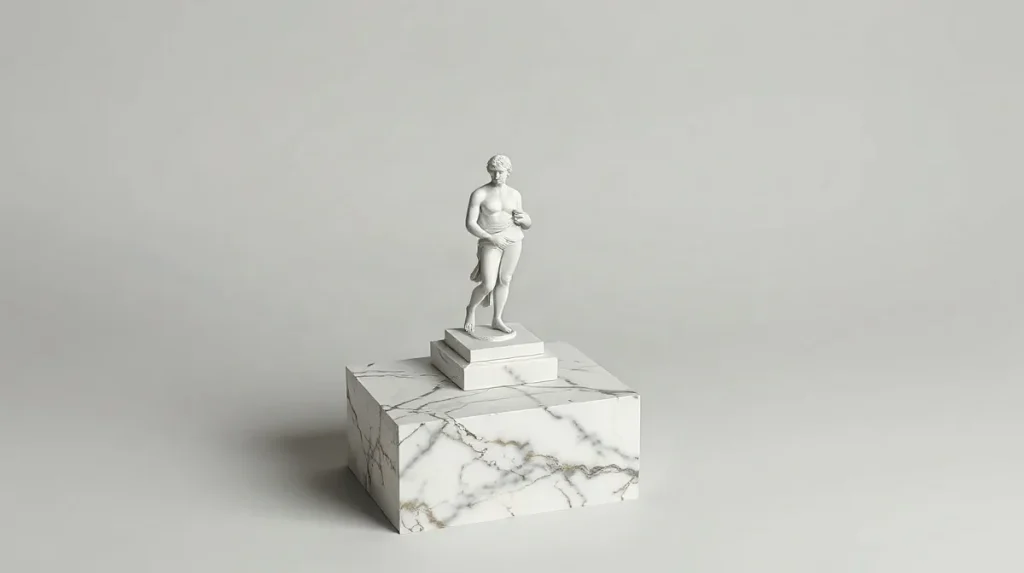
A marble sculpture by late Baroque master Pietro Bracci, bought for £300 at a Wiltshire reclamation yard, has been identified as the only surviving maquette for his 1736 bronze statue of Pope Clement XII. The roughly two-foot-tall work is expected to fetch £5,000 to £10,000 at auction. Its discovery offers a rare surviving model for a monumental sculpture that was later melted down.
A small marble linked to a lost bronze
A specialist at U.K. auction house Woolley & Wallis identified the marble as Bracci’s model for the life-sized bronze portrait of Clement XII. Until the discovery, the completed statue was known only through an engraving by eighteenth-century artists Stefano and Rocco Pozzi.
The sculpture’s two-foot scale contrasts with the life-sized bronze it helped prepare. That distinction gives the marble particular importance: it is not simply a portrait of the pope, but the only surviving maquette associated with a specific, now-lost public monument.
The statue’s Roman setting
Bracci’s bronze stood in the Great Hall of the Palazzo Nuovo, part of the Capitoline Museums. The museums were opened to the public by Clement XII in 1736, the same year as the statue, tying the commission to the pope’s cultural patronage in Rome.
The bronze did not survive the brief French-imposed Roman Republic of 1798–1799, when it was melted down. The Pozzi brothers’ engraving therefore became the only previously known representation of the completed work; Bracci’s marble now adds a three-dimensional object to that limited record.
Bracci and the papal commission
Born in Rome, Bracci trained under Roman sculptor Camillo Rusconi, who was influenced by Gian Lorenzo Bernini. Bracci’s best-known work is the colossal figure of Oceanus in Rome’s Trevi Fountain, while the Clement XII commission followed an earlier marble portrait of the pope made for Ravenna.
The commemorative portrait celebrated Clement’s urban renewal projects and his acquisition of antique statues for the Capitoline Museums collection. The rediscovered model thus connects Bracci’s work to both the pope’s building programme and the formation of a public museum collection in eighteenth-century Rome.
From reclamation yard to auction
The marble was spotted at a Wiltshire reclamation yard and purchased for £300. Woolley & Wallis now estimates it will sell for between £5,000 and £10,000, a substantial rise over its purchase price that reflects the significance of its identification as the sole surviving maquette.
The work is scheduled for sale on October 8 in Woolley & Wallis’s Fine Furniture and Collections auction. The auction house’s furniture specialist, Mark Yuan Richards, described the discovery in a statement as a rare opportunity to encounter an eighteenth-century marble figure by Bracci and a tangible link to the papal court.
Takeaway: A £300 Wiltshire salvage-yard purchase has restored a unique piece of the history of Bracci’s lost 1736 monument to Pope Clement XII.
Sources
- livrepository.liverpool.ac.uk — “Barbara Hepworth: The International Context”
- documents.coastline.edu — “Introduction to Art”
- udspace.udel.edu — “THE LUSTROUS STONE – UDSpace – University of Delaware”
- desire-quartz.squarespace.com — “9 repossessed and transformed: the second life of materials”
