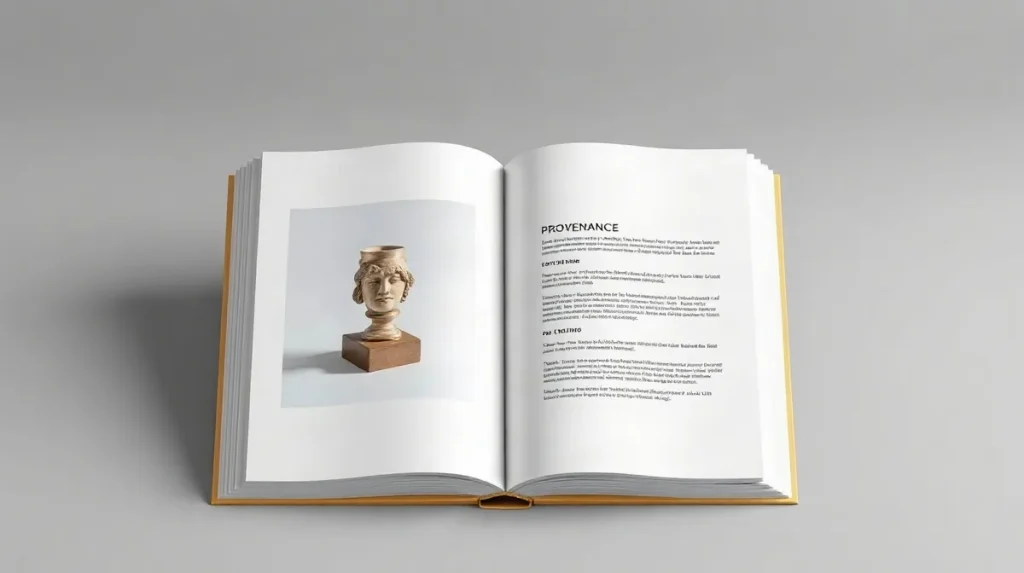
A catalogue raisonné can document an artist’s known or accepted works and explain the basis for including them; it cannot, by itself, prove that every attribution is correct or settle every dispute. It is a scholarly record, not an infallible certificate of authenticity.
That distinction matters to artists, collectors and museums because the catalogue can shape how a work is studied, exhibited and understood. Its authority rests on the evidence and judgement behind each entry—and those can change as new information comes to light.
| Evidence | What it can support | What it cannot settle alone |
|---|---|---|
| Catalogue inclusion | A documented association with the artist’s known works | Authorship as a standalone certainty |
| Image, dimensions and media | Comparison with the object | Whether every detail or attribution is correct |
| Provenance | A documented ownership chain | Clear title when the chain has gaps |
| Signature | A case for attribution | Proof of authorship |
| Scientific testing | Possible material or historical discrepancies | A complete authorship decision by itself |
- 5 types of entry detail Image, dimensions, media, provenance and exhibition history are identified in the supplied material.
- 1 documented ownership chain Provenance records the chain of ownership, which may contain gaps.
- 0 standalone guarantees A catalogue entry or signature alone does not prove authorship or clear title.
What is a catalogue raisonné?
A catalogue raisonné is a scholarly master list of works known to be associated with an artist, documenting each entry within the project’s stated scope. It may include an image, dimensions, media, provenance—the recorded ownership history—and exhibition history. For a sculpture, for example, those details can help distinguish a documented work from an object merely attributed to the artist.
What its coverage means
A catalogue raisonné is not automatically a complete record of every object an artist ever made: its coverage depends on the boundaries declared by the project. A list might be limited to a particular medium or category, so absence from it does not by itself establish that an object is inauthentic. Inclusion is a significant scholarly record, but the catalogue is not proof of authorship on its own.
For an installation, the distinction between a documented work and a merely attributed object matters too: an entry can record the work’s identification and history, while the scope determines what the catalogue set out to cover. A signature may support an attribution but does not settle it; provenance can have gaps, and scientific testing may reveal discrepancies. The catalogue is therefore evidence to consider alongside other evidence—not a verdict that proves every claim.
What can an entry tell you about a particular artwork?
An entry in a catalogue raisonné can help you assess a particular artwork by setting out comparable details—such as its image, dimensions and stated media—alongside its recorded history; it cannot, by itself, settle every question of authorship. Treat the entry as evidence to examine against the object, not as a universal certificate.
Compare the object with the record
A catalogue raisonné entry may identify an artwork through its image, dimensions and media. Compare the image and measurements with the object in front of you, then check whether the stated materials match what is present: a discrepancy is a reason to investigate further, not an automatic verdict that the work is inauthentic.
- Image and dimensions: compare the recorded view and measurements with the object.
- Media: compare the materials stated in the entry with the work’s materials; any mismatch calls for further examination.
Trace the documented history
An entry’s exhibition history records where a work has been shown; its provenance describes the documented chain of ownership. Read these details alongside the image, dimensions and media: provenance can contain gaps, and the entry is a structured record, not a single certificate that answers every question about the artwork.
Does inclusion prove that an artwork is authentic?
Inclusion in a catalogue raisonné does not, by itself, prove that an artwork is authentic. For artists whose work is covered by one, however, inclusion can carry substantial practical weight: a listed work may be easier to trade through a major auction house, while an absent work may face a significant market barrier.
Market recognition is not proof of authorship
A catalogue raisonné is a scholarly record that can identify an artwork through details such as its image, dimensions, medium, provenance and exhibition history. Its listing can therefore support a work’s market standing, but it is not a standalone guarantee that the artist made it.
A signature may support an attribution, but a signature alone cannot establish who made the work. Provenance—the documented chain of ownership—can add evidence, yet gaps may remain; scientific testing and independent scholarly opinions can also contribute to assessment. The catalogue’s inclusion is consequential evidence in practice, not a substitute for considering the work’s authorship on its merits.
Why do provenance and ownership need separate checks?
Provenance and ownership need separate checks because an ownership history can support an authenticity assessment without proving that the current seller has clear title. A catalogue raisonné may record provenance alongside an artwork’s image, dimensions and medium, but the entry is a documented account—not a guarantee that every transfer is recorded or legally valid.
What each check can establish
- Provenance: The documented chain of ownership can help assess whether an object’s history is consistent with an authorship claim. Gaps in that chain remain gaps even when the work appears in a catalogue raisonné.
- Authorship: Catalogue inclusion is relevant evidence about whether a work is associated with an artist; it does not establish who currently owns the object or has the right to sell it.
- Title: Compare the recorded ownership chain with available records for the transfers in question. A catalogue entry listing provenance does not, by itself, show that ownership passed validly at every step.
These checks answer different questions: authorship concerns who made the object, while title concerns who may lawfully claim or transfer ownership. Treat catalogue inclusion as one part of an authenticity assessment, then examine the ownership history separately; neither a listed provenance nor an authorship finding alone establishes clean title.
When can a catalogue raisonné be incomplete or misleading?
A catalogue raisonné can be incomplete or misleading because absence may reflect a project’s scope or the limits of its documentation, while inclusion does not settle authorship. Provenance, recorded object details and scientific findings must be considered alongside the catalogue entry.
Absence is not a verdict
A work missing from a catalogue raisonné is not automatically inauthentic: it may fall outside the project’s declared scope or simply not have been documented when the catalogue was compiled. The catalogue’s images, dimensions, medium, provenance and exhibition history provide points of comparison; a mismatch between the object and those recorded details calls for further examination, not an automatic conclusion.
Market acceptance is not proof
For an artist with a catalogue raisonné, inclusion can affect whether a work is marketable: the supplied material says excluded or absent works often cannot trade at a major auction house. That market consequence is not, by itself, proof that a work is or is not authentic.
- Provenance: A gap weakens the documented ownership chain, but does not alone settle authorship or title.
- Scientific testing: A result can expose discrepancies between materials or other findings and the recorded details, but it is one part of the evidence.
- Catalogue entry: Inclusion supports a case; it does not prove authorship on its own.
How should a buyer use a catalogue raisonné?
Use a catalogue raisonné as one part of a buyer’s due diligence: check whether one exists for the artist, whether the specific work is included, and how its entry compares with the object. A catalogue raisonné records works through details including an image, dimensions, media, provenance and exhibition history; compare the first three directly with the work being considered rather than relying on a title or signature alone.
- Catalogue entry: Confirm that the artist has a catalogue raisonné and locate the entry for the specific work. Inclusion is relevant evidence, but it does not by itself prove authorship.
- Object details: Compare the entry’s image, dimensions and media with the physical work. A discrepancy is a reason to investigate, not a conclusion on its own.
- Provenance: Trace the documented ownership chain separately from the catalogue entry and note any gaps. Provenance can support authenticity and clean title, but gaps weaken the record.
- Exhibition history: Check the recorded exhibitions as a separate strand of evidence; do not treat a listing as proof of authorship.
For a disputed attribution, combine the catalogue record with independent scholarly opinions and scientific testing. Testing may expose discrepancies, while a signature can support a case without proving who made the work; neither a catalogue entry nor a strong provenance should replace that wider review.
Frequently asked questions
What is a catalogue raisonné in plain English?
Does being listed in a catalogue raisonné guarantee authenticity?
Does an artwork’s absence mean it is fake?
Does a catalogue raisonné prove that the seller owns the artwork?
Key takeaways
- A catalogue raisonné records known works and may include images, dimensions, media, provenance and exhibition history.
- Inclusion can influence market access, but it is not standalone proof of authorship.
- A signature supports an attribution without proving it; provenance can also contain gaps.
- Check the object, catalogue entry, ownership chain and any relevant scientific or independent scholarly evidence together.
Sources
- Masterworks Academy — “How Art Authentication Actually Works: Connoisseurship, Science, and Archives”
- momaa.org — “Catalogue Raisonné: The Gate That Decides What Your”
- navigating.art — “What Is a Catalogue Raisonné? Meaning, Contents and”
- researchgate.net — “(PDF) Jumping into the artistic deep end”
- vwart.com — “Authentication Methods Summarized – VWART”
