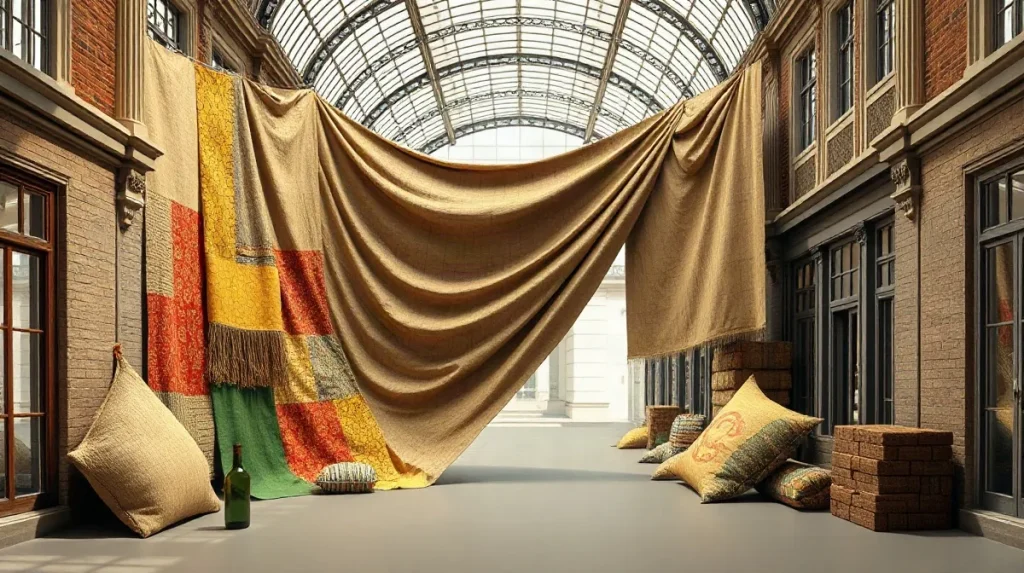
Ibrahim Mahama’s “The Harvest Season” takes over the Fondation Cartier pour l’art contemporain in Paris, bringing projects grounded in Ghana into the institution’s entire building. The exhibition includes a new work built around the abandoned Aboso Glass Factory, which Mahama purchased, and a changed version of his ongoing installation “Parliament of Ghosts.” Its scale makes the show a major Paris presentation, but its central concerns are Ghanaian histories, materials and collective work.
A Paris exhibition built from Ghanaian contexts
Mahama has described “The Harvest Season” as his most ambitious exhibition to date. Rather than treating the Paris venue as a neutral container, the exhibition connects its setting with histories linking Europe and West Africa. Curator Aby Gaye-Duparc points to the Fondation Cartier building, constructed in the 1850s, as one part of that exchange.
The exhibition brings together work on Ghana’s railway system, a new textile installation and projects connected to industrial and cultural heritage. Fabrics made in northern Ghana, truck inner tubes, jute sacks and found textiles will form an installation across the building’s arcades. The materials link the architecture in Paris to the labour, trade and reuse that recur throughout Mahama’s practice.
Royal stools shift the terms of display
A new iteration of “Parliament of Ghosts,” first presented in 2019, adds about 200 collected and restored royal stools from the Asante Empire. The wider installation draws on discarded train seats, railway sleepers, school furniture, worn jute sacks and government archives. Bringing the stools into this body of work places objects with royal histories alongside the everyday materials and records through which public life is remembered.
Mahama’s exhibition proposes that visitors encounter the stools outside the glass cases often used to display them in Western museums. He is interested in what changes when objects from Ghana can be approached as living things and used in relation to their original purpose. The presentation raises questions about looting and return without reducing the stools to museum property: their histories, and the people connected to them, remain active parts of the work.
Aboso Glass Factory returns to Ghana
The new project “Things Fall Apart” reconstructs the Aboso Glass Factory, a bottle-making plant established in 1966 by Ghana’s first president, Kwame Nkrumah. The factory was part of an industrialisation effort, but Nkrumah was overthrown in a coup in the same year. Mahama bought the abandoned site about two years ago; production funds from Fondation Cartier supported the project.
The Paris installation is only one component of a reconstruction that also involves spaces including Red Clay Studio in Tamale and a former colonial building. After the exhibition, the factory project is to return to Ghana for permanent installation in Kumasi, where Mahama plans to build a new institution. That destination matters: the work’s movement to Paris does not make the factory a permanent export, but connects an international exhibition to a longer project in Ghana.
Institutions and collaboration behind the work
Mahama’s practice extends beyond gallery installations into institution-building. In Tamale, he founded Red Clay Studio and the Savannah Centre for Contemporary Art; he has also transformed abandoned buildings and other sites into spaces for art and education. He has called these efforts a “lifetime work,” describing a practice concerned with materials, archives and industrial and national heritage.
That approach also depends on collaboration. Mahama has credited market women, weavers, craftspeople, studio assistants and railway workers among the people who contribute to his work. The worn jute sacks that recur in his art first came from market women in Accra, who continued helping him collect them after learning what he was making. The exhibition’s scale therefore reflects not only an artist’s reach but a network of people and places that begins in Ghana.
International visibility, local direction
Mahama has exhibited internationally, including at Kunsthalle Osnabrück, Oude Kerk in Amsterdam and the Venice Biennale. The Paris show adds a full-building presentation to that record, while keeping Ghana in view as both subject and site of the work. His international visibility has also been channelled into the cultural institutions he is establishing in the country.
For the Fondation Cartier audience, “The Harvest Season” offers several ways into Mahama’s concerns: the stools and their contested display, the factory’s unfinished industrial history, and textiles made from materials with distinct working lives. Taken together, these projects make the Paris exhibition less a break from Ghana than a platform for extending conversations rooted there.
Takeaway: “The Harvest Season” fills a Paris institution, but its central histories and planned legacy remain in Ghana.
What this piece draws on
- But Its Core Is in Ghana — “Ibrahim Mahama Show Is Headed to Paris”
- White Cube — “Ibrahim Mahama”
- africanscolumn.com — “Ghanaian Artist Ibrahim Mahama Becomes The First African to Top ArtReview Power 100 – Africans Column”
- timesensitive.fm — “Ibrahim Mahama on the Great Potential of Art to Change How We Look at the World | Time Sensitive: A Podcast Featuring Leading Minds on Time”
- musemagazine.it — “Ibrahim Mahama / Documents Arts & Culture – Issue 68 – EN”
Topic guide: Exhibitions: The Complete Guide