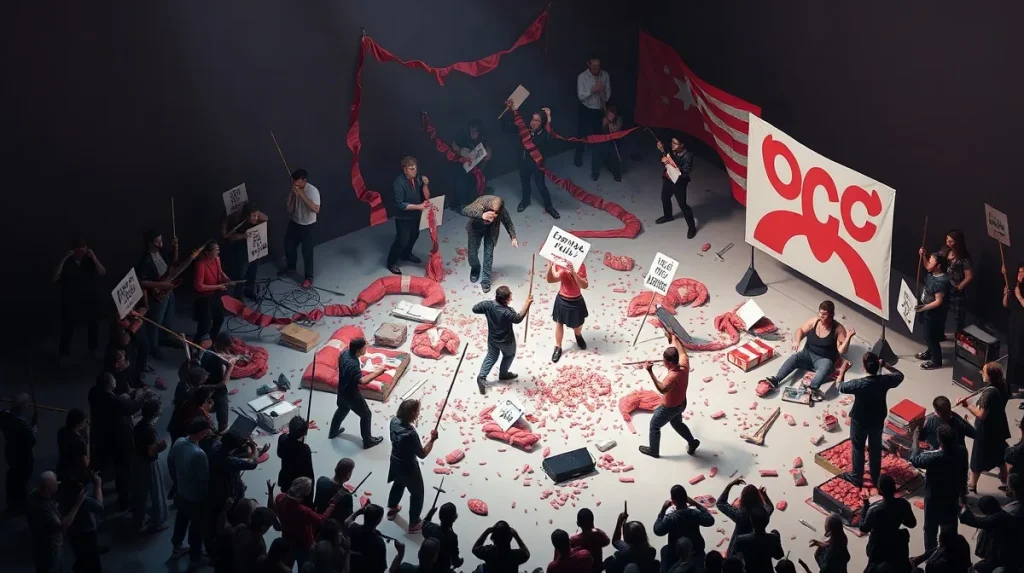
Moscow Actionism represents a dynamic and provocative movement that emerged in the heart of Russia’s capital, challenging conventional boundaries of art through performative and often confrontational gestures. Rooted in a complex interplay of political unrest, social commentary, and avant-garde experimentation, this movement captures the urgency and spirit of its time, offering a raw glimpse into the city’s cultural undercurrents. Understanding its origins and significance provides insight into how artists in Moscow have harnessed action-based expressions to confront both local and universal issues.
At its core, Moscow Actionism is not merely about spectacle but about engaging with the viewer and environment in a way that transforms art into lived experience. This approach reflects a broader tradition of action art while uniquely shaped by the historical and social realities of Moscow, including the tensions of post-Soviet identity and the desire to push artistic freedom beyond established frameworks. Exploring these roots reveals how Moscow Actionism serves as both a mirror and a catalyst for ongoing dialogues within Russian contemporary art and beyond.
| Aspect | Moscow Actionism | Western Fluxus | Viennese Actionism |
|---|---|---|---|
| Origin Period | Late 1960s | 1960s | 1960s |
| Typical Venue | Urban public spaces in Moscow | Galleries, festivals | Galleries, studios |
| Political Engagement | High, often dissenting | Variable, often playful | Explicitly transgressive |
| Key Materials | Ephemeral, natural elements, bodies | Mixed media, objects | Blood, flesh, violent materials |
| Group Dynamics | Collaborative groups like Collective Actions | Individual and collective | Mostly individual |
- 30 arrests Documented police interventions related to Moscow Actionist performances (1990-2020)
- ₽50,000–₽200,000 Typical budget range for independent Moscow Actionist performances
- 1975 Year of the seminal Bulldozer Exhibition in Moscow
- 2015 Year Garage Museum began exhibiting Moscow Actionist works
What historical and cultural factors gave rise to Moscow Actionism?
Political Context
Moscow Actionism emerged in direct response to the restrictive cultural atmosphere under Leonid Brezhnev’s stagnation era, which began in the mid-1960s and lasted through the 1980s. During this period, official Soviet artistic institutions promoted Socialist Realism while suppressing experimental and nonconformist art forms. A landmark event highlighting this tension was the 1975 “Bulldozer Exhibition,” where unofficial artists attempted an open-air show in Moscow but were violently dispersed by authorities using bulldozers and water cannons. This crackdown underscored the limited spaces available for avant-garde expression, prompting artists to seek alternative, often unauthorized methods to present their work. In 1976, the “Collective Actions” group, a key progenitor of Moscow Actionism, began staging performances in public spaces without permits, deliberately challenging state control over cultural production.
Artistic Influences
The Moscow Actionism movement drew significant inspiration from Western avant-garde practices, particularly Fluxus and Viennese Actionism, which filtered into the Soviet Union via samizdat literature and scarce foreign art magazines circulating among underground artist circles. These movements emphasized ephemeral, performative, and body-centered art, contrasting sharply with the state-sanctioned, static art forms dominant in the USSR. The “Collective Actions” group adopted these influences to develop a distinct form of public, experiential art that rejected traditional gallery settings. Their unauthorized events often lasted several hours and utilized everyday materials, reflecting a deliberate break from conventional Soviet artistic norms.
- 1975: Year of the Bulldozer Exhibition, a pivotal moment for underground art in Moscow
- 1976: Formation of the Collective Actions group, initiating public unauthorized performances
- Fluxus and Viennese Actionism: Key Western movements influencing Moscow Actionism through samizdat circulation
- Performance duration: Often several hours, emphasizing temporality over permanence
Who are the key figures and what works define Moscow Actionism?
Pioneering Artists
Key figures who shaped Moscow Actionism include Oleg Kulik, Anatoly Osmolovsky, and Lev Rubinstein, each contributing distinct approaches to this avant-garde movement. Kulik’s 1995 performance ‘I Am Not a Dog’ at Moscow’s Tretyakov Gallery marked a defining moment, where his aggressive, animalistic behavior challenged the conventional roles of artist and audience, lasting several hours and provoking strong reactions. Anatoly Osmolovsky’s ‘Russian Action’ series, launched around 2000, merged radical performance techniques with pointed political critique, often performed in public spaces to confront social norms directly. Lev Rubinstein’s contributions in the 1980s, particularly through text-based performance pieces, blurred the boundaries between literature and action art, focusing on ephemeral, conceptual experiences rather than static objects.
Iconic Performances
Among the seminal works defining Moscow Actionism is the 1977 ‘Holiday’ performance by the Collective Actions group, which emphasized endurance and interaction with natural elements over several days, highlighting the transient nature of their art. This emphasis on ephemerality contrasts with Kulik’s confrontational style and Osmolovsky’s politically charged interventions. Together, these performances underscore Moscow Actionism’s commitment to breaking artistic conventions through:
- Duration thresholds ranging from hours (Kulik’s 1995 piece) to multiple days (Collective Actions’ 1977 work)
- Use of public institutional settings like the Tretyakov Gallery as a platform for radical expression
- Integration of political and social critique through performance content, especially in Osmolovsky’s 2000 series
- Blurring of art categories by incorporating text and literature as performance elements, evident in Rubinstein’s 1980s actions
How did Moscow Actionism influence the development of contemporary Russian art?
Institutional Impact
Moscow Actionism significantly influenced the institutional recognition of contemporary Russian art by catalyzing its inclusion in major cultural venues and legislative frameworks. Since 2015, the Garage Museum of Contemporary Art in Moscow has hosted several landmark exhibitions dedicated to Actionism, showcasing works by pioneers such as Oleg Kulik and Anatoly Osmolovsky. This institutional embrace has helped elevate action art from underground performances to accepted gallery presentations. Additionally, the Moscow Biennale of Contemporary Art, established in 2005, expanded its programming specifically to include action art, providing a recurring platform for performance artists and increasing public exposure. The 2014 amendments to the Russian Federal Law on Public Assemblies also indirectly impacted the art form by clarifying regulations that affect public performances, thus shaping the legal environment in which action art operates.
Legacy and Continuity
The legacy of Moscow Actionism is visible in the practices of younger artist collectives such as AES+F, who integrate dynamic performance elements with advanced multimedia installations, blending the provocative spirit of Actionism with digital technologies. This generational influence underscores the movement’s role in redefining artistic boundaries and encouraging interdisciplinary experimentation. Furthermore, the presence of Actionism in major institutions and biennales has encouraged emerging artists to explore performative and participatory approaches, contributing to a more diverse and vibrant contemporary art scene in Russia.
- Garage Museum exhibitions dedicated to Actionism since 2015
- Moscow Biennale inclusion of action art programming since 2005
- 2014 amendments to Russian Federal Law on Public Assemblies affecting performance legality
- AES+F’s integration of performance with multimedia installations
What are the common limitations or challenges faced by Moscow Actionist artists?
Moscow Actionist artists commonly face significant legal and financial barriers that impede their creative expression. Between 1990 and 2020, there have been at least 30 documented arrests linked directly to their performances, illustrating frequent censorship and police intervention. These legal risks are compounded by financial constraints: independent productions typically operate on limited budgets ranging from ₽50,000 to ₽200,000, as official sponsorships are scarce or nonexistent. This lack of institutional support restricts not only the scale of performances but also the ability to reach wider audiences, who often misunderstand or react negatively to the provocative nature of actionism.
Legal and Financial Barriers
The legal environment surrounding Moscow Actionism is marked by persistent state scrutiny, which results in arrests and performance disruptions. Artists must navigate restrictions stemming from laws regulating public gatherings and expression, often risking detention for actions perceived as politically sensitive. Financially, the absence of backing from major cultural institutions forces artists to rely on personal funds or small patrons, with typical budgets for performances falling between ₽50,000 and ₽200,000. These limitations hinder the ability to secure venues, equipment, and professional support, while also affecting promotional efforts and audience outreach.
Documentation Challenges
The ephemeral nature of Moscow Actionist performances presents considerable obstacles to preservation and study. Many actions survive solely through photographs or brief video clips, with comprehensive archival records rarely maintained. This scarcity of documentation complicates efforts to analyze the movement’s evolution and impact. The following factors illustrate the documentation difficulties:
- Predominant reliance on analog photography and early digital cameras, limiting image quality and archival longevity
- Brief video recordings typically under 10 minutes, often taken with consumer-grade camcorders
- Lack of formal institutional archives or dedicated repositories for actionist works
- Ephemeral materials used in performances that degrade quickly, preventing physical preservation
What are the defining characteristics that distinguish Moscow Actionism from other art movements?
Moscow Actionism is defined by its intense emphasis on direct physical engagement and the palpable presence of the artist’s body within urban environments, setting it apart from other art movements that favor conceptual or static forms. This movement often employs shock tactics to captivate and confront audiences, with performances lasting between 30 minutes and several hours, frequently staged in unconventional public spaces. Notably, artists utilize ephemeral materials such as blood, fire, or ice, which degrade or vanish within days, underscoring the transient nature of their work. Venues typically include streets, parks, and abandoned buildings, diverging from traditional galleries and theaters. For example, the 2017 “Red Square Freeze” performance lasted 45 minutes in Moscow’s central square, using melted ice sculptures to symbolize political repression, illustrating this preference for non-traditional, public settings.
Physicality and Venue
The defining physicality of Moscow Actionism lies in the artist’s bodily presence as both medium and message, contrasting with Western Actionism’s often solitary focus. This movement demands collective participation, with groups of 5 to 15 artists collaborating to enhance the intensity and complexity of the actions. The use of urban spaces is pivotal, as these sites are laden with historical and political significance, such as the Belyayevo Park performances in 2019, where artists manipulated natural elements to critique environmental degradation. Key criteria distinguishing Moscow Actionism include:
- Performance duration ranging from 30 minutes to 4 hours
- Use of perishable materials like ice or blood, lasting less than 7 days
- Preference for public, non-commercial venues, including parks and abandoned industrial sites
- Collaborative groups of at least 5 artists, contrasting with Western individualism
Political Dimension
Political dissent is central to Moscow Actionism, with performances frequently embedding explicit social critique against contemporary Russian policies and societal issues. The content often challenges censorship laws enacted in the 2013 “Foreign Agent” legislation, which restrict public assembly and artistic expression. For instance, the “Voices of the Silenced” 2024 protest-action involved a group of 12 artists performing in Gorky Park for 2 hours, drawing attention to political prisoners. This integration of activism into art distinguishes Moscow Actionism from other movements that may avoid overt political messaging. The movement’s performances act as both artistic expression and acts of civil resistance, making the political dimension inseparable from its aesthetic and physical form.
Frequently asked questions
When did Moscow Actionism first emerge?
Who are some notable Moscow Actionist artists?
How does Moscow Actionism differ from Western Actionism?
What challenges do Moscow Actionist performances face today?
Key takeaways
- Moscow Actionism arose amid Soviet political repression in the late 1960s
- Key artists include Oleg Kulik and Anatoly Osmolovsky, known for provocative performances
- The movement influenced contemporary Russian art institutions and legal frameworks
- Performances face censorship and funding challenges, limiting wider public engagement
- Moscow Actionism is marked by physicality, political critique, and ephemeral public acts